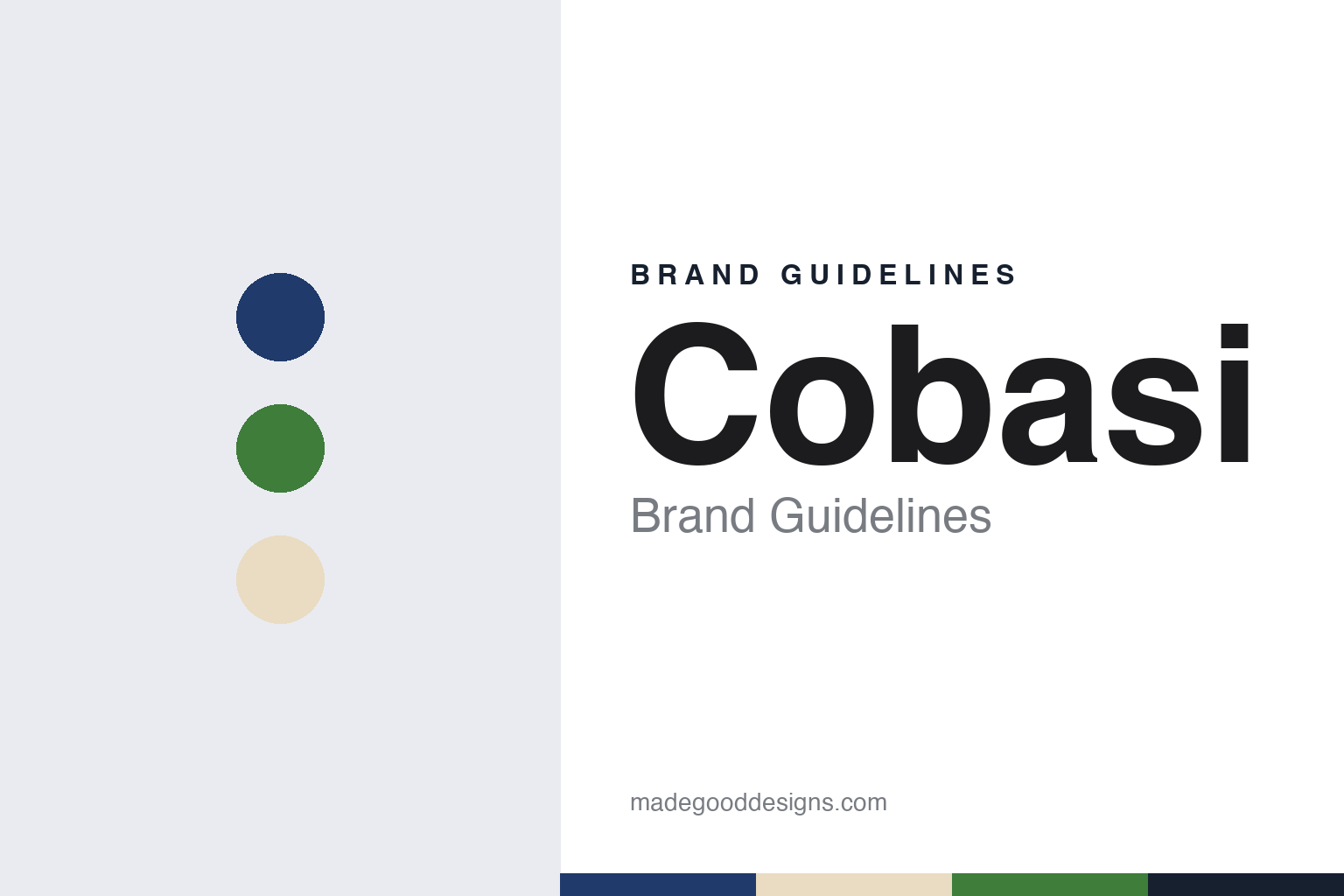
Cobasi Brand Guidelines
A 1985 São Paulo farm store turned pet, home and garden chain.
Aa
Two constants: a deep blue, leaf green and warm sand palette and a rounded sans register. Abstract homage — not a Cobasi product or mark; no logo, sign or store front is reproduced.
Comércio de Produtos Básicos
A farm-supply shop opened for three brothers.
Cobasi opened its first shop in São Paulo on 14 October 1985, according to the Curitiba newspaper Gazeta do Povo in 2019. The name is short for the company’s legal name, Comércio de Produtos Básicos e Industriais, a trace of what it first sold: Portuguese Wikipedia and Gazeta do Povo both describe it as an agricultural supply store. Época Negócios reported in 2014 that the first shop sold horse feed, fertiliser, bales of wire and saddlery to small farmers and smallholders around the city. The company’s own timeline names that store Cobasi Villa-Lobos, and Gazeta do Povo places it in the Vila Leopoldina district.
The business grew out of an older family retailer. Rames Nassar had run Bazar 13, a haberdashery his father opened in 1953 on Rua Teodoro Sampaio in Pinheiros, and turned it into a supermarket chain of nine stores, the two publications reported. The family sold that chain to Grupo Pão de Açúcar in the early 1980s — Época Negócios gives 1983, while Gazeta do Povo dates the decision to sell to 1980 — and Rames Nassar then opened Cobasi for his sons. The brothers Paulo, Ricardo and João Nassar went on to run the company.
The turn to pets followed time abroad. Brazil Journal reported in 2021 that Paulo Nassar, by then chief executive, had studied at Berkeley, seen the PetSmart model there and decided to adapt it for Brazil. Gazeta do Povo describes the store importing accessories for cats and dogs as import rules eased in the early 1990s, with pet food from large manufacturers gradually taking over the shelves. The company’s timeline dates the move from farm store to pet shop to 1994 and the start of imports and exclusive products to 1992; Gazeta do Povo and Portuguese Wikipedia say the agricultural lines were finally dropped in 1996.
Colour
Company-owned stores, then pet, home and garden.
For most of its history Cobasi grew slowly and with its own money. Its timeline lists the first store outside the city of São Paulo, in Campinas, in 2005, and the first outside São Paulo state, in Rio de Janeiro, in 2010. Época Negócios reported in October 2014 that the chain was still limited to São Paulo and Rio de Janeiro, that every store was company-owned and that the family did not want to franchise. That year it opened its 25th store at the Rua Teodoro Sampaio address where Bazar 13 had begun. By February 2019 there were 76 stores, all company-owned and all funded from the business’s own cash, Gazeta do Povo reported, and the company dates its 100th store, Cobasi Eldorado, to 2020.
The store format mixes pets with the house. Brazil Journal described Cobasi in April 2021 as a chain of stores divided by theme, with a range reaching beyond cats and dogs into decoration, gardening and swimming-pool products, and counted 120 stores, most of them in São Paulo state. The company’s current website groups its catalogue under dogs, cats, birds, fish, other pets, home, garden and pool, and names own labels including MyHug, Flicks, Origem Natural and Joy.
The visual identity changed in 2021. Portuguese Wikipedia, citing the advertising trade paper Meio & Mensagem of August 2021, says the chain adopted a new logo and visual identity that year, and that the words “Pet, Casa e Jardim” — pet, home and garden — were added to store fronts to signal the range beyond pets. The company’s own timeline also lists the launch of a new brand in 2021.
Acquisitions widened the business at the same time. The company says it bought Pet Anjo, a platform arranging pet boarding, pet sitting, dog walking, training and day care, in 2021, opened the first Pet Anjo grooming franchise in 2022, and completed the purchase of the Mundo Pet chain in the north-east of Brazil in 2023.
Typography
Pet-store chains and their signs.
Pet-store chains present themselves above all through the shopfront: a sign that has to read from a retail park, a high street or a shopping-centre corridor, and a logo repeated on loyalty cards, carrier bags, delivery apps and, increasingly, shop-in-shops inside other retailers. For chains that began online, the website and the app do the work of the sign. Tiendanimal, for example, started as an online shop in Málaga in 2006 and opened its first physical store there in 2012, according to Spanish trade press.
Ownership shapes these brands as much as design does. Many chains have passed from their founders to private-equity investors, family offices or larger retail groups, and some now sit beside former rivals under one parent. Arcaplanet, founded in Liguria in 1995, passed through several investors before the German Fressnapf group completed its takeover in December 2024, RetailDetail reported; in Spain, Tiendanimal and Kiwoko have shared an owner, the Peruvian Mulder family’s Emefin, since 2020, and trade under the IskayPet group name. Corporate pages on founders and owners are often the plainest record of these changes, and this guide states each owner with a date.
Store formats vary widely: large out-of-town units, small city shops, grooming salons, clinics run under separate names, and corners inside DIY or farm-supply stores. Networks change quickly, so every store or country count in these guides is given with its date and its source. Own-label ranges, mascots and loyalty schemes are named only as the companies name them.
The chains and online retailers in this group come from Europe, Asia, Latin America and Australia. Each guide sets out what can be checked — who founded the business, who owns it now and how its network is published — and marks plainly what rests only on the company’s own word. The colours and type in each guide are our unofficial interpretation, not the companies’ own.
Aa
A rounded sans for a pet, home and garden sign. (Specimen set in Nunito, a sans STAND-IN; NOT the Cobasi logo.)
Cobasi
From family firm to Grupo Petz Cobasi.
The family-only model ended in 2021. In April that year the investment manager Kinea took an undisclosed minority stake, with one seat on a five-member board, Brazil Journal reported; until then, the paper said, the Nassar family had funded expansion itself and had never taken on debt. The investor-relations site of the merged group now lists the Nassar family and Kinea Private Equity together as its controlling block.
In 2024 Cobasi agreed to combine with Petz, the São Paulo chain that the group’s own history says was founded in 2002 as Pet Center Marginal. Brazil’s competition authority, CADE, approved the deal on 10 December 2025 on condition of an agreement that included the sale of 26 stores in São Paulo state, according to CADE’s announcement, which described Cobasi as founded in 1985 with about 230 stores and Petz as having 257. Under the structure CADE set out, Cobasi absorbed Petz’s shares, Petz became a wholly owned subsidiary, and Petz’s former shareholders took 52.6 percent of the combined company.
The combination was completed in January 2026. The holding company, renamed União Pet Participações, began trading on the B3 exchange under the ticker AUAU3, replacing Petz’s former listing, according to B3’s own news service Bora Investir on 20 January 2026. That report named Paulo Nassar as chief executive of the group, which presents itself as Grupo Petz Cobasi, and Sergio Zimerman, the founder of Petz, as chair of its board. Cobasi continues as a store brand inside the group, and as of November 2026 the group’s investor site gave it more than 240 stores in 20 states and the Federal District.
For a design guide, Cobasi shows how a name taken from a farm-store legal title can carry a pet, home and garden chain, with those three words written onto the store front. Compare PetSmart, the US chain whose model Paulo Nassar studied, and Petlove, another São Paulo pet retailer. For this guide we use a deep blue, a leaf green and a warm sand with a rounded sans, an unofficial interpretation; no product or logo is reproduced.
Explore & save
Keep Cobasi’s identity on hand — save it to a board in the Made Good inspiration library.
Cobasi identity set
Pin the deep blue, leaf green and warm sand palette and the rounded sans register to your own board.
Source & notes
Frequently Asked Questions
What font can I use to match the Cobasi look?
This guide describes Cobasi’s type as “A rounded sans for a pet, home and garden sign”. Its type specimen is set in Nunito from Google Fonts as a stand-in; Nunito is not Cobasi’s own lettering.
What colours are in the Cobasi palette?
This guide’s Cobasi palette is Deep blue #1F3A6B, Leaf green #3E7D3A, Warm sand #E9DCC2, Ink #16202E and Paper #F7F5EF. The tones are the guide’s own unofficial interpretation, not official Cobasi hex codes.
When was Cobasi founded?
Cobasi was founded in 14 October 1985, in São Paulo, Brazil.
Who founded Cobasi?
Cobasi was founded on 14 October 1985 by Rames Nassar and sons Paulo, Ricardo and João.
Who owns Cobasi?
Cobasi today: A brand of União Pet Participações (Grupo Petz Cobasi) (since January 2026).


