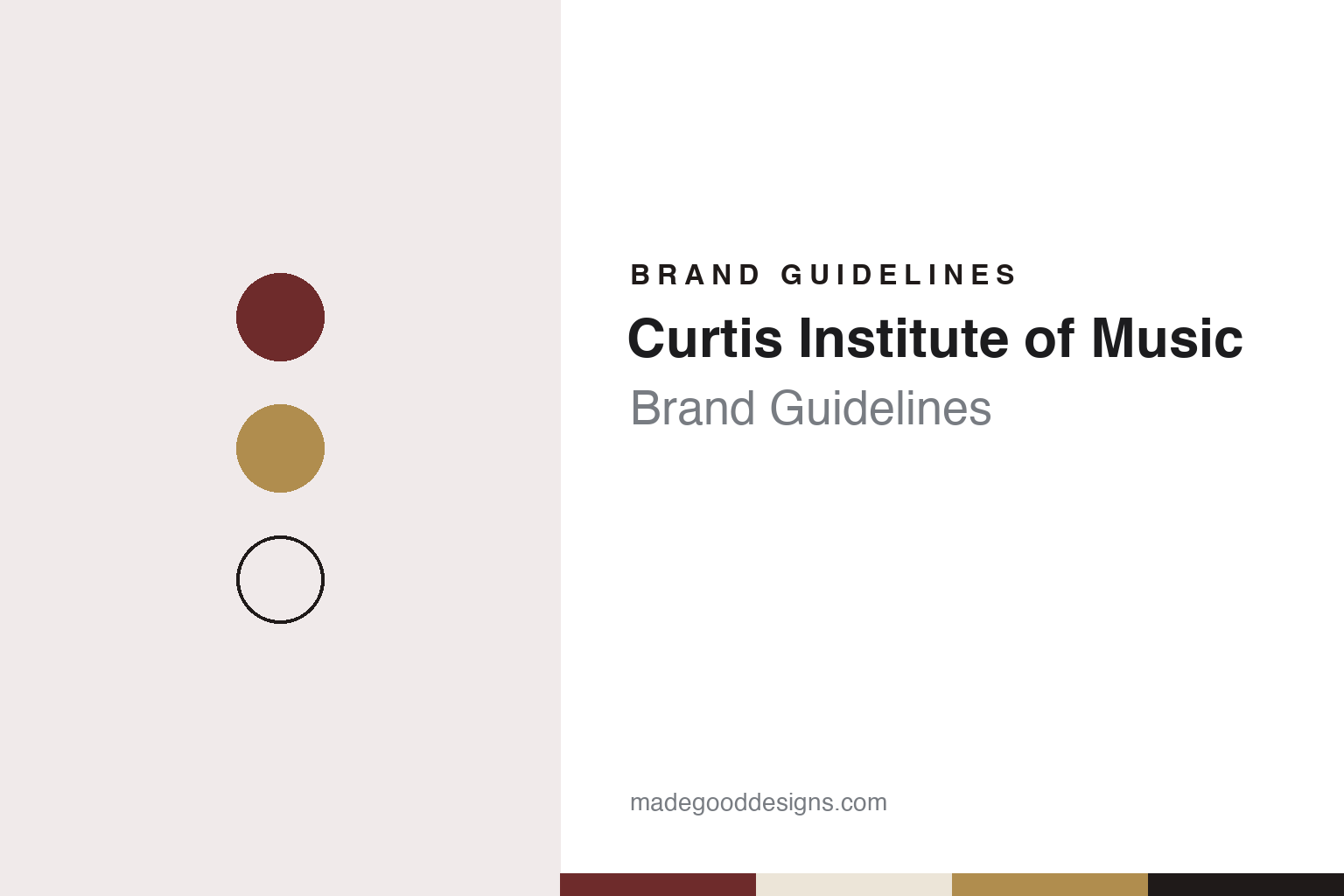
Curtis Institute of Music Brand Guidelines
A Philadelphia conservatory in three mansions and a new hall.
Aa
Two constants: a brick, stone and brass palette and an old-style serif register. Abstract homage — not a Curtis Institute of Music asset or mark; no crest, logo or building is reproduced.
Curtis, 1924
A school named after a publisher.
The Curtis Institute of Music was founded in Philadelphia in 1924 by Mary Louise Curtis Bok, who named it after her father, the magazine publisher Cyrus Curtis, according to English Wikipedia and the Encyclopedia of Greater Philadelphia. The encyclopedia’s essay on the city’s classical music describes her as a major supporter of the Philadelphia Orchestra. English Wikipedia says the Commonwealth of Pennsylvania chartered the institute on 18 April 1924; the school itself gives its opening date as 13 October 1924. For its first year, English Wikipedia says, Curtis shared a building in South Philadelphia with the Settlement Music School, which Bok had long supported.
The school’s lasting home became a group of former mansions near Rittenhouse Square, which the Philadelphia Inquirer described in 2011 as still in use alongside newer space. Bok served as the first president, a post English Wikipedia says she held until 1969. Directors changed quickly in the early years: Johann Grolle, then William E. Walter from 1925, then the pianist Josef Hofmann from 1927. The original teachers named by English Wikipedia include the conductor Leopold Stokowski, the violinist Carl Flesch, the soprano Marcella Sembrich and the pianist Isabelle Vengerova.
Under Hofmann the school cut its intake so that each student received closer attention, and it began weekly radio broadcasts on CBS in 1929. The Curtis String Quartet was formed in 1928 and lasted until 1981, and the conductor Fritz Reiner led the Curtis Orchestra from 1931 to 1941, touring with it and broadcasting its concerts. English Wikipedia says the first commencement came about a decade after opening, with Bachelor of Music and Master of Music degrees, and that since 1928 every admitted student has studied on a full scholarship. Hofmann was followed as director by the composer Randall Thompson in 1939 and by the violinist Efrem Zimbalist in 1941.
Colour
One orchestra, one opera company.
Curtis keeps its intake small. English Wikipedia says that, apart from composers, conductors, pianists, organists and guitarists, the school admits only enough students to fill a single orchestra and an opera company, giving an enrolment of roughly 150 to 175; the school’s own site puts the student body at about 160, with a teacher for nearly every student. It offers a performance diploma, a Bachelor of Music, a Master of Music in opera and a Professional Studies Certificate in opera, English Wikipedia says.
Its ties to the city’s orchestra run deep. The Encyclopedia of Greater Philadelphia says the Philadelphia Orchestra’s principal players taught at Curtis and that the school supplied a large share of the orchestra’s recruits. The same essay names composers trained there, among them Samuel Barber, Gian Carlo Menotti and Vincent Persichetti.
English Wikipedia describes Field Concert Hall as a 240-seat auditorium used for weekly student recitals, faculty and alumni concerts, master classes and recording sessions, with a four-manual Dobson organ, Opus 100. The Rock Resource Center, which combines the John de Lancie Library and the Curtis Archives, holds more than 100,000 scores, books and recordings, and the Dover Quartet is the school’s ensemble in residence, teaching and helping young string quartets form.
The pianist Gary Graffman led the school from 1986 to 2006, and the violist Roberto Díaz became president in 2007, according to English Wikipedia.
Typography
Conservatories and their buildings.
Music conservatories and drama schools present themselves first through their names. Many carry a founder, a benefactor, a city or a royal title, and many have changed name more than once as they merged, widened their teaching or joined a larger body. Juilliard, for example, began in 1905 as the Institute of Musical Art and took its present title in 1968, while Berklee started in 1945 as Schillinger House, according to English Wikipedia. A school’s history page is often where those changes are set out in order.
Crests, wordmarks and seals sit on prospectuses, certificates, signage and programmes. Some schools hold royal charters or belong to a university or a federation of schools, and their published materials usually describe those links in plain terms: who granted the charter, when the affiliation began and which degrees are awarded. Mergers produce their own naming systems, with one name at the top and member schools carrying it, as Berklee and Boston Conservatory at Berklee have done since 2016.
Buildings do much of the visual work. Concert halls, theatres, recital rooms and rehearsal studios appear on posters, season brochures and websites, and a move or a rebuild can change how a school is seen from the street. Architectural Record described Juilliard’s 2009 extension at Lincoln Center as replacing a closed stone front with a glazed one facing Broadway.
Season programmes, concert listings and production posters carry the identity week to week, usually alongside the names of ensembles, theatres and libraries within the school. This guide sets out the dated facts behind each school, its founding, renamings, mergers and buildings, and describes its colours and type only as our own unofficial interpretation.
Aa
An old-style serif — a register suited to a school of mansions. (Specimen set in Cormorant Garamond, a serif STAND-IN; NOT the Curtis Institute of Music logo.)
Lenfest Hall
A new building on Locust Street.
The biggest addition to the campus, which the school’s announcement said doubled its size, came in September 2011, when Lenfest Hall opened on the 1600 block of Locust Street. The Philadelphia Inquirer, in a report by its music critic Peter Dobrin published on 6 September 2011, described a 105,000-square-foot building designed by Venturi, Scott Brown & Associates, giving the school dormitories for about half of its 160 or so students, a cafeteria, extra chamber-music rehearsal rooms, teaching studios and a climate-controlled vault for rare instruments. Before then, the paper noted, Curtis had housed its students in nearby apartments.
The centre of the building is an orchestra rehearsal hall on the second floor, structurally isolated from the rest of the building and, the Inquirer said, three times the size of the space previously used in Field Concert Hall, with double-layered windows to keep out street sound; English Wikipedia names it Gould Rehearsal Hall. Large studios for double bass, percussion and harp sit around it so that players can roll their instruments straight in. The building also opened as a gallery: the Inquirer counted about 70 works of art, including a Frank Stella sculpture, works by Pennsylvania impressionists and textiles from Punjab.
In its own announcement of August 2011, Curtis said the design preserved and restored two 19th-century townhouse façades on the block, with a four-storey front between them that picks up the window groupings and horizontal lines of its neighbours, and a sandstone façade with cherry panelling inside. The Inquirer described the walk from the new building to the older mansions near Rittenhouse Square as a trip across a century of architecture.
For a design guide, Curtis Institute of Music shows how a small school can carry its identity through a founder’s family name, a cluster of historic houses and one carefully placed modern building. Compare Juilliard, another American conservatory, and Carnegie Hall, the New York concert hall. For this guide we use a deep brick red, warm stone and a soft brass with a serif, an unofficial interpretation; no product or logo is reproduced.
Explore & save
Keep Curtis Institute of Music’s identity on hand — save it to a board in the Made Good inspiration library.
Curtis Institute of Music identity set
Pin the brick, stone and brass palette and the old-style serif register to your own board.
Source & notes
Frequently Asked Questions
What font can I use to match the Curtis Institute of Music look?
This guide describes Curtis Institute of Music’s type as “An old-style serif — a register suited to a school of mansions”. Its type specimen is set in Cormorant Garamond from Google Fonts as a stand-in; Cormorant Garamond is not Curtis Institute of Music’s own lettering.
What colours are in the Curtis Institute of Music palette?
This guide’s Curtis Institute of Music palette is Locust brick #6E2B2B, Ink #1F1A19, Mansion stone #ECE5D8, Organ brass #B08D4E and Paper #F8F5EF. The tones are the guide’s own unofficial interpretation, not official Curtis Institute of Music hex codes.
When was Curtis Institute of Music founded?
Curtis Institute of Music was founded in 1924, in Philadelphia, Pennsylvania.
Who founded Curtis Institute of Music?
Curtis Institute of Music was founded by Mary Louise Curtis Bok in 1924.