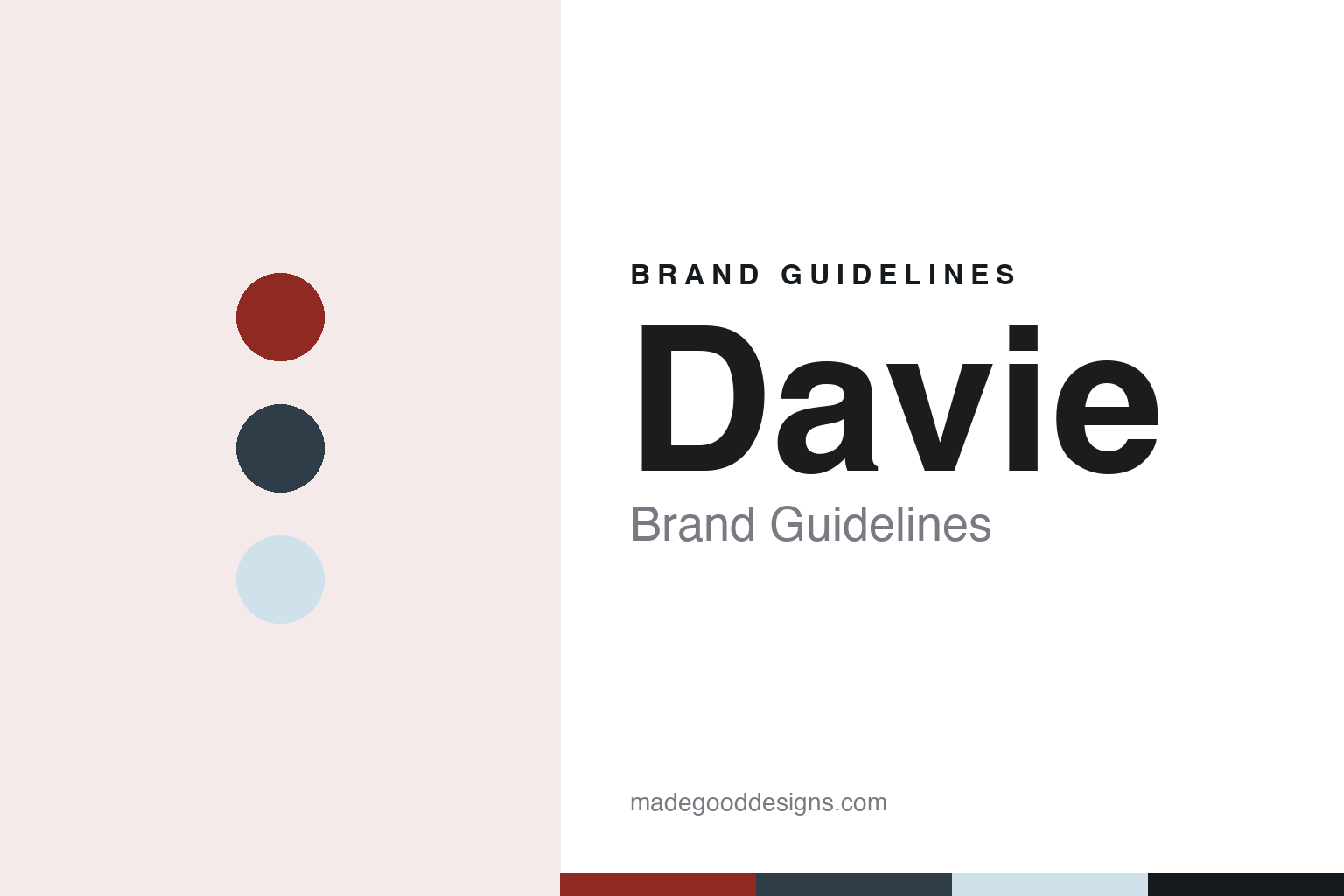
Davie Brand Guidelines
The St. Lawrence yard that kept a captain’s surname through two centuries of owners.
Aa
Two constants: a Davie deep red, slate and ice blue palette and a Maritime serif register. Abstract homage — not a Davie product or mark; no ship, logo or emblem is reproduced.
A captain’s name
Lauzon, across from Quebec City.
Davie is a shipbuilder at Lévis, Quebec, on the south shore of the St. Lawrence opposite Quebec City; the yard stands in Lauzon, now part of Lévis. English Wikipedia dates the firm to 1825, when the English-born ship captain Allison Davie went into partnership with his father-in-law, the shipbuilder George Taylor, who had begun building ships after arriving from England in 1811. The same source notes that Davie’s own construction record only begins in 1897. The company now operates as Chantier Davie Canada Inc., and its French-language website presents Davie as a pioneer for two centuries and part of Canada’s maritime heritage.
Names changed with the generations. The business became George T. Davie & Sons in 1850, under Davie’s son George Taylor Davie, and Davie Shipbuilding & Repairing in 1914. In 1929 the family sold the yard to Canada Steamship Lines, while starting a separate George T. Davie yard next door, which stayed in family hands until 1951 and closed in 1989, according to Wikipedia.
Under its new owner the Lauzon yard moved from wooden sailing ships and steamers to steel cargo and passenger ships. During the Second World War it built warships for the Royal Canadian Navy, among them Flower-class corvettes in 1940, Bangor-class minesweepers in 1940–42 and River-class frigates in 1943–44, Wikipedia lists. Later work included ships of the Restigouche, Mackenzie and Iroquois destroyer classes, the Seaway icebreaker CCGS D’Iberville and the ferry Bluenose of 1956. The Lauzon shipyard was designated a National Historic Site of Canada in 1990.
Colour
A long line of owners.
The last half-century brought a run of owners and restructurings. Wikipedia records that Canada Steamship Lines sold the yard in 1976 to Soconav, a company formed by former Marine Industries employees with backing from the Quebec government; that Dome Petroleum bought it in 1981 and Versatile Corporation in 1985, renaming it Versatile Davie; and that a 1986 merger with Marine Industries created MIL-Davie Shipbuilding. The Lauzon yard stayed open to build two large vessels for Marine Atlantic and three frigates for the Canadian Patrol Frigate Project.
After that work ended in the early 1990s, MIL-Davie went into receivership. The yard passed through the Quebec government to Dominion Bridge, went into trusteeship in 1998 after its parent’s bankruptcy, and was sold again in 2000 as Industries Davie. In 2006 the Norwegian company TECO Maritime bought it and formed Davie Yards Incorporated; TECO entered a creditor restructuring in February 2010. A bid from Fincantieri fell through in July 2011, and on 21 July 2011 Upper Lakes Group bought the assets, forming Chantier Davie Canada Inc. with partners to bid under the National Shipbuilding Procurement Strategy. Davie was not chosen for that strategy’s first contracts, which went to Vancouver Shipyards and Halifax Shipyards, Wikipedia says.
In November 2012 Upper Lakes sold the yard to Inocea, the group that still owns it. In October 2013 Davie launched the offshore construction vessel Cecon Pride, which Wikipedia calls the 717th ship built at the yard, and in 2018 it delivered Asterix, a converted supply ship leased to the Royal Canadian Navy through its sister company Federal Fleet Services. In 2020 Davie was selected as a partner in the National Shipbuilding Strategy, with work on the large icebreaker CCGS Arpatuuq and a fleet of medium icebreakers.
Typography
Design and documentation.
Shipbuilders present themselves to a small number of very large customers: navies, coast guards, shipowners and energy companies. Their identities therefore lean on a short, sturdy wordmark, often a set of initials or a group name, set in navy, blue or red against white, and repeated on yard gates, crane girders, hard hats and the hulls of ships still on the slipway. Many yards sit inside wider industrial groups, so the mark on the crane is frequently the parent’s symbol rather than the yard’s own.
The photography does most of the work. Launch ceremonies, float-outs and naming days, sea trials with a bow wave, aerial views of a dry dock with a goliath crane spanning it: these are the standard images on yard websites and in annual reports. Scale is the message, and a single picture of a hull in dock is usually given more room than any slogan.
Ships are named by type and class, in the words the yards themselves use: LNG carriers, container ships, tankers and bulk carriers, ferries and research vessels, and, for naval yards, patrol vessels, frigates, corvettes and submarines described by programme or class name. Specification panels with length, beam, deadweight and capacity in containers or cubic metres stand in for product shots, and order books are reported ship by ship.
Most shipbuilder websites follow a similar plan: a history page told as a timeline of yards, mergers and renamings; sections for new builds, repair and conversion, and offshore work; a page on facilities, docks and cranes; and, for listed and state-owned yards, investor pages with annual reports. For a designer, the sector shows how an identity can be built from places, dates and ship classes rather than from consumer advertising.
Aa
A maritime serif — a founder’s surname kept since 1825. (Specimen set in Source Serif 4, a serif STAND-IN; NOT the Davie logo.)
Davie
Helsinki, Texas and the icebreakers.
Inocea took Davie abroad. In November 2023 Monaco Life reported that the group had completed the purchase of the assets of Helsinki Shipyard Oy, the Finnish icebreaker builder, after steps that began in December 2022: Davie exercised an option to buy in March 2023, signed a purchase agreement in April and secured a 50-year land lease from the City of Helsinki in July. The Canadian and Finnish yards remain separate legal entities, with the business headquarters in Québec, the company said. Monaco Life described Inocea as based in Monaco; The Maritime Executive, in 2025, called it a privately held British marine industrial group.
The United States followed. The Maritime Executive reported on 3 December 2025 that Davie Defense, an Inocea division launched that September, had completed its purchase of Gulf Copper’s shipbuilding assets in Galveston and Port Arthur, Texas, first announced in June. In May 2026 Davie Defense finalised a contract for five Arctic Security Cutters for the US Coast Guard, the first two to be built in Helsinki and the other three in Texas, gCaptain reported in August 2026; it said Inocea now runs five major shipyard facilities across Canada, the United States and Finland.
Icebreakers now sit at the centre of the brand. In August 2025 Davie cut steel in Lévis for the Polar Max, the 138.5-metre CCGS Arpatuuq, with early hull work in Helsinki and most construction and the delivery in Lévis, due by 2030, gCaptain reported. In August 2026 Davie signed a fixed-price contract for six Program Icebreakers, Polar Class 3 ships for the Canadian Coast Guard, with work on the first due to begin in 2027.
For a design guide, Davie shows how a founder’s surname can outlast a long line of owners and two centuries of renaming. Compare Hanwha Ocean, the former Daewoo Shipbuilding & Marine Engineering, which joined a 2011 Davie bid, and Fincantieri, whose 2011 offer for the yard fell through. For this guide we use a deep red, a slate and an ice blue with a serif, an unofficial interpretation; no product or logo is reproduced.
Explore & save
Keep Davie’s identity on hand — save it to a board in the Made Good inspiration library.
Davie identity set
Pin the Davie deep red, slate and ice blue palette and the Maritime serif register to your own board.