de Sede Brand Guidelines
The saddle-leather sofa.
Aa
Two constants: a cognac-and-tan palette and a modernist sans register. Abstract homage — not a de Sede sofa or wordmark.
The saddle-leather sofa
de Sede hand-crafts saddle-leather seating, from its saddlery roots, in Klingnau, Switzerland.
de Sede is a lesson in a material and a craft as the identity. A Swiss maker in Klingnau, it hand-cuts and hand-stitches thick saddle leather into seating — a craft it traces to its origins as a saddlery — most famously the DS-600 “Non-Stop,” an endless, segmented modular sofa. A sofa, made a piece of leatherwork.
Its identity is the saddle-leather sofa. de Sede’s Swiss leather craftsmanship, and icons like the Non-Stop, are the work it is known for. A material, made a signature. A maker that works leather like a saddler.
(Honest notes, so the story stays precise. de Sede was founded in 1965, growing out of a 1962 saddlery. Its ownership has changed hands several times and it came through a difficult period around 2013–14 under a previous owner, but it has since been restructured and is stable, now within the Volare Group, with a new chief executive appointed in late 2025 — so we describe it as restructured and trading, not distressed. Everything is still genuinely made in Switzerland, in Klingnau, largely by hand. One credit to get right: the DS-600 “Non-Stop” was designed by the de Sede design team, not by Ubald Klug, who designed the DS-1025 Terrazza. Its designs and name are its IP, described but never reproduced, and there is no official brand hex — these tones are an unofficial interpretation. This is design commentary and does not promote any product.)
Colour
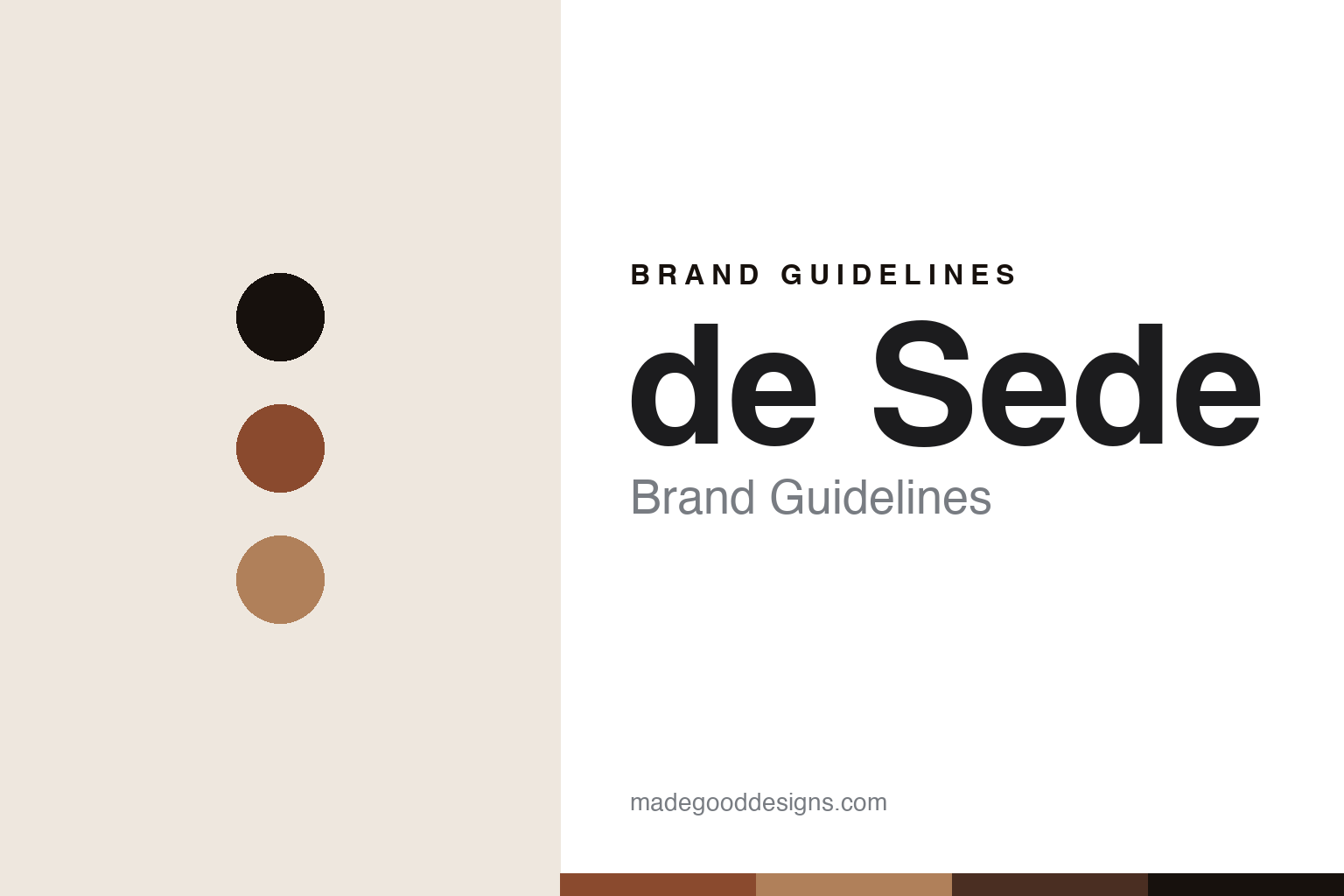
de Sede lives in a cognac-and-tan palette. Click a swatch to copy the hex.
de Sede’s identity is rich, tactile and crafted — a cognac, an ink, a tan, an espresso, and a chalk. The palette leans cognac and tan: the register of thick, hand-worked saddle leather. It signals craft and material over flash. The honest caveat: with no published brand hex, these values are an original, unofficial interpretation, not first-party colours.
The lesson is a cognac-and-tan palette signals a rich, leather identity. de Sede’s world is a tactile, hand-worked, Swiss-made object. For designers, it is a reminder that warm leather tones can carry a brand built on a material — the cognac of hide and the espresso of a seam. Because these tones can fail as small text, keep type dark and let the colour live in the accents, palette and band. The takeaways: own a material; work it by hand; keep it in Switzerland; and treat any single hex as unofficial.
Typography
The register is a modernist sans — clean, bold, confident.
de Sede’s identity carries a clean, bold, confident spirit — a modernist object, not a fussy one. A modernist sans captures the mood: even, strong and Swiss, the register of a 1970s design icon in leather. Set in a cognac-and-tan palette, the modernist sans feels clean and bold — exactly the personality de Sede carries. It is confident rather than decorative, mirroring an endless modular sofa. (de Sede’s real sofas and wordmark are things we describe but do not reproduce, and the exact typeface is not ours to use.) Because it is not ours to use, the honest description is “a modernist-sans spirit,” shown here in a stand-in. The type behaves like the maker: clean, bold and confident.
Aa
A modernist-sans spirit — clean and bold. (Specimen set in Hanken Grotesk, a modernist-sans STAND-IN; NOT the de Sede wordmark or any sofa design.)
A material as identity
de Sede stands for the saddle-leather sofa.
de Sede is a lesson in making a material the identity. A cognac-and-tan palette, a modernist sans and hand-worked leather seating make one material the whole maker — rich, tactile and confident. The material is the differentiator. The differentiator is a genuine craft — cutting and stitching thick saddle leather by hand, a discipline carried from a saddlery into a design house.
Put to work, the identity is a material as design. A maker building in this spirit would master one material completely, keep the craft at home, and be candid about a hard history, so the customer buys into a made object rather than a trend. It would let a single icon — an endless leather sofa — stand for the whole house, so that a design becomes shorthand for a brand. It would treat leatherwork as a saddler’s discipline rather than upholstery, so that the craft has a lineage. The lesson de Sede teaches is that mastering a material can build a brand — and survive turbulence: the leather gives it substance, and the Swiss making gives it credibility. The material is the personality, and the making is the proof.
For designers and brand-builders, de Sede offers a clear takeaway: master a material and work it by hand. The lessons: own the leather; stitch it by hand; keep it in Switzerland; and be honest about the story. It is also a reminder to stay accurate: de Sede is a Swiss maker founded in 1965, restructured and stable within the Volare Group, hand-crafting saddle-leather seating in Klingnau — its DS-600 Non-Stop the work of the in-house design team, not Ubald Klug — with the palette here an unofficial interpretation. de Sede made the saddle-leather sofa the maker — proof that a material can be the difference.
Explore & save
Keep de Sede’s identity on hand — save it to a board in the Made Good inspiration library.
de Sede identity set
Pin the cognac-and-tan palette and the modernist-sans register to your own board.