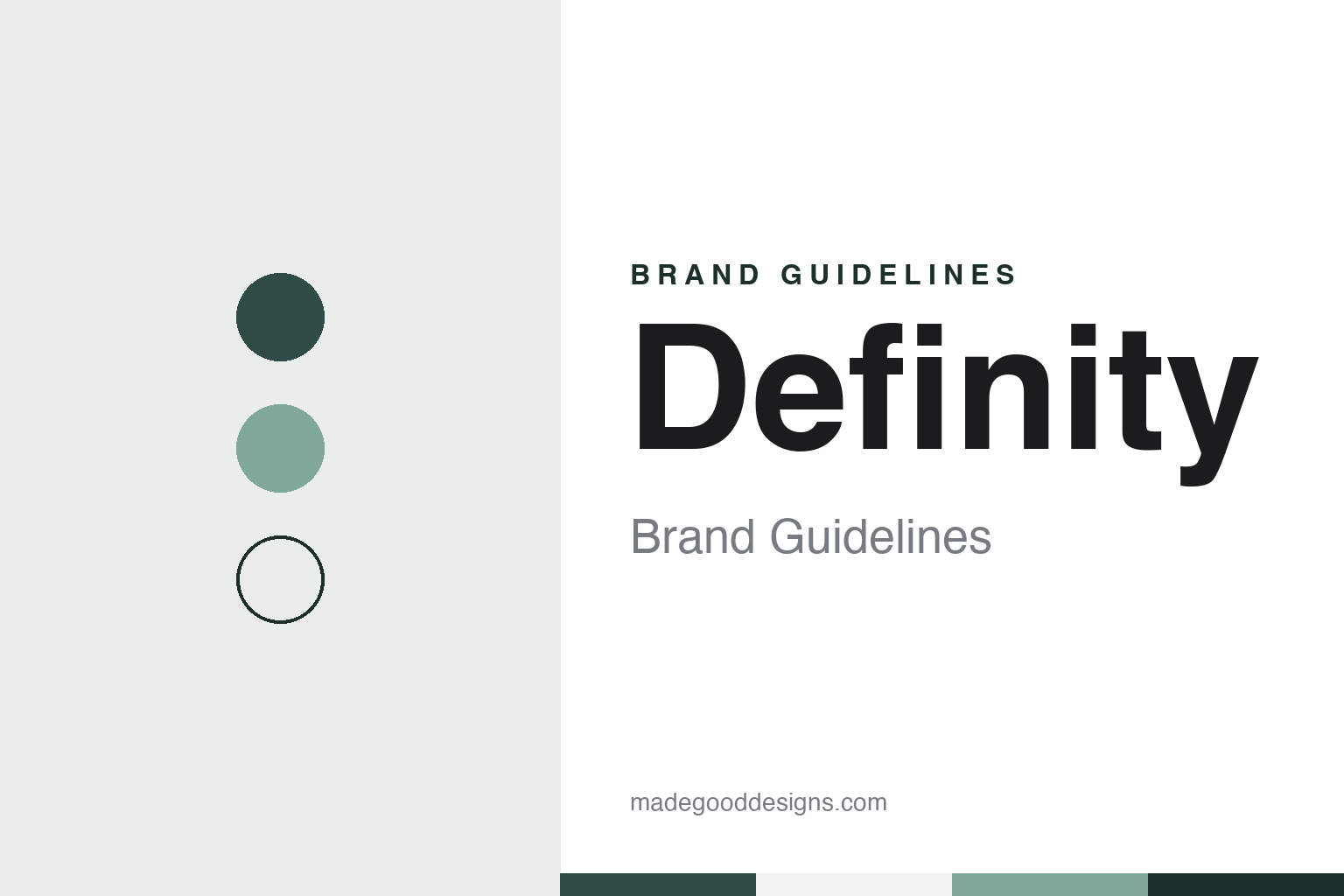
Definity Brand Guidelines
The 1871 Berlin mutual that became a listed Waterloo insurer.
Aa
Two constants: a deep green and sage palette and a Clean sans register. Abstract homage — not a Definity, Economical or Sonnet product or mark; no logo or policy document is reproduced.
Economical of Berlin
A house, a barn and a town that changed its name.
Definity’s story starts in a town that no longer has its original name. In 1871 a group of residents of Berlin, Ontario — now Kitchener — set up a plan to shield themselves and their neighbours from the hardship caused by fire and lightning, English Wikipedia says. On 25 November 1871 the Economical Mutual Fire Insurance Company of Berlin issued its first policy, on a house and barn. The company opened its headquarters on the town’s main street in 1887, and one of its early directors was Moses Springer, a member of Parliament.
The First World War brought the town’s name into question. English Wikipedia records that the company was drawn into controversy when its general manager, a former mayor of the town, opposed the renaming of Berlin as Kitchener.
Expansion came through purchases. In 1937 Economical entered Québec by buying an insurer based in Waterloo, and ten years later it reached the Maritimes by acquiring the Canadian operation of the Northwestern Mutual Fire Insurance Association, English Wikipedia says. It went on to acquire The Missisquoi and Rouville Insurance Company of Québec in 1956, The Perth Mutual of Stratford in 1968, Waterloo County Mutual Fire Insurance Company in 1980, the insurance assets of the Family Group of Companies of British Columbia in 1999, Federation Insurance in 2000 and Hartford Insurance Company of Canada in 2001. In 2006 the Mattei Companies of Seattle became its first subsidiary outside Canada.
The company also built a home for itself. Plans for a new head office in Kitchener began in 1947; the building contract was awarded in September 1949, staff began moving in during 1951, and the building was officially opened on 22 February 1952, English Wikipedia says. Through these changes the headquarters stayed in the same area; today the executive offices are in Waterloo, Ontario, which Insurance Journal also gave as Definity’s base in January 2026.
Colour
From mutual to listed company.
For most of its history Economical was a mutual, owned by its policyholders. In December 2010 the board of Economical Mutual Insurance Company announced its intention to demutualise, and English Wikipedia says it was the first general insurer in Canada to pursue that route. The process was then put on hold while new federal rules for demutualising such insurers were finalised. Policyholders voted in favour in May 2021.
The conversion was completed in November 2021. A new parent company, Definity Financial Corporation, launched its initial public offering on 9 November 2021 and closed it on 23 November, the same day Economical completed its demutualisation, English Wikipedia says. On 18 December 2021 Economical Mutual changed its name to The Definity Insurance Company, which continues to operate as Economical Insurance. Its member companies have included Perth Insurance, Waterloo Insurance, The Missisquoi Insurance Company and Federation Insurance Company of Canada.
Definity has since grown by acquisition. In May 2025 it announced a deal to buy the Canadian personal insurance business and most of the Canadian commercial business of the American insurer The Travelers Companies; on 2 January 2026 Insurance Journal reported that the purchase had been completed, with Travelers keeping its Canadian surety business. Insurance Journal quoted Rowan Saunders, Definity’s president and chief executive, describing the completion as marking “a new era for Definity.”
English Wikipedia lists Saunders as the last president of Economical Mutual, from November 2016 until 23 November 2021, the day the demutualisation was completed.
Typography
Design and documentation.
Canadian insurers work in two official languages, and their names often show it. Canada Life is Canada Vie in French, and Great-West Life had a French name of its own before it was folded into Canada Life in 2020. Companies based in Quebec, such as Desjardins, lead with French, while national insurers run their websites, forms and statements in both languages, so a wordmark has to read well in English and in French.
Colour does much of the work. Across the sector, wordmarks and symbols come in reds, blues, yellows and greens: Manulife and Desjardins both use green, Sun Life’s mark is built around a sun, and the weather beacon on Canada Life’s Toronto building signals in green, orange and white. Maple leaves and northern landscapes are a familiar visual shorthand for the country, and they sit easily beside those colours.
The names themselves have shifted. Sun Life and Mutual Life were mutual companies, owned by their policyholders, until they demutualised in 1999 and 2000 and became listed companies, Mutual Life under the new name Clarica; later mergers folded older names such as Great-West Life, London Life and Clarica into bigger brands. Much of the selling still happens through advisor networks and employers, and the websites are organised by need: pages on life, health, home, auto and group cover, and on investment and retirement products.
Insurers also publish a great deal about themselves, from annual reports to sustainability reports and public accountability statements, and those documents carry the brand as much as any advertisement. This guide sets out what can be checked about each insurer: who founded it, who owns it, how its name has changed, and what rests only on the company’s own word.
Aa
A clean sans — a new corporate name over an 1871 brand. (Specimen set in DM Sans, a sans STAND-IN; NOT the Definity logo.)
Definity
Economical, Sonnet and a family of companies.
Definity works as a family of brands rather than under one name. The insurer itself still trades as Economical Insurance, English Wikipedia says, while Sonnet sells home and auto cover directly online. Sonnet describes itself as “Canada’s original digital-first home and auto insurance company” and a member of “the Definity family of companies,” launched in 2016. It says it is a direct writer whose policies are underwritten by Sonnet Insurance Company, and it offers home, condo, tenant and auto cover, along with pet cover and Sonnet Shift, an app-based programme for drivers.
Sonnet’s voice is plain. Its about page promises “insurance made simple” in “language you can understand,” and lists industry awards including a Guidewire Innovation Award. Its home page adds a commitment to reach net-zero emissions by 2040 and calls Sonnet “a homegrown Canadian insurance company.” It says it is an official insurance partner of the NHL Players’ Association, and it offers group discounts for university and college alumni. According to its website, Sonnet sells home insurance in British Columbia and Alberta and bundles home and auto cover in Ontario, Québec, New Brunswick, Nova Scotia and Prince Edward Island.
The names sit at different ages. The Definity name dates from 2021, when Economical moved from mutual ownership to a listed parent; Sonnet dates from 2016, by its own account; and the Economical name goes back to the Berlin company of 1871.
For a design guide, Definity shows how a mutual founded in 1871 can add a new corporate name while keeping its historic brand and launching a digital one beside it. Compare Intact, another Canadian home and auto insurer, and Co-operators. For this guide we use a deep green, a sage and a pale stone with a sans, an unofficial interpretation; no product or logo is reproduced.
Explore & save
Keep Definity’s identity on hand — save it to a board in the Made Good inspiration library.
Definity identity set
Pin the Definity deep green and sage palette and the Clean sans register to your own board.