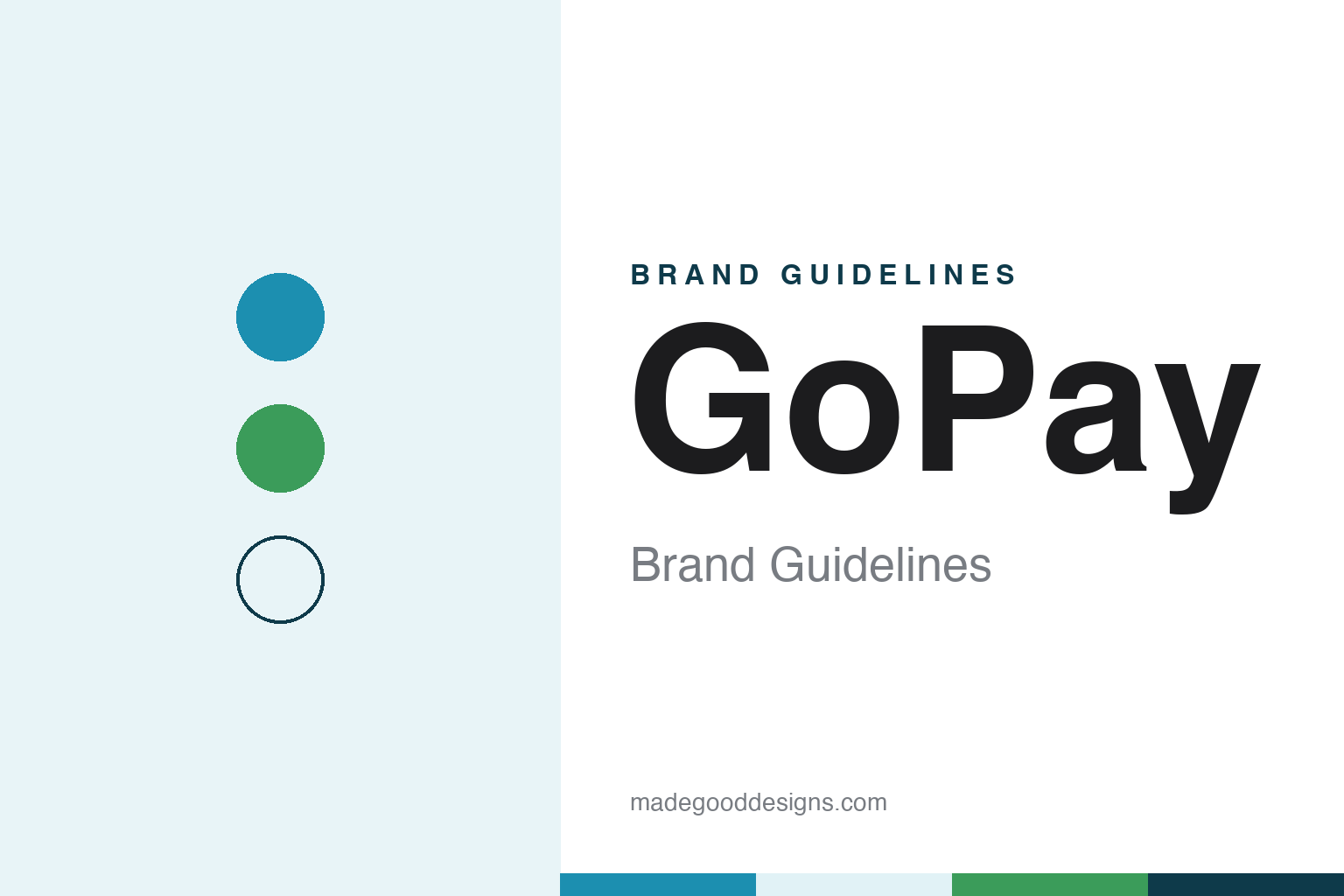
GoPay Brand Guidelines
The Jakarta ride-hailing wallet that stepped out on its own.
Aa
Two constants: a cyan, teal and green palette and a geometric sans register. Abstract homage — not a GoPay product or mark; no app screen, logo or icon is reproduced.
Go-Jek Credit
A ride-hailing balance in Jakarta.
GoPay began inside Gojek, the Jakarta ride-hailing company. English Wikipedia says Gojek was founded in 2010 by Nadiem Makarim and Michaelangelo Moran as a small call centre with 20 ojek, or motorbike-taxi, drivers, and launched its app in January 2015; TechCrunch wrote in 2017 that the company “started out in 2015 offering a ride-hailing service for motorbike taxis” in the capital’s traffic-clogged streets. The Gojek name itself comes from ojek, the Indonesian term for a motorbike taxi, English Wikipedia says. GoPay followed in 2016. English Wikipedia describes it as the successor to Go-Jek Credit, a closed-loop balance that riders used to pay drivers for trips and other on-demand services, and The Jakarta Post also dates its first introduction to 2016.
The early spelling was hyphenated. Press coverage of the period, including TechCrunch, wrote both names with a hyphen, as Go-Jek and Go-Pay. English Wikipedia says that in 2016 Gojek acquired PonselPay, a licensed electronic-money provider, to support the payments business under Indonesian rules.
Payments became a business of their own in December 2017. TechCrunch reported that Go-Jek had bought three Indonesian companies — the offline payment firm Kartuku, the payment gateway Midtrans and the payment and lending network Mapan — to strengthen a network that “centers around its Go-Pay mobile payment service.” Go-Jek said at the time that its business covered 125,000 merchants and more than 100 million transactions a month, and that Aldi Haryopratomo of Mapan would lead Go-Pay. The company’s stated goal, TechCrunch wrote, was to offer basic payment services to the many Indonesians without access to traditional banking.
Colour
QRIS, credit and a savings tab.
From 2018, English Wikipedia says, citing a Bank Indonesia Institute publication, GoPay moved from a closed loop inside Gojek to an open-loop wallet accepted by outside merchants. Its merchant payments began with QR codes and were later brought under QRIS, the Quick Response Code Indonesian Standard set by Bank Indonesia, so that one printed code at a shop counter can be read by many apps. In July 2024, English Wikipedia says, GoTo Financial launched GoPay Merchant, an app for small businesses to register for QRIS and manage payouts.
Financial products grew around the wallet. In 2020 Gojek, through GoPay, took a stake of about 22% in Bank Jago, a digital bank, English Wikipedia says, and the two later launched GoPay Tabungan by Jago, which put savings accounts inside the GoPay and Gojek apps. GoTo also lists GoPay Later, a buy-now-pay-later service previously named Findaya, and GoPay Pinjam, for cash loans. In the third quarter of 2026, DealStreetAsia reported, GoTo’s fintech business had 30.4 million monthly transacting users, and management said the volume of payments gave it a customer base for lending.
The wallet also stepped out of its parent app. On 26 July 2023, The Jakarta Post reported, GoTo Financial rolled out GoPay nationwide as a stand-alone app after a soft launch in April, aimed at people who did not yet use Gojek or Tokopedia; Hans Patuwo, then president of the fintech unit, said GoPay would remain inside those apps as well. The GoPay website, written in Indonesian, now calls it a light app for transfers and payments, for sending money “anywhere” and paying for “anything,” from QRIS codes and phone credit to electricity tokens, game vouchers and bills, with a monthly promotions page of cashback offers.
Typography
How e-wallets present themselves.
Asian e-wallets and payment apps tend to present themselves first through a small square: the app icon. Bright blues, greens, pinks, purples and oranges are common choices, often with a single letter or a short word set in a rounded sans, because the icon has to be found quickly on a crowded phone screen and read at the size of a fingertip. The same colour usually carries through to buttons, cards and the bar at the top of the home screen.
The QR code is the other recurring image. Many wallets grew up around scanning a printed code at a shop counter, and national standards such as QRIS in Indonesia and QR Ph in the Philippines mean one code can often be read by several apps. Marketing pages show phones held over codes, stickers on stall fronts and receipts on screen, so the payment itself becomes part of the identity.
Names and taglines often lean on the local language and on everyday speech. Product families frequently share a prefix or a letter, so that savings, credit, insurance and investment features read as parts of one app. Promotions bring their own visual layer: cashback badges, countdown timers, vouchers and, for some brands, mascots or illustrated characters that soften a financial product.
Behind the consumer screens sit two other audiences. Websites usually divide into pages on transfers, bills, mobile top-ups, micro-loans and pay-later credit for users, and pages on QR acceptance, payouts and point-of-sale tools for merchants. A third layer of newsroom, regulatory and investor pages has grown as several of these companies have joined stock exchanges, and those pages tend to use a quieter version of the same palette.
Aa
A geometric sans — round, open and friendly at app size. (Specimen set in Plus Jakarta Sans, a sans STAND-IN; NOT the GoPay logo.)
GoTo
Gojek plus Tokopedia, and gotong royong.
GoPay’s owner changed shape in 2021. On 17 May 2021 Gojek and the e-commerce marketplace Tokopedia merged into a new holding company, PT GoTo Gojek Tokopedia Tbk, English Wikipedia says; the name abbreviates the two companies and also echoes gotong royong, a Javanese idea of working together. GoPay became part of the group’s financial arm, GoTo Financial, alongside GoPay Later and the point-of-sale app Moka. GoTo listed on the Indonesia Stock Exchange on 11 April 2022, and English Wikipedia now names Gojek and GoPay as its current businesses. Hans Patuwo became GoTo Group’s chief executive in December 2025, and DealStreetAsia described payments and lending at GoPay as the main source of the group’s earnings growth in the third quarter of 2026.
The name has travelled in two spellings. GoTo and the GoPay website write GoPay with a capital P, while some press coverage, including The Jakarta Post and DealStreetAsia, writes Gopay. The “Go” prefix ties it to its sister services such as GoRide and GoCar, and to the Gojek mark, which was redrawn on 22 July 2019 as an icon nicknamed “Solv,” English Wikipedia says. In Vietnam, a wallet previously branded GoPay operated as WePay, according to the same source.
For a design guide, GoPay shows how a payment feature can borrow its parent’s prefix, then stand as an app of its own without leaving the parent behind. Compare Gojek, the ride-hailing app it grew out of, and OVO, another Jakarta e-wallet. For this guide we use a lagoon cyan, a deep teal ink and a leaf green with a geometric sans, an unofficial interpretation; no product or logo is reproduced.
Explore & save
Keep GoPay’s identity on hand — save it to a board in the Made Good inspiration library.
GoPay identity set
Pin the GoPay cyan, teal and green palette and the geometric sans register to your own board.