Jubilee Insurance Brand Guidelines
A 1937 Mombasa insurer that now promises “Living Free.”
Aa
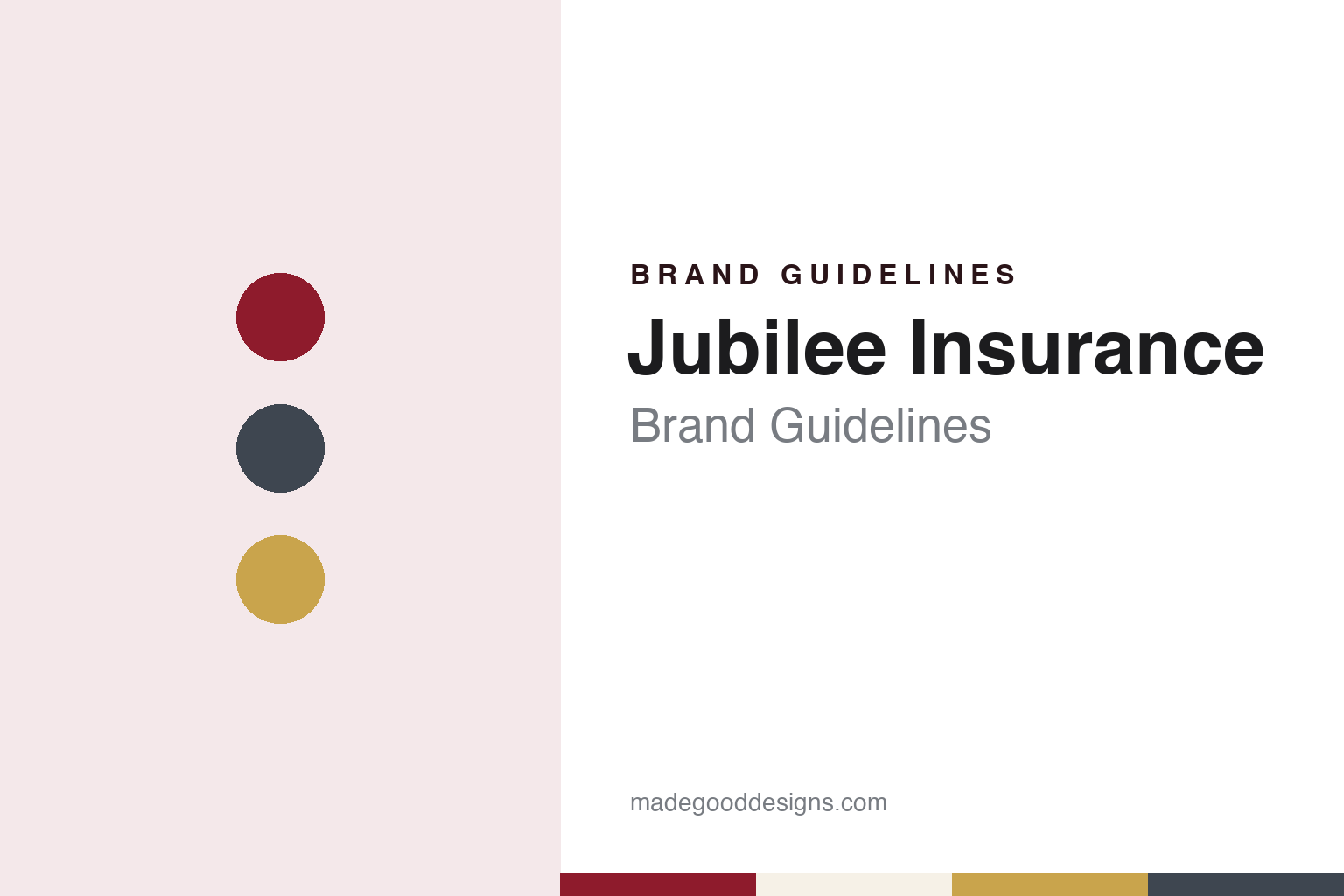
Two constants: a Jubilee crimson, ivory and slate palette and a Steady serif register. Abstract homage — not a Jubilee product or mark; no logo or nameplate is reproduced.
Mombasa, 1937
A coastal insurer that spread across East Africa.
Jubilee Insurance started on the Kenyan coast. The group says it was established in August 1937 in Mombasa, and describes itself as the first incorporated insurance company there; English Wikipedia also places its first headquarters in the port city. From Mombasa it opened offices in Nairobi, Dar es Salaam and Kampala, Wikipedia says, and branches as far away as Bombay and Karachi, as well as on Mauritius and Zanzibar.
The parent company, Jubilee Holdings Limited, was listed on the Nairobi Stock Exchange in 1973, where it trades as JUB, according to English Wikipedia. The regional companies were rebuilt in stages: Wikipedia says the Ugandan company re-established its presence in 1992, co-owned with the DFCU Group and the Aga Khan Fund for Economic Development, and that a Tanzanian subsidiary was set up again in 1998, the first privately owned insurer licensed there after the sector was opened to private owners. In 2006 the holding company cross-listed on the Uganda Securities Exchange and the Dar es Salaam Stock Exchange.
The group’s largest shareholder is the Aga Khan Fund for Economic Development (AKFED), which the Aga Khan Development Network describes as an international development agency that builds enterprises in the developing world. Jubilee Holdings’ 2025 annual integrated report lists AKFED with 37.98 percent of the shares at 31 December 2025, ahead of Pyrus Investments with 10.60 percent. English Wikipedia notes that AKFED is also a shareholder in the Diamond Trust Bank Group, which holds part of Jubilee’s Burundi company.
Today Jubilee says it operates in Kenya, Uganda, Tanzania and Burundi and is listed on the Nairobi, Dar es Salaam and Uganda exchanges. Its businesses are Jubilee Life Insurance, Jubilee Health Insurance and Jubilee Asset Management; its Kenyan site sorts products into life and pension, health cover and asset management, with names such as Faida, J-Care and the Jubilee Money Market Fund.
Colour
There’s living, and there’s living free.
Jubilee’s brand is built around one line. Its about page calls its brand promise “There’s Living, and There’s Living Free,” and says the idea behind the group is that “life is meant to be lived freely.” The site’s headline phrase is “Pioneering Insurance Since 1937,” and the founding year is the first figure on the group’s home page.
The supporting language is plain. Jubilee states its vision as “enabling people to overcome financial uncertainty,” its mission as providing solutions for the future of its customers, and its values as integrity, passion, teamwork and excellence. The group’s 2025 report returns to the same theme, describing resilience and financial empowerment as “key enablers of living free.” Lines on the site such as “One Jubilee Group. One ambition. Greater impact.” stress a single group identity across its markets.
The brand also reaches into public causes. Jubilee says it sponsors The Blue Company Project, an anti-corruption initiative for East African private-sector firms that it says was founded in 2018 by its group chairman and now brings together more than 500 businesses and institutions. Its 2025 report adds a partnership with the Aga Khan Foundation on environmental work, including six micro-forest sites, and an art competition called Live Free appears in the Kenyan site’s menus.
The name and the promise do most of the work. “Jubilee” is paired with a founding year, a plain-spoken vision and a single repeated idea of freedom, and the same wording runs across the group site, the Kenyan site and the annual report.
Typography
How African insurers present themselves.
Africa’s insurers often carry their history in their names. Some of the oldest were founded in Afrikaans or English and still trade under those words or their acronyms: Sanlam’s name is built from the Afrikaans title it was registered under in 1918, and Old Mutual’s comes from a nickname for a Cape Town society of 1845. Others work in Swahili- and French-speaking markets, and pan-African groups such as SanlamAllianz present their pages in both English and French.
The visual language is usually simple: a wordmark or a monogram, a shield or an emblem, and a small set of corporate colours, with greens, blues, reds and golds common across the sector. Few of these companies publish their colour codes or typefaces, so the palettes in these guides are our own interpretations rather than official values. Brand pages tend to lean on photography of families, workplaces and communities rather than on product images, because the products themselves are policies.
Those policies are organised in familiar ranges: life cover, health cover, motor and property cover, family cover, savings, retirement and investments, alongside business and corporate lines. Many groups sell through branches, tied agents and brokers as well as online, and several have moved into banking or mobile services; Old Mutual, for example, launched the digital-only OM Bank in 2025, and Sanlam announced a banking partnership in 2026. Mobile money and USSD menus are part of how some insurers reach customers who do not use apps.
Listed groups also speak through their reports. Integrated reports, results presentations and sustainability reports set out structure, ownership and strategy, and stock exchange listings in Johannesburg, Windhoek, Nairobi, Lagos and elsewhere keep a record of mergers and joint ventures. This guide sets out what those sources show for each company, and marks what rests only on a company’s own word.
Aa
A steady serif for a founding year and a promise. (Specimen set in Source Serif 4, a serif STAND-IN; NOT the Jubilee logo.)
Jubilee
General insurance passed to Allianz.
A major change in the group’s recent history was the sale of its general insurers. Jubilee Holdings’ 2025 annual report says that in 2020 the company agreed to sell majority stakes in its regional general-insurance subsidiaries to Allianz SE, under which Allianz would take controlling stakes of between 51 and 66 percent in the units in Kenya, Uganda, Tanzania, Burundi and Mauritius while Jubilee kept significant minority stakes. The sales of the Kenyan and Ugandan companies were completed in 2021, the report says, and those in Tanzania, Burundi and Mauritius in 2022. Business Insurance reported on 5 May 2021 that Allianz had completed its purchase of 66 percent of the Kenyan general business.
A second step followed through SanlamAllianz, the joint venture of Sanlam and Allianz. Jubilee’s board approved the sale of its remaining shares in the general-insurance businesses to Sanlam Allianz Africa, announced on 4 September 2025, the 2025 report says. Business Insurance, citing Atlas Magazine, reported on 15 September 2025 that the sale had been completed; Jubilee’s own report for 2025 still lists minority holdings in the Sanlam Allianz general insurers in Kenya, Uganda, Tanzania and Mauritius among its associates. Jubilee now concentrates on life, health cover and asset management, and its shareholder documents include a proposed amalgamation of its insurance subsidiaries in Uganda.
For a design guide, Jubilee Insurance shows how a long-established insurer can hang an identity on a founding year and a single promise, “Living Free,” while the business changes underneath. Compare it with Allianz, which bought into its general insurers, and Britam, another Nairobi insurance group. For this guide we use a deep crimson, an ivory and a slate grey with a serif, an unofficial interpretation; no product or logo is reproduced.
Explore & save
Keep Jubilee Insurance’s identity on hand — save it to a board in the Made Good inspiration library.
Jubilee Insurance identity set
Pin the Jubilee crimson, ivory and slate palette and the Steady serif register to your own board.