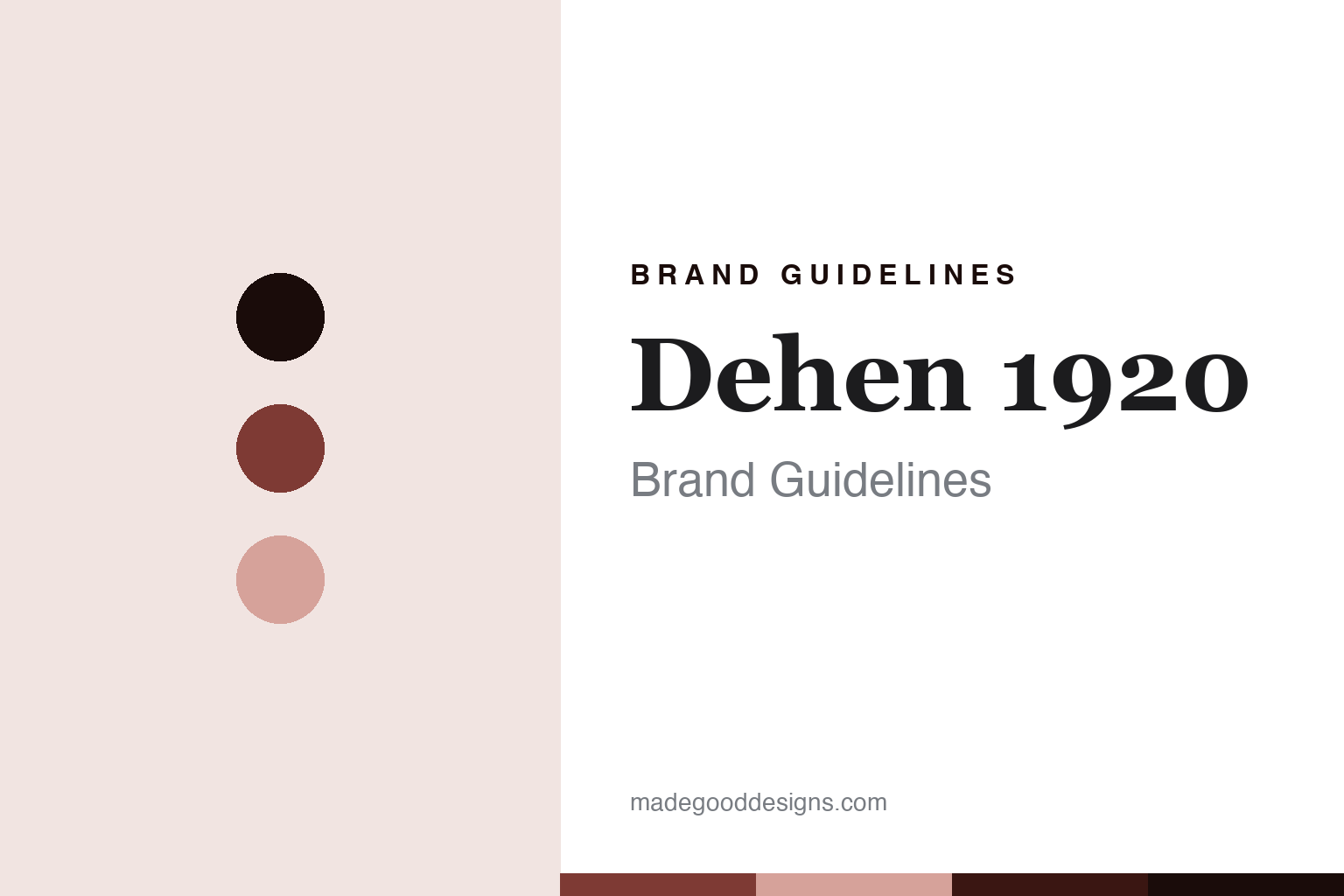
Dehen 1920 Brand Guidelines
Still made in Portland.
Aa
Two constants: an oxblood palette and a heritage-serif register. Abstract homage — not a Dehen 1920 garment or mark.
Still made in Portland
Dehen 1920 is the Portland, Oregon knitwear house that has made wool sweaters and workwear in its own American factory since 1920.
Dehen 1920 opens the round with the rarest answer — a genuine old house that never left. From Portland, Oregon, Dehen makes wool knitwear and workwear outerwear — the wool moto and club sweater above all, with varsity and club jackets and deck jackets — in its own factory, as it has for over a century. Its answer to how a maker becomes a name is simple endurance: keep knitting and sewing in Portland, and never move the factory. A wool sweater, still made where it always was.
Its identity is still made in Portland. Dehen 1920’s own Portland factory, its wool knits and its century of American making are the work it is known for. A sweater, made in the USA. A house that stayed.
(Honest notes, so the story stays precise. Dehen 1920 — at dehen1920.com — makes wool sweaters, knitwear and workwear outerwear, with the wool moto and club sweater and the varsity and club jacket as its signatures. It was founded in 1920 in Portland, Oregon, by William Peter Dehen as the Dehen Knitting Co.; its heritage is genuine, including a documented Depression-era chapter when the family kept the knitting machines running in a home basement. On where it is made — the theme of this round — the made-in-USA claim is explicit and repeated on its own site, which says its goods are made in its Portland, Oregon factory, so we state the own-factory American making plainly. On ownership, it describes itself as a fourth-generation family business making for a hundred years; the modern brand relaunched under the Dehen 1920 name in the early 2010s, and we could not confirm whether today’s operators are still the Dehen bloodline, so we present the family-continuity claim as its own and name no current owners. Its name and marks are IP, described but never reproduced, and there is no official brand hex; these tones are an unofficial interpretation. This is design commentary and does not promote any product.)
Colour
Dehen 1920 lives in an oxblood palette. Click a swatch to copy the hex.
Dehen 1920’s identity is heritage, wool and made — an oxblood, an ink, a rose, a deep oxblood, and a paper. The palette leans oxblood and rose: the register of a club-knit wool and a varsity melton. It signals a century-old American knit house. The honest caveat: with no published brand hex, these values are an original, unofficial interpretation, not first-party colours.
The lesson is an oxblood palette signals a heritage, made-in-USA knit identity. Dehen 1920’s world is a heritage, wool, American object. For designers, it is a reminder that a deep oxblood and a soft rose can carry a wool-knit house — the red of a club sweater and the neutral of a knit. Because these tones can fail as small text, keep type dark and let the colour live in the accents, palette and band. The takeaways: keep the factory; make the wool at home; let a century speak; and treat any single hex as unofficial.
Typography
The register is a heritage serif — classical, warm, made.
Dehen 1920’s identity carries a classical, warm, made spirit — a century-old knit house, not a fashion label. A heritage serif captures the mood: traditional, steady and American, the register of a Portland factory. Set in an oxblood palette, the heritage serif feels classical and made — exactly the personality Dehen 1920 carries. It is wool heritage rather than a logo, mirroring a club sweater. (Dehen 1920’s real wordmark and any club patch are things we describe but do not reproduce, and the exact typeface is not ours to use.) Because it is not ours to use, the honest description is “a heritage-serif spirit,” shown here in a stand-in. The type behaves like the knit: classical, warm and made.
Aa
A heritage-serif spirit — classical and made. (Specimen set in Cormorant Garamond, a heritage-serif STAND-IN; NOT the Dehen 1920 logo.)
Made still at home
Dehen 1920 stands for the old house that never left.
Dehen 1920 opens the round with the answer the last one longed for: a maker still made at home. An oxblood palette, a heritage serif and a wool sweater make one thing — still made in Portland — the whole identity: heritage, wool and made. The own American factory is the differentiator, and the century of staying is the meaning. The point is a genuine old knit house that kept its Portland factory when almost every peer moved offshore.
Put to work, the identity is endurance, told straight, as design. A maker in this spirit would keep the factory and the craft in one place — wool sweaters, knitted and sewn in Portland. A brand learning from it would see that staying can be an identity — that a made-in-USA claim carries weight when a house can point to a hundred years in the same city — and that being precise, founded 1920 by William Peter Dehen as the Dehen Knitting Co., keeps it honest. Dehen sets the round’s premise: after a round of overall names gone offshore, here is the maker that stayed. It is the round’s one genuine old house, against the contemporary makers who chose to make at home; it shows that made-at-home can be a legacy as well as a modern choice. The honest editorial moves are to state the own-factory American making plainly, and to present the fourth-generation-family and hundred-year claims as the brand’s own, naming no current owners. The lesson Dehen teaches is that staying can hold an identity: the factory gives it substance, and the honesty about the ownership keeps it credible. The Portland factory is the personality, and the wool sweater is the proof.
For designers and brand-builders, Dehen 1920 opens made still at home, from America: keep the factory — and let a century speak. The lessons: make in one place; hold the craft at home; earn a made-in claim by staying; present a family history as a claim; and never reproduce a logo. It is also a reminder to stay precise: Dehen 1920 is the Portland, Oregon knitwear house that has made wool sweaters and workwear in its own American factory since 1920 — with the palette here an unofficial interpretation. Dehen made staying home the identity — proof that a wool sweater, honestly made, can be the difference.
Explore & save
Keep Dehen 1920’s identity on hand — save it to a board in the Made Good inspiration library.
Dehen 1920 identity set
Pin the oxblood palette and the heritage-serif register to your own board.