DFM Brand Guidelines
Dubai’s exchange, listed on its own market since 2007.
Aa
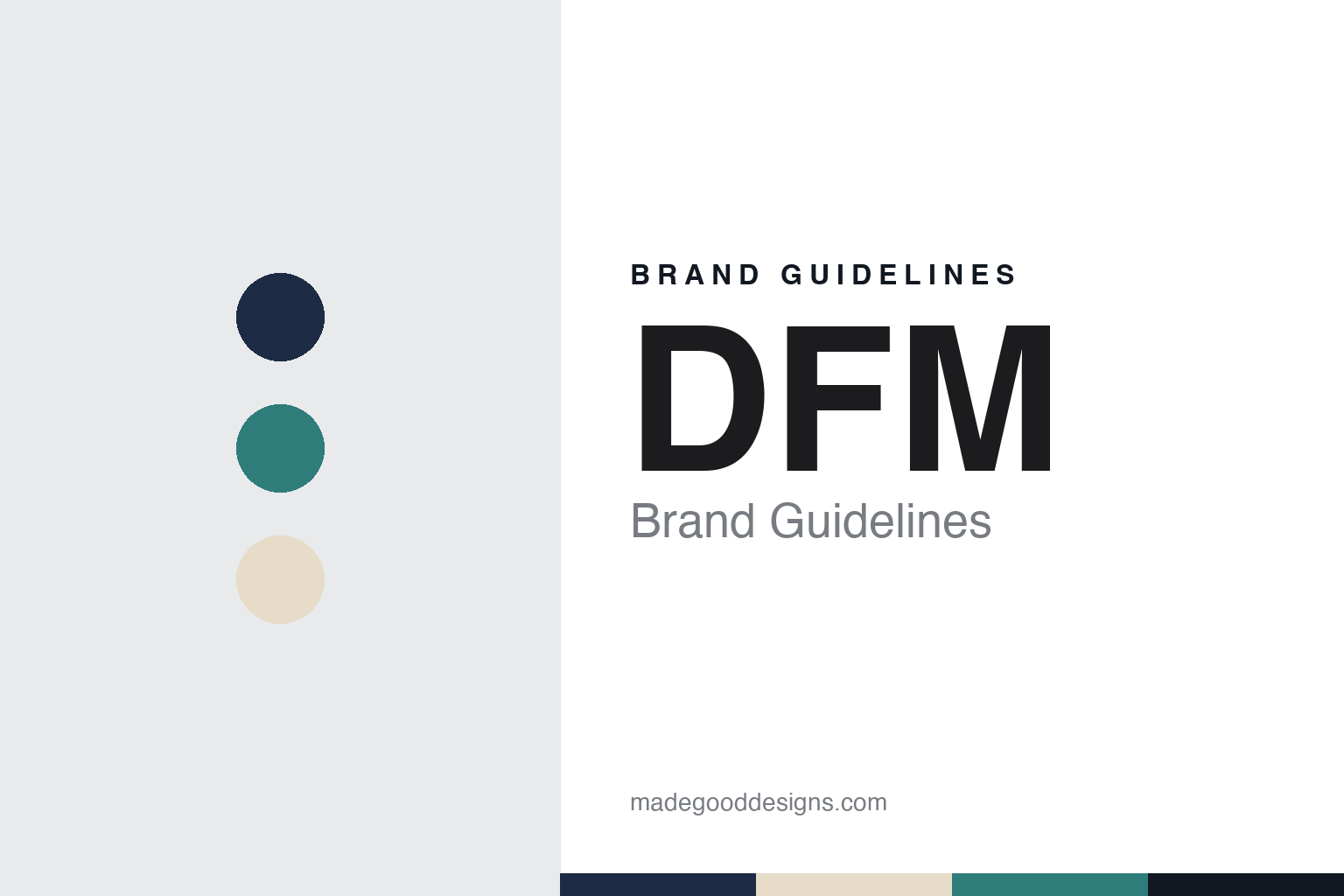
Two constants: a navy, sand and teal palette and a plain exchange sans register. Abstract homage — not a DFM product or mark; no logo, ticker board or wordmark is reproduced.
A Public Institution
A government exchange that sold a fifth of itself.
The Dubai Financial Market (Arabic: سوق دبي المالي), known by its initials DFM, was founded on 26 March 2000, according to English Wikipedia. The exchange says it launched that year as a public institution and calls itself the first exchange in the UAE. It is one of three stock exchanges in the country: the Abu Dhabi Securities Exchange lists mostly UAE companies as well, and Nasdaq Dubai was set up to trade international shares, English Wikipedia says.
The early years were volatile. English Wikipedia records large increases in trading volumes and share prices during 2004 and 2005, followed by a fall of around 60 percent in share values on DFM from late 2005 into the first months of 2006, in line with similar falls across most other Gulf stock markets.
Ownership changed in 2006. DFM was fully owned by the Government of Dubai until November of that year, when it became a public joint-stock company through an initial public offering, English Wikipedia says: 20 percent of the shares went to the public and 80 percent were subscribed by Borse Dubai, a holding company owned by the Dubai government. The company’s own investor-relations page gives the same split, saying its capital was divided into 8 billion shares and that 1.6 billion of them were offered to the public.
The company then listed on the market it runs. DFM says Dubai Financial Market Company was listed on 7 March 2007 under the ticker DFM, and on its “Why DFM” page it describes itself as the region’s first publicly listed exchange.
DFM and the Abu Dhabi exchange are regulated by the UAE Capital Market Authority (CMA), according to both English Wikipedia and DFM’s own website; Nasdaq Dubai, by contrast, sits under the Dubai Financial Services Authority.
Colour
One investor number across two exchanges.
The second half of the DFM story is Nasdaq Dubai. English Wikipedia says that exchange launched on 26 September 2005 as the Dubai International Financial Exchange (DIFX), inside the Dubai International Financial Centre, a financial free zone. In 2008 the Nasdaq OMX Group took a one-third stake and the exchange was renamed Nasdaq Dubai; Borse Dubai held the other two-thirds. The Nasdaq name has stayed on the Dubai exchange since.
The two markets then moved closer together. In 2010, English Wikipedia says, Nasdaq Dubai moved all its equities trading onto DFM’s trading platform, and in May 2010 DFM bought a two-thirds stake in Nasdaq Dubai from Borse Dubai and Nasdaq OMX, with Borse Dubai keeping one-third. Nasdaq Dubai remains regulated by the Dubai Financial Services Authority and is described by English Wikipedia as an electronic exchange with no trading floor.
DFM presents the pair as one system. Its website says the two exchanges are consolidated so that investors can reach securities on both with a single Investor Number, and that clearing runs through Dubai Clear and Nasdaq Dubai Clear. The same site lists what can be traded on DFM: shares, futures, sukuk and bonds, and exchange-traded funds, alongside REITs and a carbon-credit product. A Shari’a classification list and Shari’a compliance pages sit in the site’s regulation section.
Its management is shared as well. In October 2026 the Emirates News Agency (WAM), reporting DFM’s nine-month results through Zawya, named Hamed Ali as chief executive of both DFM and Nasdaq Dubai and Helal Saeed Al Marri as DFM’s chairman. Ali said the investor base now exceeded 1.3 million, and the same report gave the level of the DFM General Index at the end of September 2026. DFM’s own website says its investors come from 212 nationalities.
Typography
How exchanges present themselves.
Stock exchanges sell trust before they sell anything else, and their identities tend to show it. Many lean on a short set of letters rather than a full name, set in a sober sans or serif, and on a narrow, conservative palette: navies, deep reds and golds recur across exchange wordmarks, chosen to read as steady rather than fashionable. Few exchanges publish full brand guidelines, so most of what a designer can study is what they put on their own websites and in their own reports.
Photography does much of the work. Exchanges publish pictures of the places and rituals of a market: trading floors, where they still exist or once did, and listing ceremonies such as bell ringings and gong strikes, when a newly listed company’s executives mark its first day of trading. Where trading floors have closed and dealing has moved to screens, those ceremonies and the buildings themselves carry more of the visual story.
The websites follow a common pattern. A home page usually leads with an index ticker or chart and the day’s gainers and decliners; behind it sit listing pages that explain to companies how to raise capital, market-data pages, announcements, and rulebook or regulation pages that set out how the market is run. NZX in Wellington, for example, shows a chart of its headline index, upcoming listings and a section of rules and guidance on its own site.
Exchanges also speak to investors and shareholders. Many run investor-education pages, courses, videos or podcasts aimed at first-time savers, and an exchange that is itself a listed company publishes annual reports and investor news like any other issuer. This guide sets out what can be checked about each exchange: where it began, how it changed its structure, which markets and indices it runs, and how it presents itself today.
Aa
A plain exchange sans for tickers and listing pages. (Specimen set in IBM Plex Sans, a sans STAND-IN; NOT the DFM logo.)
DFM
Listings, an index and a promise to accelerate.
Much of DFM’s public profile comes from the companies it lists. English Wikipedia says the Dubai Electricity and Water Authority planned to float 18 percent of its share capital as a public offering listed on DFM, and that the offering went ahead in April 2022. Arab News, reporting the utility’s half-year results in August 2022, described that offering as a record. Earlier, English Wikipedia notes, the merger of Emirates Bank International and National Bank of Dubai led to new shares in Emirates NBD being listed on DFM on 16 October 2007.
The exchange’s website is built around that work of raising capital. Its main sections are headed Raise Capital, Investing, Brokers & Members, The Exchange and Discover DFM, with pages for established companies, family businesses, small and medium-sized firms, free-zone companies and dual listings, an IPO subscription service and an IPO Accelerator Programme. Investors are pointed to a mobile app and to iVestor, the exchange’s investor card service, and to pages on dividends and how to trade.
The words DFM uses about itself are short and repeated. Its “Why DFM” page opens with the line “We are Dubai’s financial market,” adds “Where the East meets West,” and ends its statement of belief with “Accelerating tomorrow.” The same page describes DFM as a multi-platform marketplace for raising capital, listing and trading, and gives headline counts for 2024 of listed companies, investors and new investors. As a listed company itself, DFM publishes an integrated report and an investor presentation for its own shareholders.
For a design guide, DFM shows how an exchange that is itself a listed company presents two audiences at once: companies looking to list and the investors who will buy their shares. Compare ADX in Abu Dhabi and Nasdaq, whose name the Dubai exchange still carries. For this guide we use a creek navy, dune sand and gulf teal with a sans, an unofficial interpretation; no product or logo is reproduced.
Explore & save
Keep DFM’s identity on hand — save it to a board in the Made Good inspiration library.
DFM identity set
Pin the DFM navy, sand and teal palette and the exchange sans register to your own board.