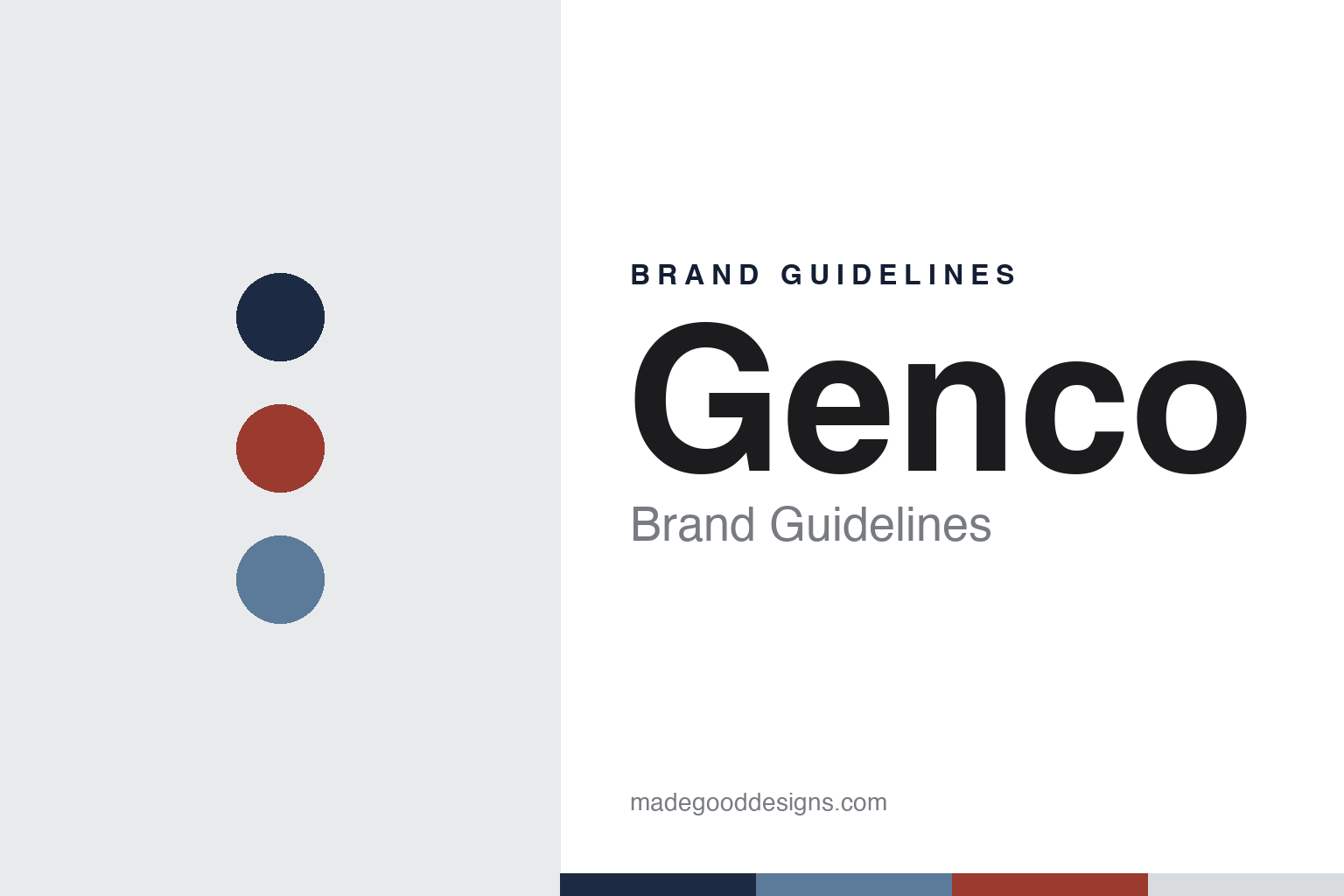
Genco Brand Guidelines
A New York dry bulk owner built around major bulk and minor bulk.
Aa
Two constants: a harbour navy, hull red and steel blue palette and an industrial sans register. Abstract homage — not a Genco vessel, product or mark; no logo or livery is reproduced.
Genco
A New York shipowner, a downturn and a restructuring.
Genco Shipping & Trading began in 2004. The company’s website dates its “inception” to that year and describes Genco as a U.S.-based drybulk shipowner headquartered in New York City. Its first chairman was Peter Georgiopoulos, a New York-born shipping investor who also led the tanker owner General Maritime, gCaptain reported in 2022. When he stepped down as chairman in October 2016, the interim executive chairman thanked him for “his leadership since Genco’s founding,” gCaptain reported at the time.
The company grew as a carrier of iron ore, coal, grain, steel products and other dry cargoes on worldwide routes. In April 2014 gCaptain, republishing a Bloomberg report, described a fleet of 53 dry-bulk carriers spread across five classes, from Capesizes, the largest, down to Handysizes, the smallest. The same report said Genco also held stakes in Baltic Trading, a listed affiliate, and in Jinhui Shipping & Transportation.
The years after 2008 were hard on the sector. An analyst told Bloomberg that shipowners had bought too many vessels before the 2008 recession, and the resulting glut drove charter rates down and left many companies with heavy debts. On 21 April 2014 Genco filed for Chapter 11 bankruptcy protection in the U.S. Bankruptcy Court in Manhattan, after weak charter rates made it difficult to pay its creditors, Bloomberg reported through gCaptain.
The filing followed an agreement with a majority of its lenders under which most of the reorganised company’s equity would go to the holders of a 2007 credit line, and convertible noteholders would receive a smaller share. A committee of shareholders opposed the plan, arguing that it undervalued the fleet. In July 2014 the bankruptcy judge said he would confirm it, Reuters reported, and Genco left bankruptcy under the control of its senior creditors. Looking back in 2016, gCaptain described the April 2014 filing as a move to reduce Genco’s debt.
Colour
Major bulk, minor bulk and a family of names.
The current fleet is split into what Genco calls major bulk and minor bulk. Its website lists 44 wholly owned vessels: Newcastlemax and Capesize ships for the larger trades, and Ultramax and Supramax ships for medium-sized cargoes. It names those cargoes as iron ore, grain, steel products, bauxite, cement and nickel ore, among others. The company calls this mix a “barbell” approach, pairing the earnings potential of the big ships with the steadier income of the smaller ones, in its own words.
Every ship on the list carries the Genco prefix. The two Newcastlemaxes, both built in 2020 at the New Times yard, are Genco Stars and Stripes and Genco Valkyrie. Capesizes carry names such as Genco Augustus, Genco Tiberius and Genco Constantine, alongside Genco Lion, Genco Tiger and Genco Bear. The Ultramaxes include Genco Hornet, Genco Mantis and Genco Wasp, and a run of Supramaxes built at the Dayang yard between 2009 and 2011 includes Genco Auvergne, Genco Bourgogne and Genco Languedoc.
The fleet took its present structure after a merger with Baltic Trading. In April 2015 Genco agreed to take over Baltic Trading, then its New York Stock Exchange-listed subsidiary, in an all-share deal; at the time Genco itself traded over the counter and expected to list on the NYSE afterwards, gCaptain reported. The merger was completed in July 2015, giving a fleet of 70 drybulk carriers, gCaptain reported the following year. Today the shares trade on the NYSE under the symbol GNK, according to the company.
Management is split between Genco’s own staff and a partner. Genco handles commercial management in-house and runs technical management through GS Shipmanagement Pte. Ltd., a joint venture with The Synergy Group, it says. Its website lists offices in New York, Singapore and Copenhagen, with Chennai also named on its home page, and memberships of the Maritime Anti-Corruption Network and TRACE.
Typography
How dry bulk owners present themselves.
Dry bulk shipowners rarely sell to the public, so their identities are made for a small audience: charterers, lenders, shipbrokers, port agents and shareholders. Most present themselves with a short wordmark in a restrained palette, with navy, red and steel blue recurring, and let the ships carry the rest. The photographs on their websites are of their own bulk carriers, at sea and in port, as the companies choose to publish them.
The fleet list is the centre of most of these sites. Ships are grouped by vessel class, from Capesize and Newcastlemax to Kamsarmax, Ultramax and Supramax, with year of build, deadweight, shipyard and flag set out ship by ship. Many owners name their vessels in a single pattern, a prefix or a theme that runs through the whole fleet, so the list itself becomes part of the identity.
Alongside it sit ESG reports, codes of conduct and fleet-renewal pages with newbuildings and their delivery dates; Norwegian owners add a report under the Transparency Act. Investor pages carry quarterly results, annual reports, presentations and a running archive of stock exchange releases, which for a listed owner is often the fullest public record of what the company has done and when.
This guide sets out what can be checked about each company — when and where it was founded, who owns it, which ships it runs and how that has changed — and marks clearly what rests only on the company’s own word. Where a company has sold its fleet, been taken private or merged into another, that is stated with its date.
Aa
An industrial sans for a New York shipowner. (Specimen set in Archivo, a sans STAND-IN; NOT the Genco logo.)
Genco
A value strategy, a proxy contest and an independent course.
John Wobensmith, who became Genco’s president in December 2014 according to gCaptain, now leads the company as chief executive. Genco presents its plan as a Comprehensive Value Strategy built on low debt, the purchase of fuel-efficient vessels, the sale of older ones and a quarterly dividend. It describes itself as the largest U.S.-headquartered drybulk shipping company; that is the company’s own claim. Its website opens with the line “Drybulk. Dividends. Differentiated.” and carries pages for the fleet, the ESG reports and investors.
That strategy was tested in 2026. Diana Shipping, the dry bulk owner founded by the Paliou family, proposed combining the two companies, and Genco’s rejection turned into a proxy contest, gCaptain reported in June 2026. Genco adopted a shareholder rights plan, which Diana criticised. At Genco’s annual meeting in June, shareholders re-elected all six of its director nominees, with nearly 90% of the shares outside Diana’s holding voting for each of them, and rejected Diana’s proposals, according to preliminary results reported by gCaptain.
Diana withdrew its offer on 14 August 2026 after the two sides failed to agree on value, gCaptain reported; MarineLink carried Diana’s statement that it was “not going away” and would remain Genco’s largest shareholder. By early September Diana had sold enough shares to fall below a 10% stake, describing its filing as an “exit filing,” though it still held a significant position, gCaptain reported. Genco remains an independent listed company.
For a design guide, Genco shows a shipowner whose identity sits in a single prefix repeated across a whole fleet, and in a website that speaks to charterers and shareholders at once. Compare Diana Shipping, the owner that bid for it in 2026, and Eagle Bulk, another U.S. dry bulk name. For this guide we use a harbour navy, a hull red and a steel blue with a sans, an unofficial interpretation; no product or logo is reproduced.
Explore & save
Keep Genco’s identity on hand — save it to a board in the Made Good inspiration library.
Genco identity set
Pin the Genco harbour navy, hull red and steel blue palette and the industrial sans register to your own board.