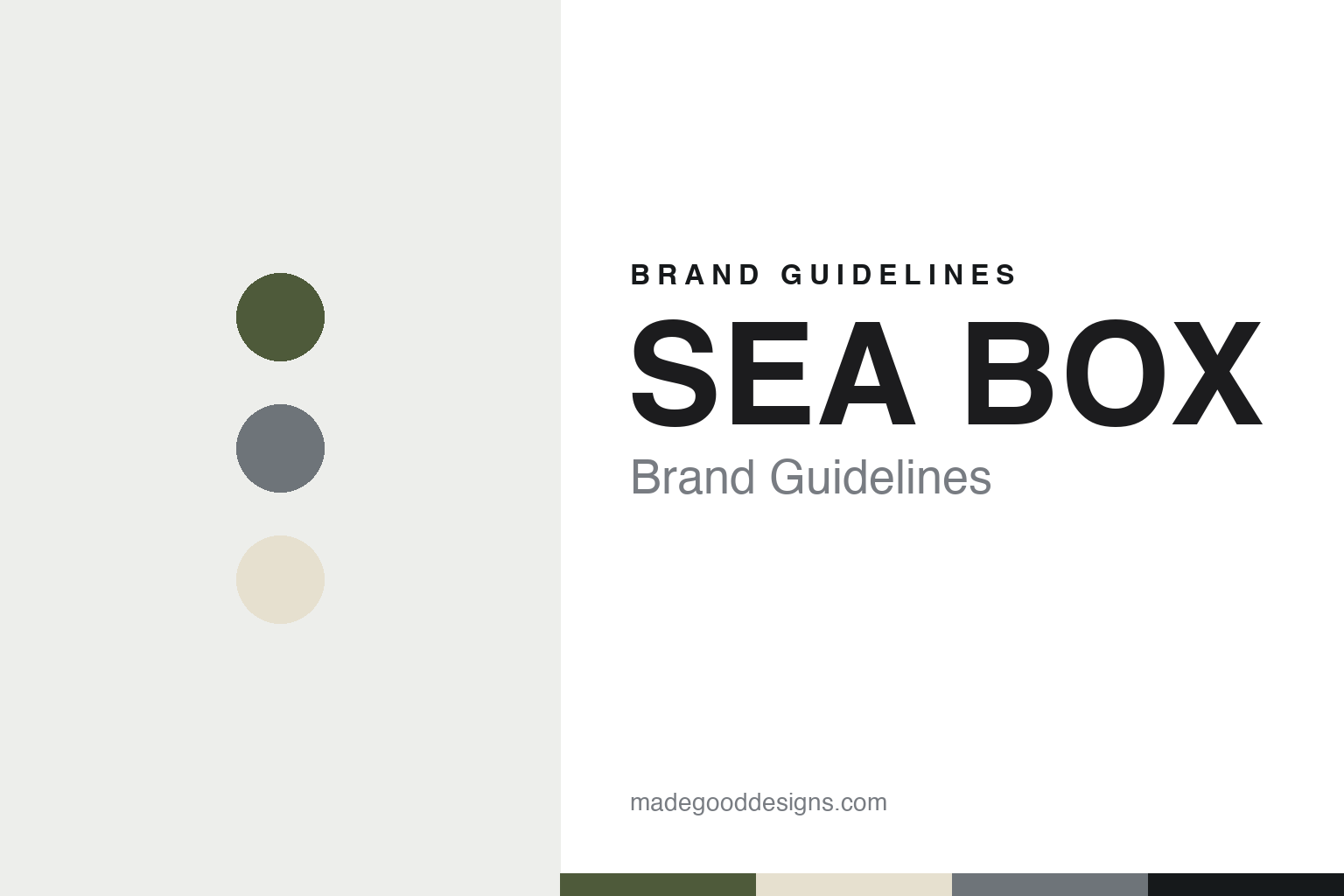
SEA BOX Brand Guidelines
A New Jersey container maker supplying US military buyers.
Aa
Two constants: a SEA BOX olive and steel palette and a Stencil-free sans register. Abstract homage — not a SEA BOX product or mark; no container, logo or marking is reproduced.
A New Jersey box maker
Shipping containers for government buyers.
SEA BOX, Inc. — the company writes its name in capitals — is an American maker of shipping containers based in Cinnaminson, New Jersey. In February 2026 the US Attorney’s Office for the District of New Jersey described it as a corporation “specializing in the design, modification, and manufacturing of shipping containers,” with its headquarters in Cinnaminson.
Its own description, published with a partner in October 2026, is similar. In that announcement SEA BOX is called “a U.S.-based manufacturer and supplier of shipping and storage containers and specialized containerized systems serving military, government and commercial customers,” with “extensive experience supporting U.S. government procurement programs and developing containerized solutions for demanding operational environments.” The announcement named Jim Brennan as president of SEA BOX, and quoted him on the company’s “decades of experience supporting the U.S. military.”
Government work is the thread through the company’s documented history. The same announcement pointed to SEA BOX’s government contracting qualifications, registrations and relationships, including those with the Defense Logistics Agency and the General Services Administration, and other government purchasing channels.
Colour
Army prototypes, built abroad.
In March 2005 American Shipper, in a report now carried by FreightWaves, described SEA BOX as a New Jersey container manufacturer that had completed an initial order of 15 prototype containers for the US Army’s Tank-Automotive and Armaments Command, known as TACOM, in Warren, Michigan. The prototypes covered several types of ISO and non-ISO shipping containers.
They were the first part of a much larger contract. According to the report, SEA BOX had won the contract from TACOM in November 2004, after bidding to supply the US Defense Department with 138,000 containers over five years. The report also said where the boxes would be made: the containers would be built in Turkey and fitted with some American components, with delivery scheduled by November 2009.
That is the clearest dated statement of where containers for that contract were to be made. In its 2026 announcement with GenFlat, by contrast, SEA BOX is to manufacture a prototype “in the United States,” and the US Attorney’s Office describes the company itself as a designer, modifier and manufacturer of containers.
Military orders continued. The US Attorney’s Office said that between late 2017 and late 2021 SEA BOX was awarded about 35 contracts to supply containers built to International Organization for Standardization standards for the Department of the Army and the Department of the Air Force, mainly through the Defense Logistics Agency.
Typography
Design and documentation.
Container lessors own the steel boxes that shipping lines fill and move. A carrier that does not want to buy every box it needs can lease them for a few months or many years, return them at a depot and lease again somewhere else. The lessors earn their names on the boxes themselves: a company wordmark, often in a strong blue, orange or green, painted on the doors and sides of containers that travel the world’s ports and railways for years.
Their websites are built around that fleet. Most sort it by box type: standard and high-cube dry containers for general cargo; refrigerated containers, or reefers, for chilled and frozen goods; tank containers for liquids; and specials such as flat racks, open tops and palletwide boxes for cargo that does not fit a standard van. Photographs of stacked dry, reefer and tank containers, as the companies publish them, do much of the visual work, together with technical sheets that give each box’s dimensions and standards.
The next layer is the network. Lessors publish depot maps and depot finders, lists of regional offices and customer portals where shipping lines can book, return and track their units. Many also sell boxes: pages for the sale of used containers offer units at the end of their marine life for storage, conversion or one more trip, and some lessors invite outside investors to own container portfolios that the lessor manages.
Behind the boxes sits finance. Container leasing is a business of long-lived assets and long contracts, so ownership matters, and many of the companies in this series have been merged, listed, taken private or folded into larger groups. Their investor pages and press releases are where those changes are recorded, and this guide sets out what each company’s own pages and dated reports show.
Aa
A stencil-free sans — SEA BOX in capitals. (Specimen set in Archivo, a sans STAND-IN; NOT the SEA BOX logo.)
SEA BOX
A settlement and a folding box.
Those contracts led to a settlement. In February 2026 the US Attorney’s Office for the District of New Jersey announced that SEA BOX had entered a settlement agreement with the United States resolving allegations that it had breached the Cargo Preference Act and its defence contracts by using foreign-flagged vessels to carry containers made for the Army, the Air Force and the Defense Logistics Agency. The government’s position, as set out in the release, is that supplies bought for defence agencies may travel by sea only on US vessels, a requirement it dates to about 1904 and which is written into both the law and the contracts. SEA BOX agreed to settle claims under the civil False Claims Act, with payment plus interest over three years, according to the office’s release as reprinted by Hellenic Shipping News on 25 February 2026.
Eight months later the company announced a new project. On 6 October 2026 GenFlat Holdings, a developer of collapsible marine containers traded on the OTCQB market, said it had contracted SEA BOX to manufacture a 20-foot collapsible container prototype in the United States, in response to interest from several branches of the US military; GenFlat said the project came at the urging of several senior military officers that it build 20-foot collapsible containers in the United States. The two companies also signed a strategic collaboration agreement under which SEA BOX is to be GenFlat’s exclusive US manufacturer of 20-foot collapsible containers for US military applications.
GenFlat says its containers fold when empty so that four can travel or be stored in the space of one conventional empty container, which it presents as a way to cut the cost of moving empty boxes. The Maritime Executive carried the announcement on 10 October 2026, and the defence-technology site i-HLS described the planned prototype, about 6 metres long, in November 2026. It noted that empty standard containers take up as much space as full ones, which can reduce the room left for vehicles, equipment and other supplies, and that the idea could also suit commercial supply chains. Brennan said SEA BOX looked forward to completing the prototype, so at the time of writing it was under contract rather than finished.
For a design guide, SEA BOX shows a container maker presented through its government work, in its own words and in official records. Compare CARU Containers, the Rotterdam trader that took a stake in a collapsible-container developer in 2013, and Textainer, a container lessor founded in 1979. For this guide we use an olive green and a steel grey with a sans, an unofficial interpretation; no product or logo is reproduced.
Explore & save
Keep SEA BOX’s identity on hand — save it to a board in the Made Good inspiration library.
SEA BOX identity set
Pin the SEA BOX olive and steel palette and the Stencil-free sans register to your own board.