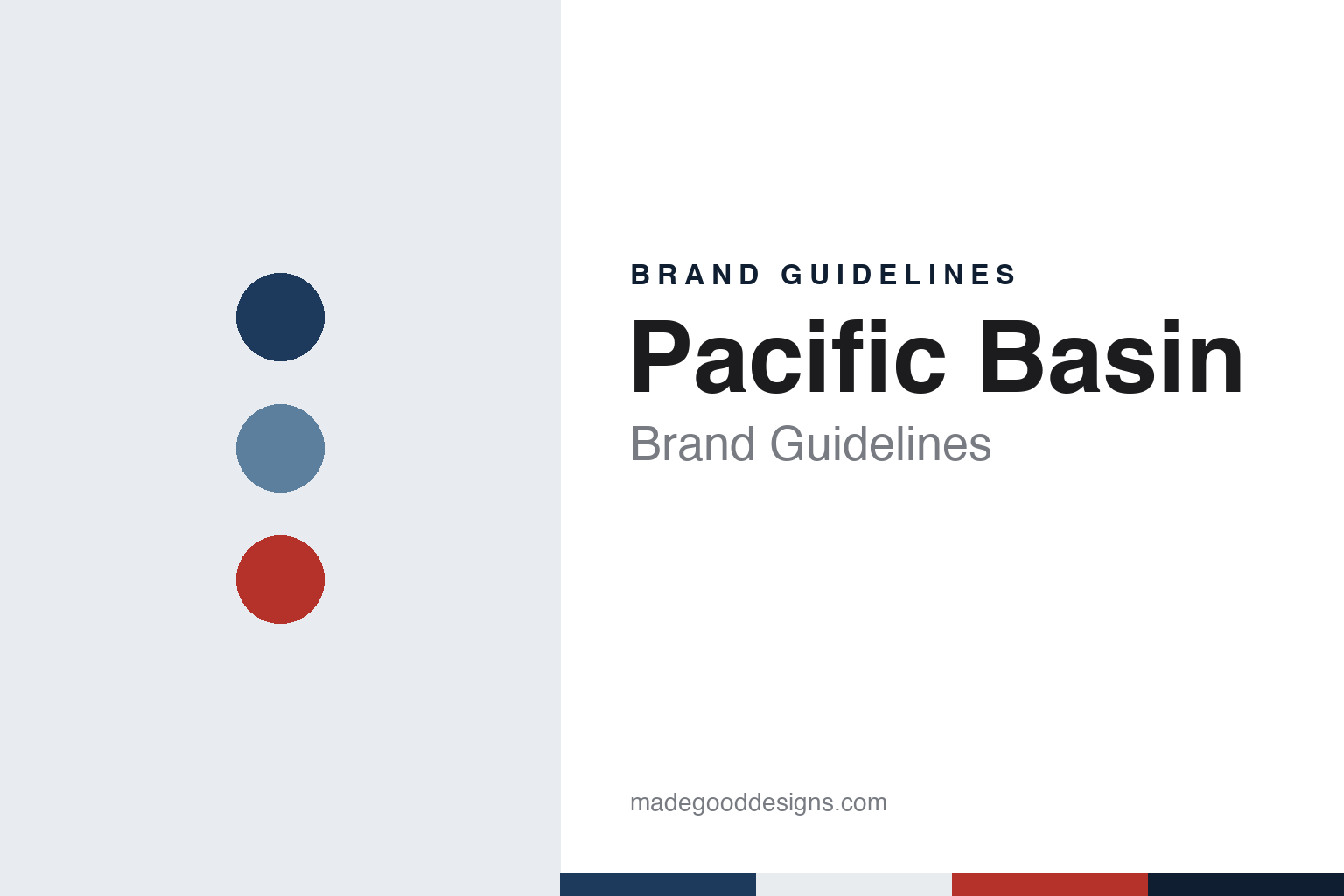
Pacific Basin Brand Guidelines
A 1987 Hong Kong Handysize owner that came back in 1998.
Aa
Two constants: a harbour navy, steel blue and signal red palette and a plain maritime sans register. Abstract homage — not a Pacific Basin ship, mark or livery; no logo or funnel design is reproduced.
Pacific Basin Bulk Shipping
A Hong Kong Handysize owner, taken private and relaunched.
Pacific Basin began in Hong Kong in 1987. English Wikipedia gives its first name as Pacific Basin Bulk Shipping Limited, and the company’s own history page describes that first business as a specialist owner and operator of Handysize bulk carriers, the smaller end of the dry bulk fleet. The company says Pacific Basin Bulk Shipping was listed on NASDAQ in 1994.
The first company did not stay independent. In 1996, the history page says, Pacific Basin and its more than 30 ships were bought and taken private by a third party; English Wikipedia describes the same step as an acquisition and privatisation by an independent company. Two years later, in 1998, the founding management team relaunched the business as Pacific Basin Shipping Limited, the name it still uses. The company says private equity investment from 1999 paid for fleet growth through acquisitions and newbuildings, and that in 2000 it took over the technical management operations of Jardine Ship Management. In 2001 it set up a Handysize pool called International Handybulk Carriers, later folded into its owned fleet.
The next step was the stock market. The company reorganised into its present corporate structure in 2004 and listed on the Hong Kong Stock Exchange on 14 July 2004; English Wikipedia also gives 2004 as the listing year. Before the listing, the company says, its dry bulk fleet was made up of 19 owned, 7 chartered and 16 managed ships. Regional offices in London and Melbourne opened the same year, followed by Dalian, Tokyo and Vancouver in 2005 and Beijing and Dubai in 2006.
For a few years Pacific Basin widened its reach. The history page says it moved into cargo terminal operation and harbour towage in 2007 and into offshore towage and roll-on roll-off ships in 2008, then in 2012 began to leave these businesses to concentrate on dry bulk again. By 2010, it says, its owned, operated and newbuilding fleet had reached 180 vessels.
Colour
Handysize, Supramax and a newbuilding rethink.
Today Pacific Basin describes itself as an owner and operator of modern Handysize and Supramax dry bulk ships. Its at-a-glance page puts the fleet at around 250 ships: 107 owned and about 147 more chartered in. The company says the ships are built mainly in Japan and are designed and equipped for its trades for the long term, and that it serves more than 600 industrial producers, traders and users of dry bulk commodities under spot and long-term cargo contracts. Owning its ships and running its own crews and technical operations is central to how it presents the business; the company lists about 4,100 seafarers and 416 onshore staff across 13 offices on five continents.
Fleet renewal has been the main story of recent years. Baird Maritime reported on 29 November 2024 that Pacific Basin had ordered four 64,000-deadweight Ultramax bulk carriers with dual-fuel engines from Japan’s Nihon Shipyard, two contracted jointly with Nihon Shipyard and Imabari Shipbuilding and two with Mitsui & Co., for delivery in 2028 and 2029. The plan changed in 2026. The Maritime Executive reported on 17 April 2026 that the company had agreed to end the contract for the four methanol dual-fuel ships and turn it into an order for four conventional Ultramax newbuilds, keeping an option on two dual-fuel ships for later delivery, and that it cited uncertainty over the timing and final shape of a global regulatory framework for shipping fuels. The same report said two more 40,000-deadweight Handysize newbuilds had been ordered from China’s Jiangmen Nanyang Ship Engineering yard, for delivery in the second half of 2028.
The company also lists industry awards on its history page: the BIMCO Shipping Company of the Year award in 2014, Lloyd’s List Global Awards for Shipping Company of the Year in 2017 and Dry Bulk Operator of the Year in 2018, Shipping Company of the Year at the Seatrade Maritime Awards in 2022, and Bulk Ship Operator of the Year at the International Bulk Journal Awards in 2022 and 2023.
Typography
How dry bulk owners present themselves.
Dry bulk shipowners rarely sell to the public, so their identities are made for a small audience: charterers, lenders, shipbrokers, port agents and shareholders. Most present themselves with a short wordmark in a restrained palette, with navy, red and steel blue recurring, and let the ships carry the rest. The photographs on their websites are of their own bulk carriers, at sea and in port, as the companies choose to publish them.
The fleet list is the centre of most of these sites. Ships are grouped by vessel class, from Capesize and Newcastlemax to Kamsarmax, Ultramax and Supramax, with year of build, deadweight, shipyard and flag set out ship by ship. Many owners name their vessels in a single pattern, a prefix or a theme that runs through the whole fleet, so the list itself becomes part of the identity.
Alongside it sit ESG reports, codes of conduct and fleet-renewal pages with newbuildings and their delivery dates; Norwegian owners add a report under the Transparency Act. Investor pages carry quarterly results, annual reports, presentations and a running archive of stock exchange releases, which for a listed owner is often the fullest public record of what the company has done and when.
This guide sets out what can be checked about each company — when and where it was founded, who owns it, which ships it runs and how that has changed — and marks clearly what rests only on the company’s own word. Where a company has sold its fleet, been taken private or merged into another, that is stated with its date.
Aa
A plain maritime sans. (Specimen set in Archivo, a sans STAND-IN; NOT the Pacific Basin logo.)
Pacific Basin
Listed in Hong Kong, led from Singapore.
Pacific Basin’s centre of gravity has shifted in the past two years. In 2024, its history page says, it opened a regional office in Singapore, and in 2025 it relocated strategic leadership and final commercial decision-making to Singapore, along with technical management of its Singapore-owned fleet. Its shares are still listed on the Hong Kong Stock Exchange, where they have traded since 2004, and the company says the stock is a constituent of the Hang Seng sub-index series and the MSCI index series. Its chairman, Stanley H. Ryan, was appointed in 2023, and its chief executive, Martin Fruergaard, joined in 2021, the company says.
The way the company presents itself is plain and customer-led. Its at-a-glance page uses “with you for the long haul” as a service line and stresses long-term relationships, a large fleet of interchangeable ships and local offices that allow face-to-face service. The Maritime Executive described Pacific Basin in April 2026 as one of the largest operators of dry bulk vessels. Its site sets fleet facts, office lists and investor pages with results and presentations side by side, and its sustainability section covers environmental, people and governance commitments, including the Getting to Zero Coalition it joined in 2020 and the Neptune Declaration on crew change it signed in 2021.
For a design guide, Pacific Basin shows a Hong Kong-listed shipowner that presents itself through one fleet type, long-term customer service and plain investor reporting. Compare it with Star Bulk, the Athens dry bulk owner, and Golden Ocean, another listed dry bulk owner. For this guide we use harbour navy, steel blue, signal red and a pale hull grey with a sans, an unofficial interpretation; no product or logo is reproduced.
Explore & save
Keep Pacific Basin’s identity on hand — save it to a board in the Made Good inspiration library.
Pacific Basin identity set
Pin the Pacific Basin harbour navy, steel blue and signal red palette and the plain maritime sans register to your own board.


