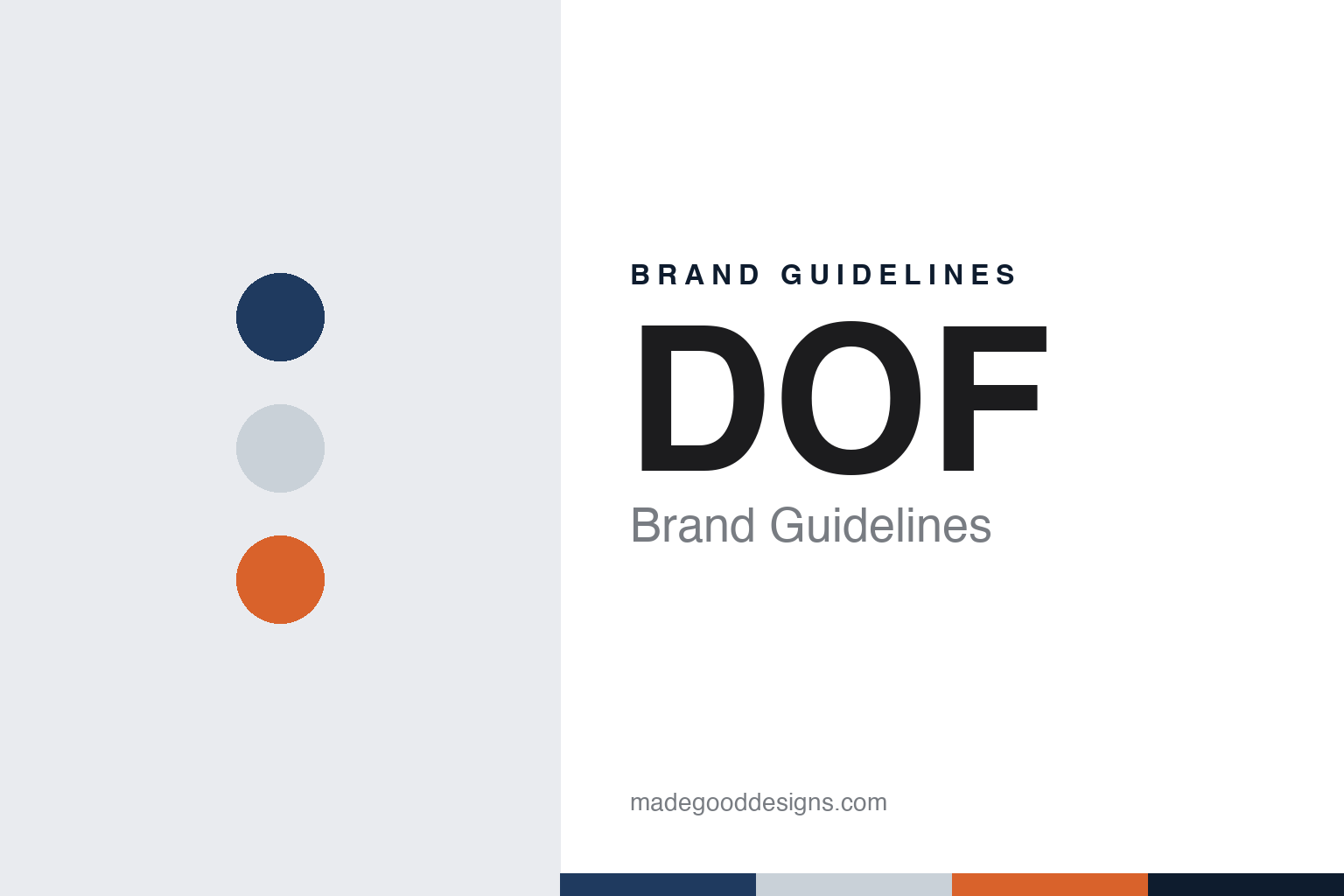
DOF Brand Guidelines
The Austevoll offshore group that kept its name through a reset.
Aa
Two constants: a navy, sea grey and signal orange palette and an industrial sans register. Abstract homage — not a DOF vessel or mark; no ship, logo or livery is reproduced.
Austevoll
An island start in the North Sea boom.
DOF began at Austevoll in western Norway in 1981. The company’s own history says it was founded to take part in the growing North Sea offshore industry, on a long-term strategy of building a modern fleet of offshore vessels and placing those ships on long-term contracts. Store norske leksikon, the Norwegian national encyclopaedia, gives the same year and puts the head office at Storebø in Austevoll, with offices in places including Australia, Brazil, Scotland and the United States. It names the Møgster family, through its company Laco, as the main owner of the group before its 2023 reset.
The move into subsea work has a clear date. Norwegian Wikipedia says the subsidiary DOF Subsea was created in 2005, when DOF ASA bought Geo Group ASA and its subsidiary Geoconsult AS, and that the ships are run through the subsidiaries DOF Management and Norskan. That combination of ship owning and engineering is what the company now presents as its core: an integrated offshore company that offers project management, engineering, survey, remote intervention, diving and vessel operations from a single group, as English Wikipedia summarises it.
English Wikipedia also gives a snapshot of the fleet as of 31 March 2023: more than 50 vessels, made up of 11 platform supply vessels, 15 anchor handling tug supply vessels and 29 construction support vessels. It lists main offices in Norway and operation centres and business units in the UK, the USA, Singapore, Brazil, Argentina, Canada, Angola and Australia.
Colour
A bankruptcy, a new parent and a Danish fleet.
The group went through a hard reset in 2023. Norwegian Wikipedia says the Hordaland district court opened bankruptcy proceedings in the old parent company, DOF ASA, on 2 February 2023. On 25 May 2023 a new parent company, DOF Group ASA, was established, and English Wikipedia says the group continued to operate as an integrated offshore services supplier with global operations. Store norske leksikon records the same sequence in brief: bankruptcy in February 2023 and a new start in May. Norwegian Wikipedia lists the new company’s shares on the Oslo exchange under the ticker DOFG.
The next step was an acquisition rather than a merger of equals. On 2 July 2024, gCaptain reported, DOF Group ASA agreed to buy Maersk Supply Service A/S, paying partly in cash and partly in new shares, so that the seller would end up holding 25 percent of DOF, and the combined company would operate under the DOF Group name. The seller sat inside A.P. Moller Holding, which had taken over Maersk Supply Service from A.P. Moller – Maersk in 2023. Some parts were left out of the deal, including the offshore wind installation business and Maersk Supply Service’s operations in Brazil.
Offshore Energy reported on 1 November 2024 that the purchase was complete. Maersk Supply Service A/S was renamed DOF Denmark, and the Maersk holding company became the owner of 25 percent of DOF’s share capital and votes. The enlarged group then counted a workforce of more than 5,000 people and a fleet of 78 vessels, 65 of them owned, and DOF said its core businesses remained unchanged.
Typography
Ships, names and specification sheets.
Offshore support vessel operators present themselves first through their ships. A fleet is usually painted in one house scheme, with a strong hull colour such as red, blue or orange, a mark on the funnel and a shared naming prefix, so that a client, a port or another crew can tell whose vessel is working a field. In Norway the prefix habit is easy to see: DOF’s ships sail as Skandi vessels and Solstad’s as Normand vessels.
On the web, the core of most operator sites is the fleet list. Vessels are sorted by type — platform supply vessels that carry cargo, fuel and water out to installations, anchor handling tug supply vessels that tow rigs and set moorings, and construction support vessels with cranes, large decks and remotely operated vehicles — and each ship usually has its own specification sheet listing deck area, crane capacity, berths and equipment, often as a downloadable file.
Beside the fleet sit pages on services. Many operators now describe work for offshore wind as well as for oil and gas, and many offer subsea services such as inspection, repair and maintenance, survey and ROV work, sometimes through a sister company or a subsidiary with its own name. Contract announcements, usually naming the vessel, the client region and the length of the charter, keep those pages moving.
Because many of these companies are listed, the annual report and the quarterly results presentation are part of the identity too, and in a sector shaped by mergers, restructurings and fleet sales, the company story page often carries the history. For a designer, the useful material is consistent: hull colours, funnel marks, vessel names, clear fleet tables and sober corporate typography.
Aa
An industrial sans for a fleet-and-engineering group. (Specimen set in Archivo, a sans STAND-IN; NOT the DOF logo.)
DOF
Skandi names and a document library.
Today DOF presents itself as a global subsea and offshore company. Its website groups the work into subsea services, renewables, which it describes as floating wind services, and marine management, a line it dates back to 1981. Store norske leksikon, updated in May 2026, describes a fleet of 65 ships for construction, anchor handling, pipelaying and platform work, plus remotely operated vehicles (ROVs) and uncrewed underwater vehicles (AUVs), working in the Atlantic, South America, North America and the Asia-Pacific region, with around 5,400 employees serving oil and gas and offshore wind.
The most visible naming habit is the fleet itself. The fleet page on dof.com lists vessels under the Skandi prefix — among them Skandi Africa, which the company describes as built for subsea construction and ROV services to 4,000 metres, and Skandi Gamma, which it describes as an LNG-powered platform supply vessel — and sorts them by type: subsea, AHTS, PSV, ROV and AUV. Its document library carries a category called “DOF identity” beside annual reports, policies and governance papers, and the company says it has reported on sustainability to the GRI standards since 2014.
The words around the fleet are plain. DOF states its vision as being “a trusted and leading partner delivering services globally for a sustainable utilisation of offshore energy and other subsea resources,” and lists its values as respect, integrity, teamwork and excellence. Store norske leksikon notes one line of continuity through the changes: Mons S. Aase has been chief executive since 2005, across the old DOF ASA and the new DOF Group ASA.
For a design guide, DOF shows how an offshore group can keep one short name through a bankruptcy, a new parent company and the absorption of a Danish fleet. Compare Solstad, another Norwegian owner that reorganised in the same years, and Subsea7, a subsea contractor with North Sea roots. For this guide we use a deep navy, a sea grey and a signal orange with a sans, an unofficial interpretation; no product or logo is reproduced.
Explore & save
Keep DOF’s identity on hand — save it to a board in the Made Good inspiration library.
DOF identity set
Pin the navy, sea grey and signal orange palette and the industrial sans register to your own board.