EBANX Brand Guidelines
The Curitiba company that sells local ways to pay to global brands.
Aa
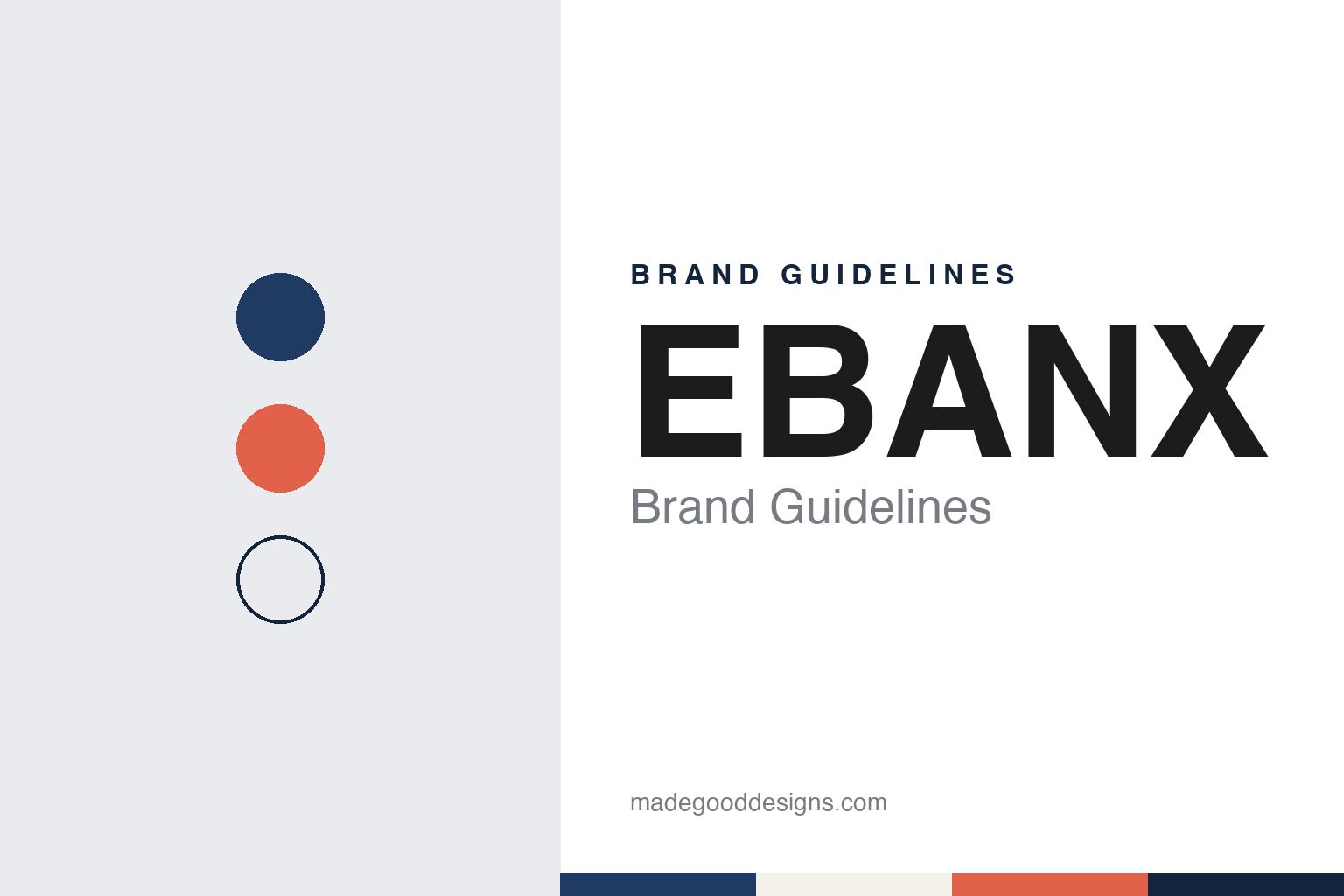
Two constants: an ink blue, coral and warm white palette of our own and a geometric sans register. Abstract homage — not an EBANX product or mark; no logo, interface or card is reproduced.
Curitiba, 2012
Three founders and a one-way idea.
EBANX is a payments company from Curitiba, the capital of the southern Brazilian state of Paraná. It was founded in 2012: the company’s own history gives that year, and so did TechCrunch in October 2019, which wrote that since its launch the business had “primarily focused on helping international merchants sell locally in Brazil.” The Korea Times repeated the founding year in November 2024. Portuguese Wikipedia describes EBANX as a Brazilian fintech that is, in legal terms, a payment institution.
The company names three founders: Alphonse Voigt, Wagner Ruiz and João Del Valle. Its about page tells the story under the line “3 dreamers. One big Dream.”, says Voigt brought the other two together to discuss the idea, and quotes him as co-founder and executive chairman. Portuguese Wikipedia adds that in May 2021 Del Valle, until then chief operating officer, became chief executive, a post Voigt had held for nine years, while Voigt moved to lead the board; Ruiz, the long-serving finance chief, took on regulatory affairs, risk and partnerships. TechCrunch was calling Del Valle co-founder and CEO in May 2023.
The original idea ran in one direction: letting people in Latin America pay foreign websites with the methods they already used at home. The company says it has given “millions of Latin American consumers access to international products and services.” Del Valle told TechCrunch in 2023 that EBANX began in 2012 by giving global merchants a way to sell goods and digital services to Latin Americans “through local payment methods.” EBANX also says it “started as the smallest company of the Endeavor program,” the entrepreneur network, and that investment from FTV Capital followed.
Colour
One connection, many ways to pay.
EBANX sells to companies rather than to shoppers. Its offer is a single connection to many local ways of paying: cards issued in each country alongside methods such as Brazil’s Pix and boleto, Mexico’s OXXO cash vouchers, India’s UPI and African mobile money, all of which appear in its own website menus. The count has grown with the map. An EBANX executive told TechCrunch in 2023 that one API integrated “more than 100 payment methods,” and in November 2024 The Korea Times reported that the platform integrated more than 200.
Brazil came first, and domestic processing came later. TechCrunch reported in October 2019 that EBANX had moved into local payment processing in Brazil in April that year, had closed a new financing round from earlier investors FTV and Endeavor Catalyst, and had become a payment partner for Uber in Latin America, alongside deals with Coursera, Scribd, Trip.com and Shopify. Portuguese Wikipedia names the April 2019 service EBANX Pagamentos, and both sources mention a Visa initiative to increase electronic payments in Paraná.
The markets then widened. According to TechCrunch, in September 2022 EBANX announced Africa as its first expansion outside Latin America, adding South Africa, Nigeria and Kenya and taking its footprint from 15 countries to 18. The same report listed Meta, Coinbase, TikTok and Garena among the brands whose payments it processed in Latin America.
Gaming has stayed close to the centre. The Korea Times reported in November 2024 that EBANX was taking part in G-Star, the games show in Busan, and already worked with a Korean game publisher; the firm told the paper that more than 150 million customers had paid through EBANX and that more than 2,500 brands had used it.
There has also been a consumer side. Portuguese Wikipedia says EBANX began testing EBANX Go, a digital account with a prepaid card aimed at individuals, in January 2020.
Typography
Design and documentation.
Payment processors and wallets present themselves in more than one place at once. A merchant meets them at the counter and in the checkout, a developer meets them in documentation, and an investor meets them on corporate pages about owners and listings. Each of those surfaces carries the brand in a different register.
At the counter, the brand is often a device. Global Payments, for example, described a modular countertop terminal for its Genius platform in November 2025, with a 15.6-inch merchant display, hidden cable management and stand, kiosk and wall-mount configurations, according to its release. Online, the brand shows up as a list of methods: PayU’s European corporate site sorts its offer into cards and digital wallets, online bank transfers, deferred payments and local schemes such as BLIK.
For developers, processors publish their own entry points. PayU’s Indian site links documentation and an API Playground, and its European site links a Developer Portal and a public status page. The Indian site also lists a mobile app SDK, a software kit for adding payments to apps, among its payment products.
Corporate pages tell the ownership story. PayU’s Indian site describes the business as part of Prosus, listed in Amsterdam and Johannesburg and majority owned by Naspers, while Global Payments’ investor site gives its New York Stock Exchange ticker, GPN, and its releases record deals such as the Worldpay purchase completed in January 2026. This guide sets out what can be checked about each company: who founded it, who owns it, and what its own pages say about its products and markets.
Aa
A geometric sans for a capitalised name. (Specimen set in Space Grotesk, a sans STAND-IN; NOT the EBANX logo or its typeface.)
EBANX today
A Curitiba headquarters and a map that keeps growing.
Today EBANX describes its technology as connecting large global companies with “millions of consumers every day in more than 20 countries in Latin America, Africa, and Asia,” and says it has more than 700 staff, whom it calls “ebankers.” Its headquarters remain in Curitiba. Its website lists an Asia-Pacific headquarters in Singapore and offices in São Paulo, Mexico City, Montevideo, Johannesburg, Cairo and Shanghai, several of them in shared workspaces. A note at the foot of every page explains that the EBANX brand and the ebanx.com domain stand for a group of products and companies in Brazil and other countries, some available only in certain industries or countries.
The name does most of the visual work. The company sets EBANX in capitals throughout its own copy, while its staff become lowercase “ebankers,” and it organises its website around a short working vocabulary — pay-in and payout, recurrence, high order value, rising markets — rather than around a single product. Its menus are arranged by payment method, by market and by industry, from e-commerce and streaming to gaming and online travel, and its developer documentation sits beside a content series it calls Beyond Borders.
That arrangement follows the company’s own account of what it sells: local knowledge of regulation, currency and consumer habits, packaged for merchants abroad. “Our local knowledge supports our partners in overcoming local challenges,” its about page says, and the same page pairs “Local in essence” with “Global in presence.” An EBANX executive told TechCrunch in 2023 that in Africa it was aiming at global brands, many of them already working with it in Latin America, rather than at local businesses.
For a design guide, EBANX shows how a business-to-business payments brand can be built from a capitalised name, a list of local payment methods and a growing map of markets. Compare dLocal, another Latin American cross-border payments company, and PagBank, from the same country. For this guide we use an ink blue, a signal coral and a warm white with a geometric sans, an unofficial interpretation; no product or logo is reproduced.
Explore & save
Keep EBANX’s identity on hand — save it to a board in the Made Good inspiration library.
EBANX identity set
Pin the EBANX ink blue, coral and warm white palette and the geometric sans register to your own board.