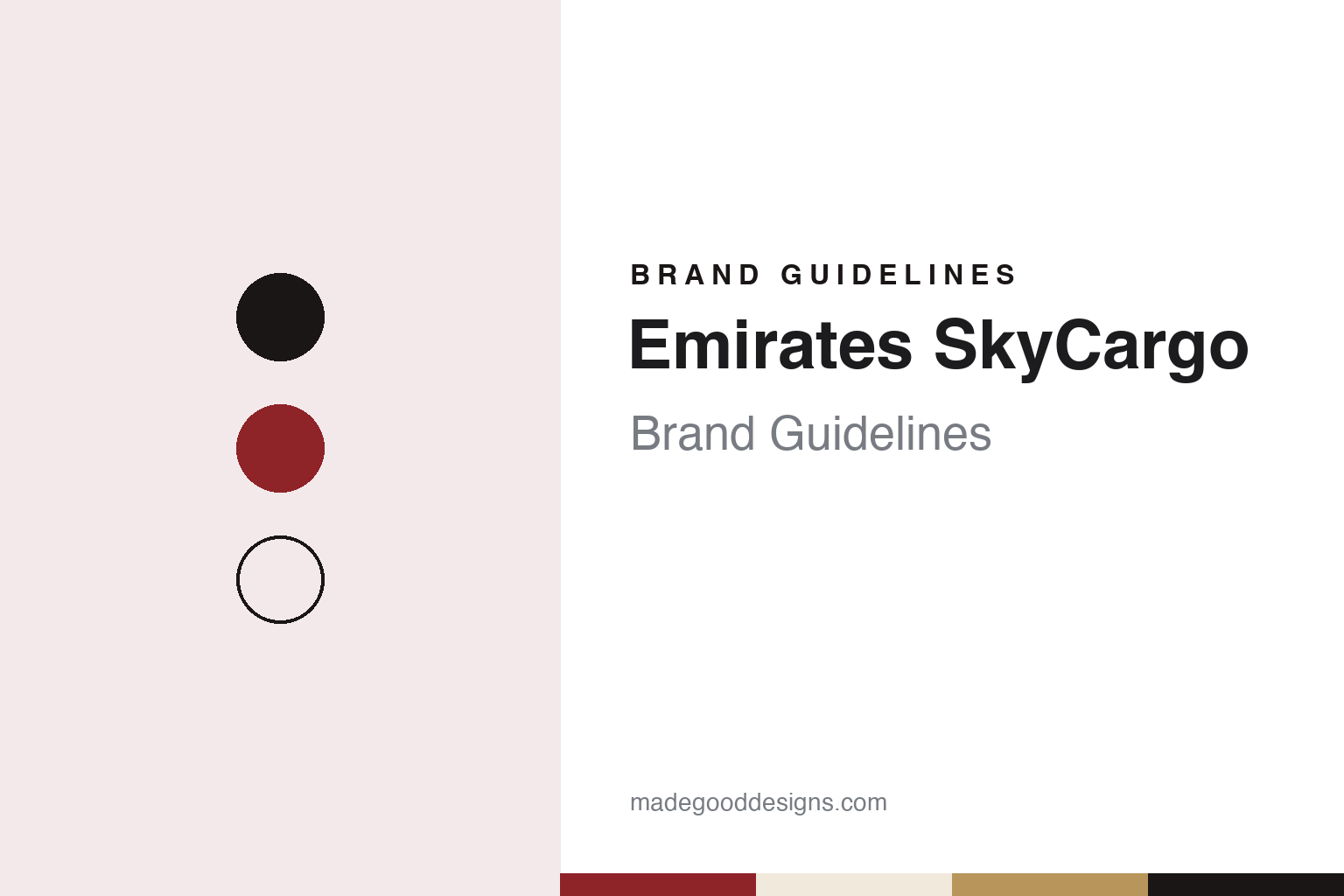
Emirates SkyCargo Brand Guidelines
Dubai’s freight division, flying the airline’s gold titles since 1985.
Aa
Two constants: a deep crimson, sand and muted gold palette and a warm display serif register. Abstract homage — not an Emirates SkyCargo product or mark; no aircraft, livery or logo is reproduced.
October 1985
A freight division born with the airline.
Emirates SkyCargo is the air-freight division of Emirates, the Dubai airline, and English Wikipedia says it began in October 1985, at the same time as the airline itself, run as a separate entity from its parent. In its first year it handled more than 10,000 tonnes of freight, Wikipedia says, and it received its first industry award in 1989; it leased its freighters from Emirates and took over management of the cargo holds on Emirates’ passenger aircraft. It sits within The Emirates Group, which is wholly owned by the Government of Dubai through the Investment Corporation of Dubai.
Growth came in steps. In October 1993, Wikipedia says, SkyCargo signed an agreement with EC International to handle shipments from the United States to 24 countries on the Emirates network. It records a Boeing 747-400F joining in May 2003, freighter services to Johannesburg and Lahore from September 2004, a 2005 agreement with Korean Air Cargo to share capacity on two routes from Delhi and Mumbai, and Airbus A310-300 freighters in the mid-2000s. In 2008 the division moved into its Cargo Mega Terminal at Dubai International Airport, a building Wikipedia says added 1.2 million tonnes a year of handling capacity, and on 27 March 2009 it took its first Boeing 777F. Orders for Boeing 747-8 freighters were later cancelled or converted, and by the end of 2012 the fleet plan centred on the 777F alone.
Other dates in Wikipedia’s account: work on a SkyCargo terminal at Dubai World Central–Al Maktoum International began in July 2013, the same year Air Cargo News named it Cargo Airline of the Year; in May 2015 the division stopped carrying lion, tiger, rhino and elephant hunting trophies, even legally obtained ones; and in 2020 Emirates removed economy seats from Boeing 777-300ER passenger aircraft and flew A380s as temporary “mini freighters” to add cargo capacity. Further 777F orders followed in November 2021, the first placed directly with Boeing, in November 2022 and in July 2024.
Colour
Gold titles, a flag on the tail, red underneath.
SkyCargo’s freighters wear the parent airline’s livery rather than a separate cargo scheme. Emirates 24|7 reported on 26 February 2025 that the 777F registered A6-EFV, delivered unpainted in July 2024, had become the first freighter to receive Emirates’ refreshed livery, applied over eight days by the in-house paint shop of Emirates Engineering. The livery was first unveiled in March 2023 and is, the report said, the third version of the airline’s aircraft colours since 1985.
The report listed what changed and what stayed. The UAE flag on the tailfin, part of Emirates branding from the start, became more dynamic and flowing, with three-dimensional artwork. The gold titles along the fuselage, in English and Arabic, grew bigger and bolder. The Arabic calligraphy on the engines and the red branding on the aircraft belly stayed. All ten 777 freighters were due to be repainted, and the 13 then on order would arrive in the new colours.
The product names are plain words, and English Wikipedia gives the division’s slogan as “Delivering the highest standards of product quality.” On its site, skycargo.com, the division sorts its services into families such as Pharma, with Pharma Plus and Pharma Active tiers for temperature-sensitive medicines; Fresh, with Fresh Breathe and Fresh Active for perishables; Live, covering horses, pets, aquatic life and day-old chicks; and Secure for valuable and vulnerable shipments. Two of its Dubai facilities carry the Sky prefix, Emirates SkyCentral and Emirates SkyPharma, and a service for server racks and semiconductors is called Emirates AI Tech.
Typography
How cargo airlines present themselves.
Cargo airlines address a particular audience: freight forwarders, shippers and airport partners. Much of their identity travels on the aircraft itself. A freighter carries the livery of its parent airline or of its own cargo brand, and the fleet photographs that airlines publish on their websites and in press releases are among the most visible images of the business. In this group, the guides describe those liveries only as dated sources describe them.
Maps and schedules do a large share of the work. Cargo airlines publish network maps, hub information and seasonal timetables, because customers plan around routings and capacity as much as destinations. Nippon Cargo Airlines, for example, posts its summer and winter timetables and its road feeder schedules on its website, while Qatar Airways Cargo announces new freighter routings with their stops and weekly capacity in tonnes.
Product names carry much of the rest. Special cargo is sold under short names that the airlines set out on their own pages and in press releases, covering services for pharmaceuticals, perishables, live animals, couriers and high-value goods, each described in the terms the airline chooses. Qatar Airways Cargo, for instance, names products such as Pharma, Fresh and TechLift. The guides quote these names as the airlines give them and do not compare one service with another.
The working end of a cargo brand is digital. Shipment tracking by air waybill number, online booking portals, fuel surcharge notices and schedule downloads are where customers meet the identity day to day. The guides in this group set out what dated sources say about each airline’s history, ownership, fleet and network, and treat the palettes and typefaces shown here as unofficial interpretations rather than official brand assets.
Aa
A warm display serif for freight titles. (Specimen set in Fraunces, a serif STAND-IN; NOT the Emirates SkyCargo logo.)
Emirates SkyCargo
Courier Express and an all-777F fleet.
Emirates has stretched the cargo business into door-to-door delivery. Emirates 24|7 reported on 2 April 2025 that the airline had launched Emirates Courier Express, after a year-long pilot moving several thousand packages from markets including the UAE, Saudi Arabia, South Africa and the UK. The service sends packages from origin to destination on Emirates flights rather than through a hub-and-spoke model, uses partners for customs and the first and last mile, and opened in seven markets, with average delivery times given as under 48 hours. Service levels ran from next-day urgent delivery to a two-day Premium option, and the report said expansion to more markets was already planned.
Network numbers depend on the date. Wikipedia gives, as of January 2025, dedicated freighter flights to 26 destinations plus cargo space on a further 61 passenger routes; the airline’s cargo planning chief spoke of 38 freighter destinations in February 2025. Wikipedia also lists it, as of 2020, as the fourth-largest cargo airline by freight tonne-kilometres, and says the fleet is all Boeing 777F. On 10 November 2026, Metro Airport News carried the division’s announcement of a weekly 777F service from Milan Malpensa to New York JFK from 5 December 2026, offering about 100 tonnes per flight, alongside a weekly Milan to Dubai World Central freighter.
For a design guide, Emirates SkyCargo shows a freight business that keeps its parent’s whole visual system, gold titles, tail flag and belly red, and builds its own voice through product names. Compare the passenger airline at Emirates and its Gulf cargo neighbour Qatar Airways Cargo. For this guide we use a deep crimson, ink, sand and a muted gold with a serif, an unofficial interpretation; no product or logo is reproduced.
Explore & save
Keep Emirates SkyCargo’s identity on hand — save it to a board in the Made Good inspiration library.
Emirates SkyCargo identity set
Pin the Emirates SkyCargo deep crimson, sand and muted gold palette and the warm display serif register to your own board.