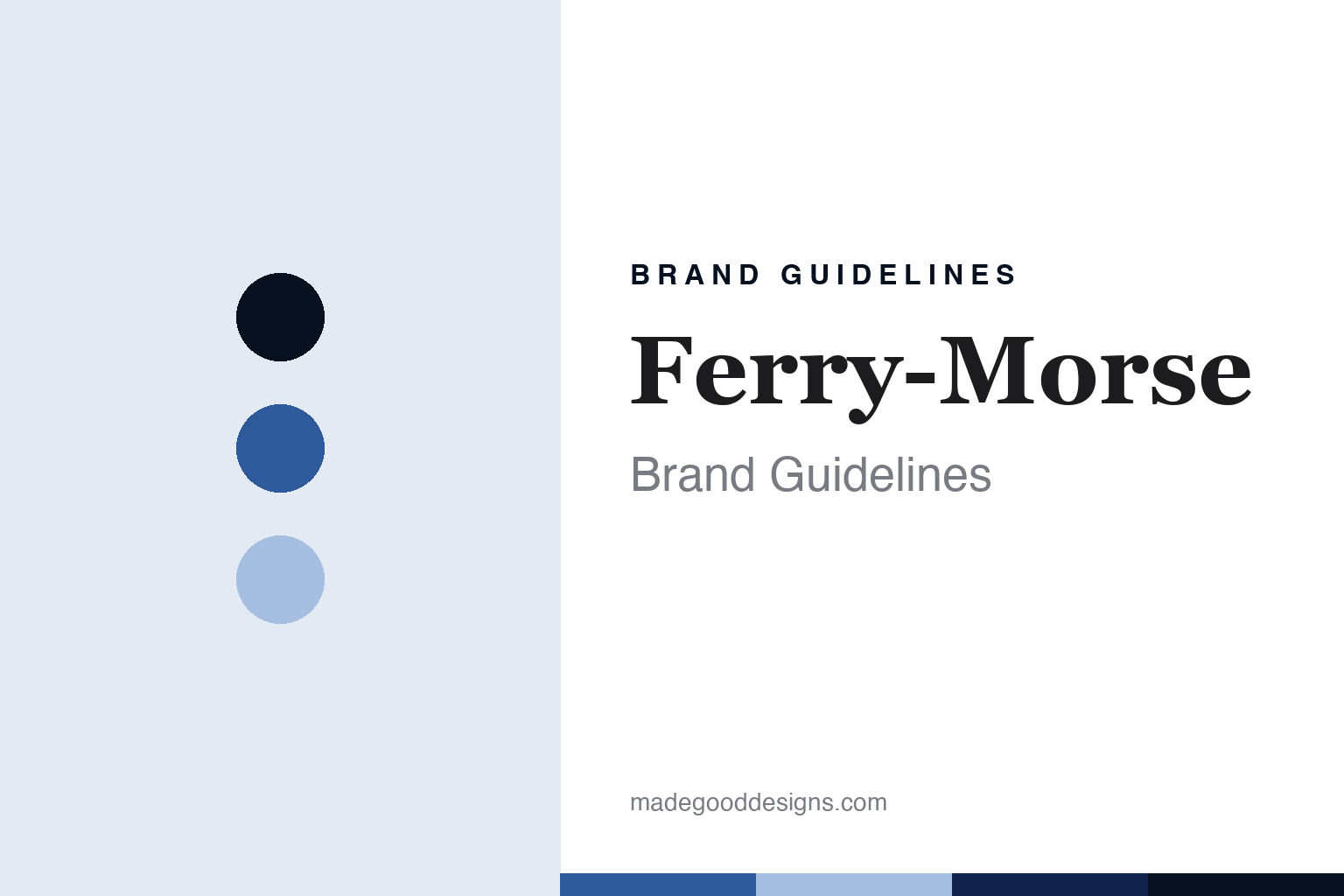
Ferry-Morse Brand Guidelines
The legacy seed house under a garden group.
Aa
Two constants: a legacy-blue palette and a legacy-serif register. Abstract homage — not a Ferry-Morse product or mark; no seed-packet artwork or logo is reproduced.
The legacy seed house under a garden group
Ferry-Morse is the 1856-rooted American seed house, owned by Central Garden & Pet via Green Garden Products and based in Norton, Massachusetts.
Ferry-Morse closes the ownership round as its longest-running legacy — the American seed house whose seed has been sold, in its own words, since before Abraham Lincoln was President, tracing to 1856, and which today sits inside a larger garden group. Ferry-Morse keeps and sells the seed, and its answer to a round about who owns a seed house is a two-level corporate chain: it is a brand of Green Garden Products, which is itself part of Central Garden & Pet. A brand, absorbed.
Its identity is the legacy seed house under a garden group. The 1856 legacy, the two-level ownership and the non-GMO catalogue are the story here. A brand, absorbed. The legacy seed house under a garden group.
(Honest notes, so the ownership chain stays exact, and a year stays open. Ferry-Morse sells flower and vegetable seed and garden supplies as its heroes, markets organic and heirloom lines, and states that all of its seed is non-GMO — and we report its performance language as the brand’s own. On who owns it, the star theme of this round, the chain has two levels and both are documented: Ferry-Morse is a brand of Green Garden Products, and Green Garden Products is part of the Central Garden & Pet family; it is based in Norton, Massachusetts. The sibling Green Garden brands include Jiffy, Livingston, Seeds of Change, American Seed, McKenzie and SUPERthrive. On its founding and the acquisition year, a point of honesty: it traces to 1856 (its own copy notes the Lincoln-era claim), but the year Central acquired Green Garden — widely reported as 2018 — and the founders behind the historical Ferry and Morse firms were not confirmable from the pages we read, so we hold those open. Its designs are IP we describe but do not reproduce; there is no official brand hex; these tones are an unofficial interpretation.)
Colour
Ferry-Morse lives in a legacy blue. Click a swatch to copy the hex.
Ferry-Morse’s identity is absorbed, legacy and American — a legacy blue, an ink, a pale sky, a deep navy, and a paper. The palette leans legacy blue and pale sky: a long-standing register that nods to an old American seed-rack blue rather than a loud logo colour. It signals a legacy seed house under a garden group. The honest caveat: with no published brand hex, these values are an original, unofficial interpretation, not first-party colours.
The lesson is a legacy blue signals an absorbed, legacy identity. Ferry-Morse’s world is a long-running American seed rack now inside a group. For designers, it is a reminder that a legacy blue and a soft pale sky can carry a garden brand — the tone of the old seed rack. Because these tones can fail as small text, keep type dark and let the colour live in the accents, palette and band. The takeaways: state the two-level ownership chain accurately; date the legacy to 1856; hold the acquisition year open; and treat any single hex as unofficial.
Typography
The register is a legacy serif — absorbed, editorial, long-standing.
Ferry-Morse’s identity carries an absorbed, editorial, long-standing spirit — a legacy seed house, not a graphics label. A legacy serif captures the mood: refined, seasoned and confident, the register of a house that has outlasted many owners. Set in a legacy-blue palette, the legacy serif feels absorbed and long-standing — exactly the personality Ferry-Morse carries. It is a kept seed rather than a logo, mirroring seed-packet paper. (Ferry-Morse’s real catalogue and designs are things we describe but do not reproduce, and the exact typeface is not ours to use.) Because it is not ours to use, the honest description is “a legacy-serif house,” shown here in a stand-in. The type behaves like the brand: absorbed, editorial and long-standing.
Aa
A legacy-serif house — absorbed and long-standing. (Specimen set in EB Garamond, a legacy-serif STAND-IN; NOT the Ferry-Morse logo or any packet art.)
The ownership
Ferry-Morse stands for the legacy seed house under a garden group.
Ferry-Morse closes the ownership round as its longest-running legacy. A legacy-blue palette, a legacy serif and an 1856 root make one thing — the legacy seed house under a garden group — the whole identity: absorbed, legacy and American. The two-level ownership is the pitch, and the century-and-a-half legacy is the proof. The point is a very old seed house now held inside a larger group, closing a round about who owns the seed.
Put to work, the identity is the legacy house told straight, with the chain described at both levels — Green Garden Products and Central Garden & Pet named in order, and the acquisition year held open. A steward in this spirit would state the two-level chain accurately, date the legacy to 1856, and hold the acquisition year open. A reader in this spirit would keep the facts right: Ferry-Morse sells flower and vegetable seed and garden supplies as its heroes, markets organic and heirloom lines, and states its seed is all non-GMO; it is a brand of Green Garden Products, which is part of Central Garden & Pet; it is based in Norton, Massachusetts; the sibling Green Garden brands include Jiffy, Livingston, Seeds of Change, American Seed, McKenzie and SUPERthrive; and while it traces to 1856, the Central acquisition year (widely reported as 2018) and the historical founders are held open as unverified. Ferry-Morse closes the round beside Burpee and Botanical Interests at the corporately-owned end. The honest editorial moves are to date the legacy to 1856, to state both levels of the chain in order, to name the sibling brands, and to hold the acquisition year open.
For designers and brand-builders, Ferry-Morse closes the ownership: describe the whole chain — both levels, in order — and hold open the year you cannot confirm. The lessons: let a long legacy carry a seed brand; describe a two-level corporate chain accurately rather than collapsing it; name the immediate parent and the group above it; hold an unverified acquisition year open; and never reproduce a mark. It is also a reminder to stay precise: Ferry-Morse is the 1856-rooted American seed house, owned by Central Garden & Pet via Green Garden Products and based in Norton, Massachusetts — with the palette here an unofficial interpretation. Read that way, Ferry-Morse is less a packet than an absorbed legacy: long-standing, American, group-held. The lesson for a brand is that a long legacy and an accurately-described chain reinforce each other, and stating both levels keeps the story earned. Ferry-Morse made the-legacy-seed-house-under-a-garden-group the identity — proof that who-owns-it closes the round.
Explore & save
Keep Ferry-Morse’s identity on hand — save it to a board in the Made Good inspiration library.
Ferry-Morse identity set
Pin the legacy-blue palette and the legacy-serif register to your own board.