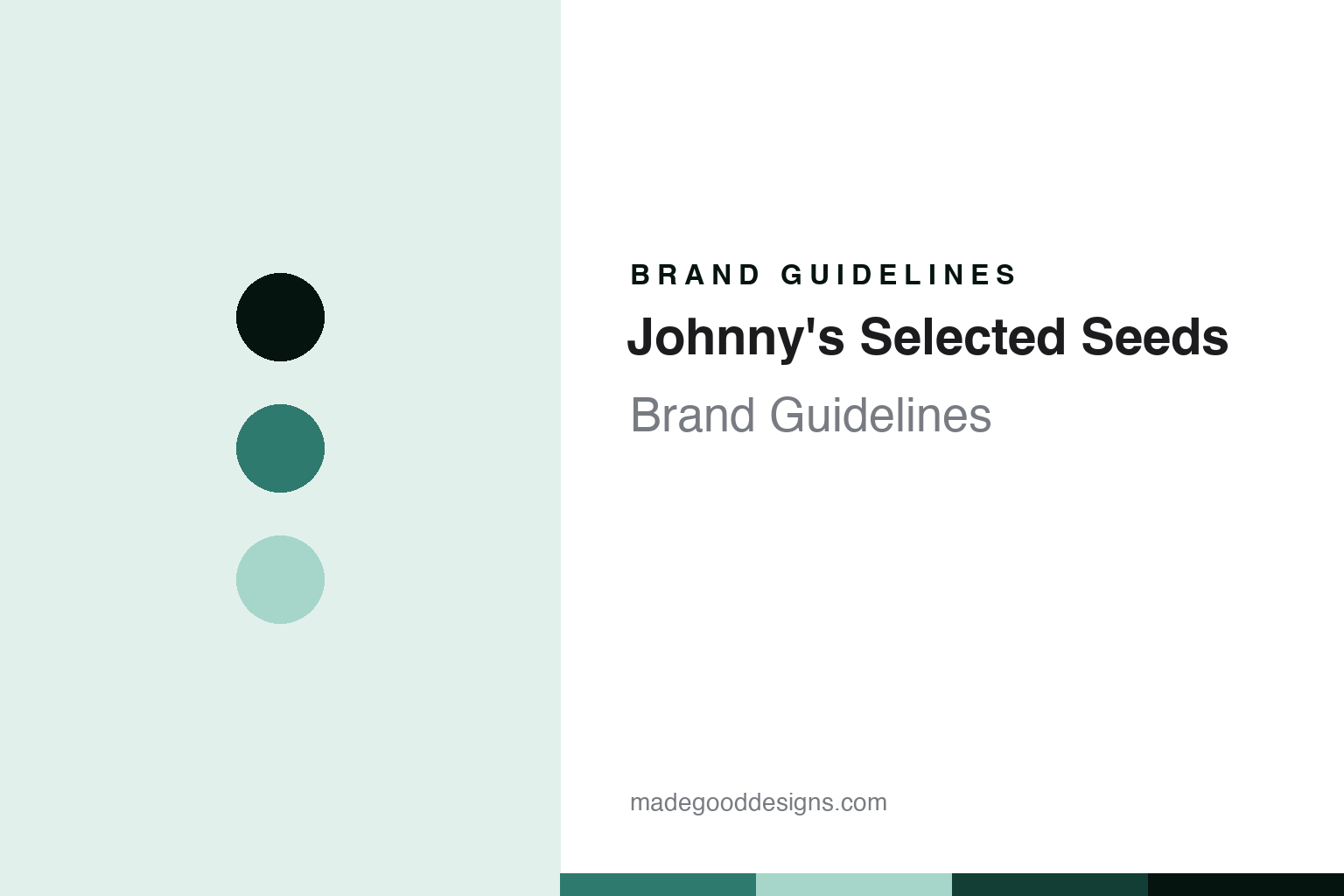
Johnny’s Selected Seeds Brand Guidelines
The employee-owned seed house.
Aa
Two constants: a Maine-teal palette and a grower-owned-sans register. Abstract homage — not a Johnny’s product or mark; no seed-packet artwork or logo is reproduced.
The employee-owned seed house
Johnny’s Selected Seeds is the Maine seed company that has been one hundred per cent employee-owned since 2012, serving growers and gardeners.
Johnny’s Selected Seeds opens this second seed-house round — the ownership round — with the cleanest answer to its question: it is one hundred per cent employee-owned. The Maine seed company that sells vegetable, herb and flower seed, along with tools and farm supplies, became fully owned by the people who work there in 2012, and that ownership is the identity. Johnny’s keeps and sells the seed, and its answer to a round about who owns a seed house is the staff themselves. A brand, owned.
Its identity is the employee-owned seed house. The employee ownership, the grower-and-gardener focus and the Maine base are the story here. A brand, owned. The employee-owned seed house.
(Honest notes, so the ownership stays exact, and a date stays hedged. Johnny’s Selected Seeds sells seed and growing supplies as its heroes — vegetable, herb and flower varieties, tools and farm goods — and we report its performance language as the brand’s own. On who owns it, the star theme of this round, it states plainly that it is one hundred per cent employee-owned, having become so in 2012; the widely-documented vehicle for that is an employee stock-ownership plan, which we name as the ownership structure. It was founded by Rob Johnston, Jr.; on the founding year, a point of honesty, its own materials cite both 1972 and 1973, so we date it to the early 1970s rather than pick one. It is based in Winslow, Maine, and signs the Non-GMO Safe Seed Pledge. Its designs are IP we describe but do not reproduce; there is no official brand hex; these tones are an unofficial interpretation.)
Colour
Johnny’s lives in a Maine teal. Click a swatch to copy the hex.
Johnny’s identity is owned, grower-focused and Maine-rooted — a Maine teal, an ink, a pale spruce, a deep spruce, and a paper. The palette leans Maine teal and pale spruce: a northern register that nods to a Maine spruce field rather than a loud logo colour. It signals an employee-owned seed house. The honest caveat: with no published brand hex, these values are an original, unofficial interpretation, not first-party colours.
The lesson is a Maine teal signals an owned, grower-focused identity. Johnny’s world is a working seed catalogue for growers and gardeners. For designers, it is a reminder that a Maine teal and a soft pale spruce can carry a garden brand — the tone of a northern trial field. Because these tones can fail as small text, keep type dark and let the colour live in the accents, palette and band. The takeaways: keep the ownership with the employees; serve growers and gardeners; hedge the founding year; and treat any single hex as unofficial.
Typography
The register is a grower-owned sans — owned, plain, practical.
Johnny’s identity carries an owned, plain, practical spirit — a working seed house, not a graphics label. A grower-owned sans captures the mood: clean, steady and confident, the register of a catalogue built for growers. Set in a Maine-teal palette, the grower-owned sans feels owned and practical — exactly the personality Johnny’s carries. It is a kept seed rather than a logo, mirroring seed-packet paper. (Johnny’s real catalogue and designs are things we describe but do not reproduce, and the exact typeface is not ours to use.) Because it is not ours to use, the honest description is “a grower-owned-sans house,” shown here in a stand-in. The type behaves like the brand: owned, plain and practical.
Aa
A grower-owned-sans house — owned and practical. (Specimen set in Work Sans, a grower-owned-sans STAND-IN; NOT the Johnny’s logo or any packet art.)
The ownership
Johnny’s Selected Seeds stands for the employee-owned seed house.
Johnny’s Selected Seeds opens the ownership round with the cleanest answer to who owns a seed house: the employees do. A Maine-teal palette, a grower-owned sans and a 2012 employee buyout make one thing — the employee-owned seed house — the whole identity: owned, grower-focused and Maine-rooted. The employee ownership is the pitch, and the working grower catalogue is the proof. The point is a seed house owned by the people who run it, opening a round about who owns the seed.
Put to work, the identity is the seed house told straight, as ownership — with the employees named as owners and the date kept honest. A maker in this spirit would keep the ownership with the employees, serve growers and gardeners, and hedge the founding year rather than fake it. A reader in this spirit would keep the facts right: Johnny’s Selected Seeds sells seed and growing supplies as its heroes; it states it is one hundred per cent employee-owned, having become so in 2012, through what is widely documented as an employee stock-ownership plan; it was founded by Rob Johnston, Jr., in the early 1970s — its own materials cite both 1972 and 1973, so we do not pick one; it is based in Winslow, Maine; and it signs the Non-GMO Safe Seed Pledge. Johnny’s opens the round at the employee-owned end, before the co-ops and the corporately-owned houses. The honest editorial moves are to name the employees as owners, to date the buyout to 2012, to hedge the founding year, and to keep the Maine base right.
For designers and brand-builders, Johnny’s opens the ownership: name the employees as owners — and hedge the date you cannot pin. The lessons: let a clean ownership fact carry a seed brand; state employee ownership precisely; name a stock-ownership plan as the vehicle only where it is documented; refuse to pick between two conflicting founding years; and never reproduce a mark. It is also a reminder to stay precise: Johnny’s Selected Seeds is the Maine seed company that has been one hundred per cent employee-owned since 2012, serving growers and gardeners — with the palette here an unofficial interpretation. Read that way, Johnny’s is less a packet than an owned catalogue: employee-owned, practical, northern. The lesson for a brand is that clear ownership and honest dating reinforce each other, and keeping the ownership with the employees keeps the story earned. Johnny’s made the-employee-owned-seed-house the identity — proof that who-owns-it can open a round.
Explore & save
Keep Johnny’s Selected Seeds’s identity on hand — save it to a board in the Made Good inspiration library.
Johnny’s Selected Seeds identity set
Pin the Maine-teal palette and the grower-owned-sans register to your own board.