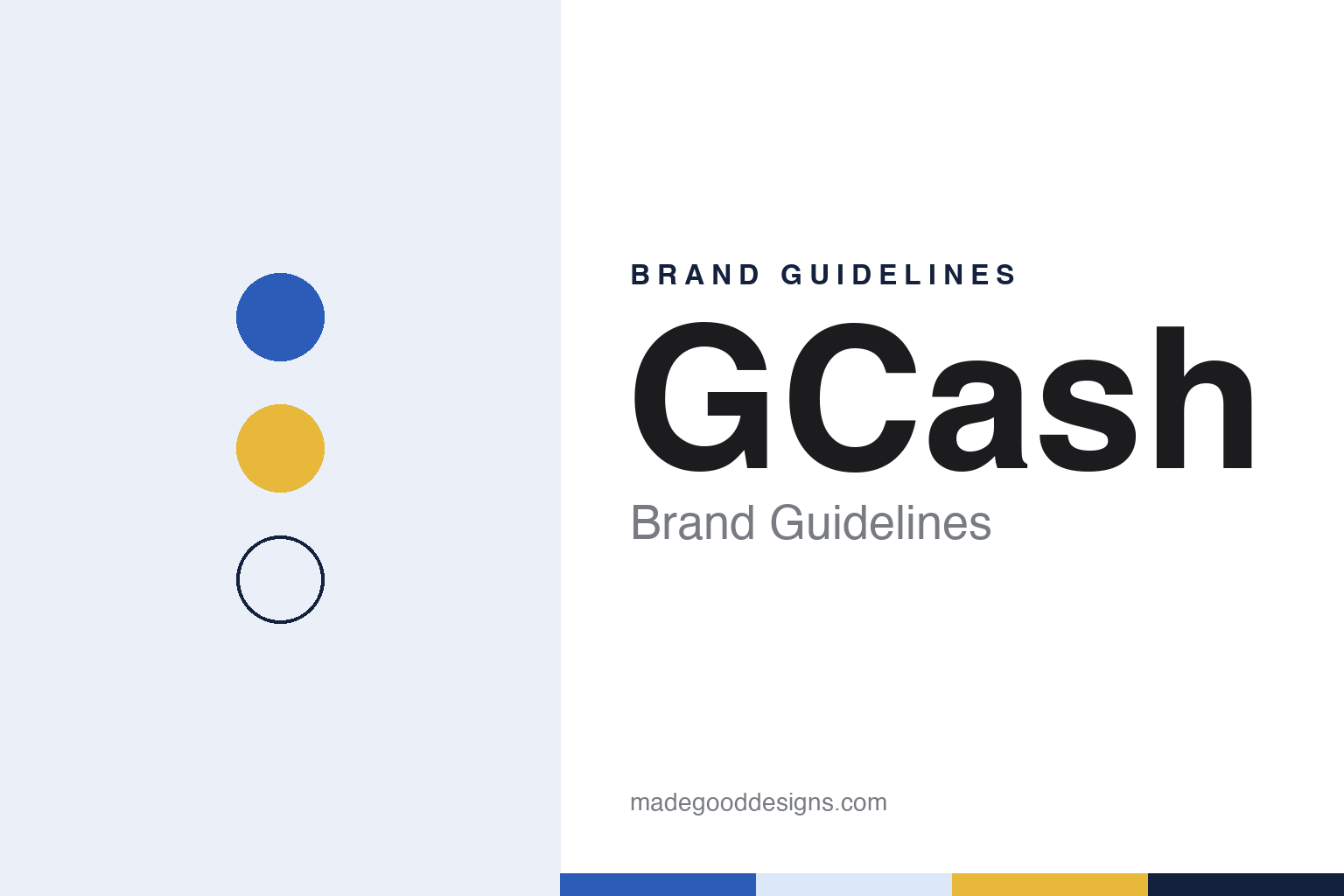
GCash Brand Guidelines
The Philippine text-message wallet that grew into a listed finance app.
Aa
Two constants: a blue, ink and yellow palette and a geometric sans register. Abstract homage — not a GCash product or mark; no app screen, logo or icon is reproduced.
An SMS wallet
Globe Telecom, G-Xchange and a text message.
GCash began in October 2004 as a text-message money service. English Wikipedia describes it as an SMS-based transfer service in which people turned cash into e-money, and back again, at cash-in and cash-out outlets such as sari-sari stores, the small neighbourhood shops found across the Philippines. Mynt, the company that owns it today, says GCash was launched under Globe Telecom through its wholly owned subsidiary G-Xchange, Inc. (GXI), with the aim of widening access to financial services in the country. At the parent company’s stock-market debut in October 2026, its chief executive Martha Sazon described GCash as a business that “started as an SMS-based money transfer service,” Rappler reported.
The move to smartphones came later. Mynt says the GCash app was launched in 2012 and calls it the first e-wallet mobile app in the Philippines; English Wikipedia, citing a 2019 Rappler feature, gives the same year for the shift from physical outlets to a cashless app. Between 2013 and 2020, according to English Wikipedia, the app added QR-code payments, mobile and gaming credit purchases, online checkout, barcode cash-in, bill payments and support for InstaPay interbank transfers.
The corporate structure changed in the same years. Mynt says it was founded in 2015 as a wholly owned subsidiary of Globe Telecom, set up as the holding company for GXI and the lender Fuse. In September 2017 GMA News described GCash as “the micropayment service of Globe Telecom” and said it was operated by Globe Fintech Innovations Inc., which had partnered that February with Ant Financial, the payments group affiliated with Alibaba. Mynt says Ant Financial and Ayala Corporation joined as shareholders in 2017, and it now describes itself as formed through a partnership of Globe Telecom, Ayala Corporation and Ant Group.
Colour
From cash-in counters to QR codes.
GCash’s products grew outward from transfers. In September 2017, GMA News reported, GCash and its rival PayMaya both joined Facebook Messenger, so that users could check balances, send money, pay bills and buy prepaid mobile credit through a chatbot; English Wikipedia says the partnership did not last. Mynt dates the first QR payments in the GCash app to 2017, and English Wikipedia illustrates its in-store codes as QR Ph codes, the national standard that other wallets can also read.
Credit and savings followed. Mynt says it launched lending, savings and investment products in the app in 2018. English Wikipedia names GSave, a savings account piloted with CIMB Bank Philippines, and GCredit, a revolving credit line first powered by Fuse Lending and moved to CIMB in 2021, and says GCash Jr., for users aged 7 to 17, arrived in 2022. The current website groups its menu under five verbs — Send, Pay, Borrow, Grow and Enjoy — and lists services including GLoan, GGives, GInsure and GCash Overseas, alongside a GForest feature that the company says has planted more than three million trees.
The look has been updated once on the record. Mynt says that in 2019 it refreshed the GCash brand, “adopting a modern look to reflect its identity as a fintech,” and to prepare it for expansion as a lifestyle brand. The website’s title now calls GCash a “finance super app,” and its home page leads with promotions: cashback on train rides, game-credit offers and countdown timers.
Scale figures come from the company. The GCash website said in November 2026 that 94 million Filipinos had used the app and that six million merchants and social sellers were on it; English Wikipedia reports an earlier company figure of 81 million active users as of January 2025. The site states that G-Xchange, Inc. is regulated by the Bangko Sentral ng Pilipinas, the central bank, and places the company in Bonifacio Global City, Taguig, in Metro Manila.
Typography
How e-wallets present themselves.
Asian e-wallets and payment apps tend to present themselves first through a small square: the app icon. Bright blues, greens, pinks, purples and oranges are common choices, often with a single letter or a short word set in a rounded sans, because the icon has to be found quickly on a crowded phone screen and read at the size of a fingertip. The same colour usually carries through to buttons, cards and the bar at the top of the home screen.
The QR code is the other recurring image. Many wallets grew up around scanning a printed code at a shop counter, and national standards such as QRIS in Indonesia and QR Ph in the Philippines mean one code can often be read by several apps. Marketing pages show phones held over codes, stickers on stall fronts and receipts on screen, so the payment itself becomes part of the identity.
Names and taglines often lean on the local language and on everyday speech. Product families frequently share a prefix or a letter, so that savings, credit, insurance and investment features read as parts of one app. Promotions bring their own visual layer: cashback badges, countdown timers, vouchers and, for some brands, mascots or illustrated characters that soften a financial product.
Behind the consumer screens sit two other audiences. Websites usually divide into pages on transfers, bills, mobile top-ups, micro-loans and pay-later credit for users, and pages on QR acceptance, payouts and point-of-sale tools for merchants. A third layer of newsroom, regulatory and investor pages has grown as several of these companies have joined stock exchanges, and those pages tend to use a quieter version of the same palette.
Aa
A geometric sans — clear, rounded and readable at icon size. (Specimen set in Manrope, a sans STAND-IN; NOT the GCash logo.)
Mynt
From a telecom unit to a listed company.
Mynt’s shareholder base widened in the 2020s. The company says it raised new funding in 2021 from Bow Wave, Warburg Pincus and Insight Partners, and in 2024 from Ayala Corporation and Mitsubishi UFJ Financial Group (MUFG). It now presents itself as the parent of a group of financial businesses: GXI, which runs the GCash wallet; Fuse, for lending; Ryse, for investments; and ECPay, a payments network that the GCash website says is now part of Mynt. Its stated aim is “Finance for All.”
On 20 October 2026 Mynt listed on the Philippine Stock Exchange under the ticker GCASH. Rappler reported that the offering was the largest initial public offering in Philippine history, passing the record set by Monde Nissin in 2021, and that Mynt debuted as the seventh-largest domestic company on the exchange, according to the exchange’s president. Rappler also reported that Mynt planned to use much of the proceeds to grow from a money-sending wallet into a wider platform for savings, loans, insurance and investment products, and that some of the shares were sold to subscribers through the GCash app itself.
For a design guide, GCash shows how a brand born as a text-message service can carry one letter across a whole product family, from GSave to GCredit, while the company around it changes owners, names and structure. Compare GoPay, the Indonesian wallet that grew inside Gojek, and Touch ’n Go eWallet, another Southeast Asian payment app. For this guide we use a harbour blue, a night ink and a coin yellow with a geometric sans, an unofficial interpretation; no product or logo is reproduced.
Explore & save
Keep GCash’s identity on hand — save it to a board in the Made Good inspiration library.
GCash identity set
Pin the GCash blue, ink and yellow palette and the geometric sans register to your own board.