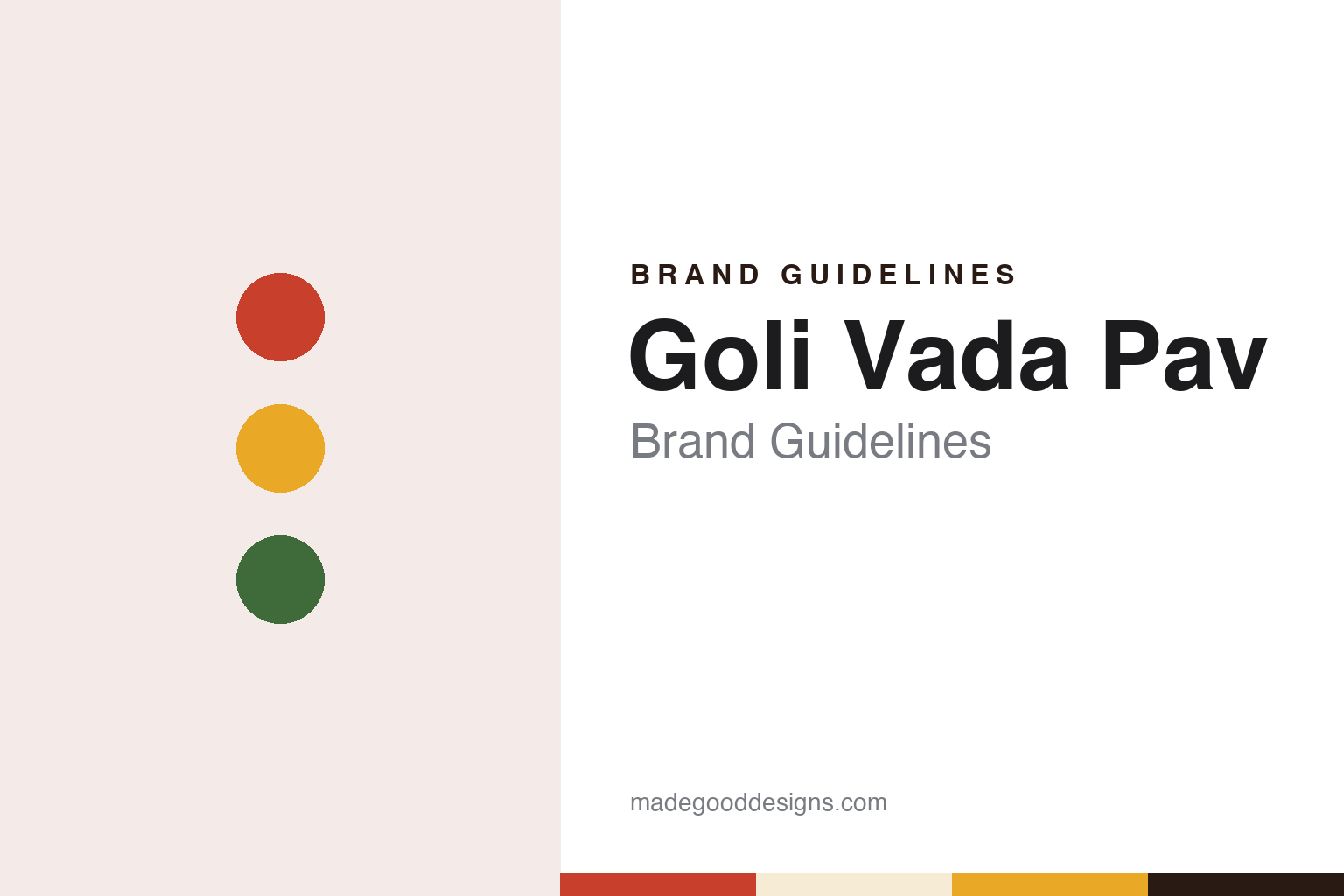
Goli Vada Pav Brand Guidelines
A 2004 Kalyan snack shop whose name grew bigger on the sign.
Aa
Two constants: a chilli red, turmeric and chutney green palette and a rounded sans register. Abstract homage — not a Goli Vada Pav product or mark; no sign, logo or packaging is reproduced.
Kalyan, 2004
Two finance partners and a Mumbai street snack.
Goli Vada Pav began in early 2004 with a single outlet in Kalyan, in Thane district outside Mumbai. Outlook Business reported in January 2014 that its founders, Venkatesh Iyer and his friend Shivadas Menon, had been running a corporate finance business together before they turned to food, and that they weighed up an idli and dosa outlet before settling on the vada pav: a spiced potato patty, fried in gram-flour batter and served in a soft bun, the pav. The Hindu BusinessLine, writing in December 2012, described the company as majority-owned by Iyer and Menon. English Wikipedia gives the company name as Goli Vada Pav Pvt. Ltd and places its headquarters in Vikhroli, Mumbai.
Iyer’s own account of the idea, as told to The Hindu BusinessLine, starts with a McDonald’s banner he noticed while holding a vada pav on a Mumbai street. Both were fast food eaten on the move, a filling inside a bun, and the vada pav needed no plate, spoon or side dish: it could be wrapped in a piece of paper and eaten on a bus or in an autorickshaw. That mattered for a chain that wanted small counters rather than seated restaurants, in a city where space is expensive. Harsh Pamnani, who wrote about the company in his book Booming Brands, told the student site InsideIIM in May 2020 that the first store stood outside Kalyan railway station.
The name is a piece of Mumbai slang. According to Pamnani, friends who heard Iyer’s plan to leave finance and sell vada pav kept asking whether he was “giving them a goli”, local slang for bluffing; and in Mumbai kitchens the round raw potato ball that is dipped in batter and fried to become the vada is itself called a goli. The team took both meanings. English Wikipedia notes that the shops trade under the longer name Goli Vadapav No.1.
Colour
Frozen patties, franchisees and smaller cities.
Growth was quick and then difficult. Pamnani told InsideIIM that by the end of 2005 Goli was a 20-store chain in and around Kalyan, three of the stores company-owned and the rest franchised, supplied from a central kitchen. The hand-made patties kept for only a short time and varied from shop to shop. An IMD business school article by Anand Narasimhan and Aparna Mohan Dogra, first published in the Financial Times in September 2012, says the business came under pressure from its bank in November 2006.
The answer was to buy in the product. IMD and SmartCEO (March 2012) both describe a supply arrangement with Vista Processed Foods, an Indian subsidiary of the US food group OSI that also supplied patties to McDonald’s in India, which began making Goli’s vadas frozen so that every shop received the same patty. Pamnani adds that the company then developed its own lower-cost automatic fryer for the frozen vadas, which he calls the “Goli fryer”. According to IMD, the only parts of the business Goli kept in-house were the brand and its own spice mix.
The second change was geography. A planned large-scale expansion had to be abandoned, and The Hindu BusinessLine recounts that an offer to open in Nashik led to one store after another outside the city. IMD says the company moved to a model in which almost all outlets were run by fee-paying franchisees, with a small full-time staff, and concentrated on second-tier cities in western and southern India. SmartCEO named shops in Nashik, Nagpur, Kolhapur, Bengaluru and Coimbatore in March 2012, when the chain counted 130 outlets; The Hindu BusinessLine put the figure at 150 that December, most of them run by franchisees. The venture fund VenturEast invested in the company in August 2011, Outlook Business reported.
By January 2014 Outlook Business counted 224 stores in ten states, including Karnataka, Tamil Nadu, Madhya Pradesh, Gujarat and the Delhi region, with more than 65 in Bengaluru and only nine in Mumbai itself. Iyer explained the Mumbai figure with a question of his own: why would anyone come to a Goli shop when the snack is easy to find in any part of the city? The magazine also named smaller towns such as Hubli, Tirupati and Agra among its markets. As of May 2020, InsideIIM put the chain at more than 300 stores in about 100 cities.
Typography
Design and documentation.
Several of the Indian sweet-shop, snack and restaurant chains in this guide began at a single counter or kitchen. Some keep the name of a founding town or family, and the shopfront, the sweet box and the takeaway bag carry that name long after the business has spread beyond its home city. Some, like Bikanervala, keep a second name for the packed snacks they sell in shops, so that the restaurant and the pack can live side by side.
The menu is usually the clearest part of the identity. Chains in this group present themselves through named dishes and drinks: bhujia and kaju katli, momos, vada pav, masala chai, barbecue platters, dosa and idli, or cakes and brownies. Their websites group products by those names rather than by ingredient, and many add gift boxes and festive ranges to the everyday menu.
Networks are published by the companies themselves, as outlet lists, city pages and franchise forms for domestic and international partners, and they change often. Some brands have moved from street-facing shops to delivery-only kitchens that carry no signage at all, which leaves the pack, the app listing and the social feed to do the work of a shopfront. Where a count is given in this guide, it is dated and attributed.
Ownership ranges from family businesses run by a second or third generation to groups that hold several restaurant brands and to companies listed on an Indian stock exchange. Corporate pages describe founders, owners and franchise networks; this guide sets those claims beside dated reporting in the business and trade press, and keeps each company’s own account clearly marked as its own.
Aa
A warm rounded sans for a counter sign. (Specimen set in Baloo 2, a rounded sans STAND-IN; NOT the Goli Vada Pav logo.)
Goli Vadapav No.1
Goli grew; vada pav shrank.
One design decision at Goli is on record in the founder’s own words, and it concerns the sign above the counter. Iyer told SmartCEO in 2012 that the brand at first rode on the name of the snack: on early signage the word Goli was small and vada pav was prominent. Over time Goli became the bigger word and vada pav the smaller one, a shift from describing the food to naming the shop. The trading name Goli Vadapav No.1, as English Wikipedia records it, keeps the brand word in front.
The formats are compact. The Hindu BusinessLine notes that a vada pav needs only a wrap of paper, and Outlook Business met Iyer in 2014 at a cramped outlet in Mulund, which he compared with the much larger McDonald’s nearby. That scale shapes the identity: a fascia, a counter, a fryer and a menu board have to do the work that seating and décor do in a larger restaurant. The menu has stayed close to the core, with English Wikipedia naming vada pav and sabudana vada as the products.
The brand has also travelled through barter. Pamnani told InsideIIM that Goli agreed with the producer of a Marathi film to show the film’s posters in its shops in return for a Goli-branded bus stop appearing in two shots of the film, and that similar deals followed with other Marathi films.
Goli was one of two vada pav chains that Outlook Business profiled in 2014. The other was Jumbo King, older by three years and, at that time, concentrated in Mumbai, while Goli had looked outward from the city.
For a design guide, Goli Vada Pav shows how a street snack becomes a brand when the name on the sign grows and the product stays the same. Compare Jumbo King, the other Mumbai vada pav chain, and McDonald’s, the burger chain Iyer has cited as his model. For this guide we use a chilli red, turmeric yellow and a chutney green on paper cream with a rounded sans, an unofficial interpretation; no product or logo is reproduced.
Explore & save
Keep Goli Vada Pav’s identity on hand — save it to a board in the Made Good inspiration library.
Goli Vada Pav identity set
Pin the Goli Vada Pav chilli red, turmeric and chutney green palette and the rounded sans register to your own board.
Source & notes
Frequently Asked Questions
What font can I use to match the Goli Vada Pav look?
This guide describes Goli Vada Pav’s type as “A warm rounded sans for a counter sign”. Its type specimen is set in Baloo 2 from Google Fonts as a stand-in; Baloo 2 is not Goli Vada Pav’s own lettering.
What colours are in the Goli Vada Pav palette?
This guide’s Goli Vada Pav palette is Chilli red #C8402B, Turmeric #E9A825, Chutney green #3F6B3A, Paper cream #F6EBD4 and Tawa brown #2A1A14. The tones are the guide’s own unofficial interpretation, not official Goli Vada Pav hex codes.
When was Goli Vada Pav founded?
Goli Vada Pav was founded in Early 2004, in Kalyan, near Mumbai, India.
Who founded Goli Vada Pav?
Goli Vada Pav was founded by Venkatesh Iyer and Shivadas Menon in Early 2004.


