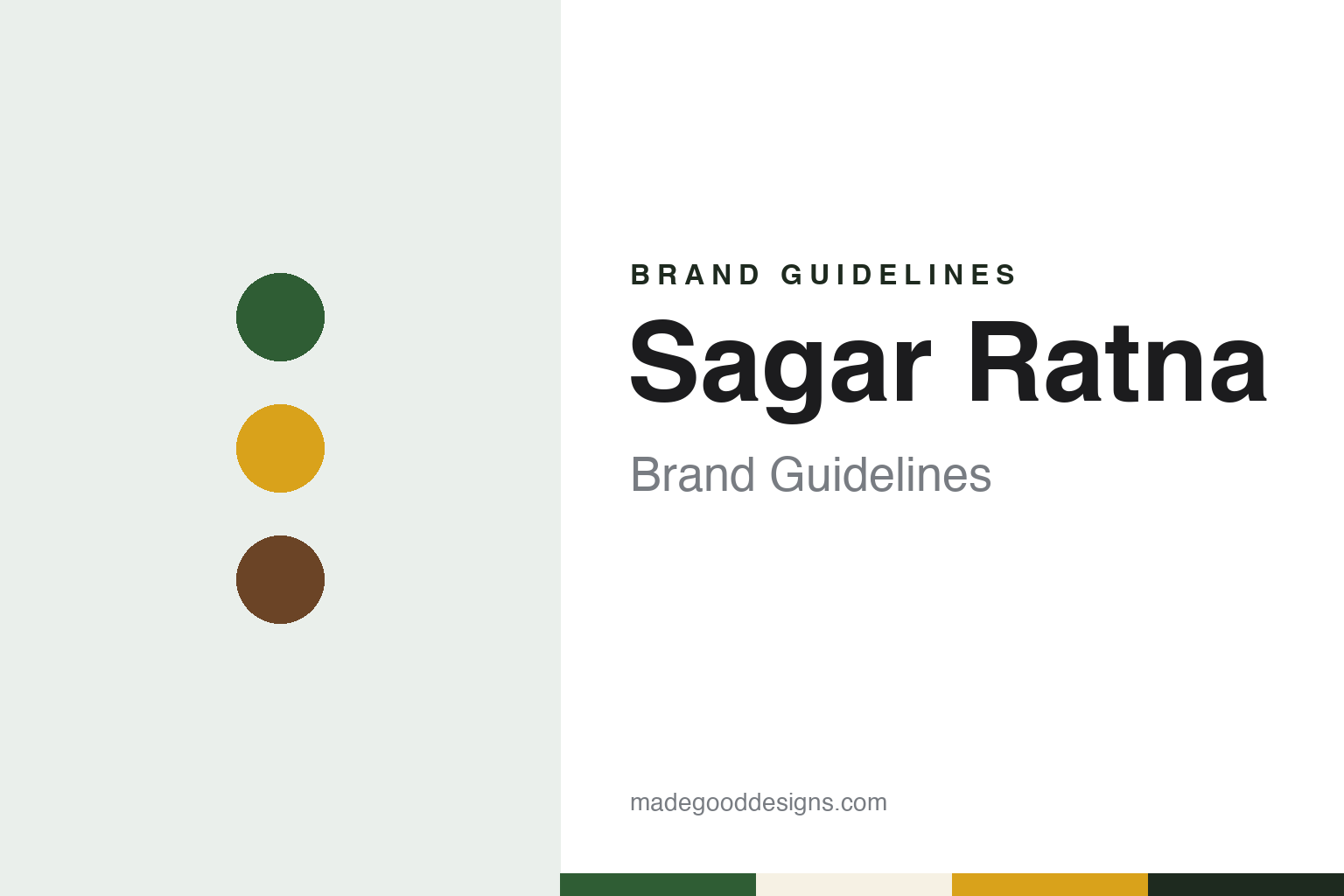
Sagar Ratna Brand Guidelines
The 1986 Defence Colony dosa house that became a chain.
Aa
Two constants: a banana-leaf green, turmeric and coffee palette and a plain sans register. Abstract homage — not a Sagar Ratna product or mark; no dish, logo or sign is reproduced.
Sagar, Defence Colony
A rented shop and a 40-seat dining room in south Delhi.
Sagar Ratna is a chain of South Indian vegetarian restaurants based in Delhi. Its founder, Jayaram Banan, came from Karkala, a village about 30 kilometres from Udupi in Karnataka, Outlook Business reported in February 2012. Before he went into restaurants, the magazine said, he worked for years in a works canteen in Mumbai, moving from the sink to waiting on tables and then to night manager, and later moved to the Delhi area, where he ran a canteen of his own at Central Electronics in Ghaziabad.
In 1986 Banan rented a shop in Defence Colony, a residential neighbourhood in south Delhi, and opened a restaurant called Sagar, serving idli, dosa and other South Indian staples. Outlook Business described it as a 40-seater; Restaurant India, writing in December 2025, gave the same figure. Banan told the magazine that rent was hard to meet at first but that the restaurant picked up quickly, at a time when, in his view, Delhi was growing more cosmopolitan and diners wanted a wider choice of food. As the queues grew, he rented the neighbouring shops and the floors above to add seating, the 2012 article said. The company’s own timeline adds that a small canteen called “Sagar” came first, in 1980, before the Defence Colony restaurant opened in 1986.
The Sagar Ratna name arrived in 1991. That year Banan bought Woodlands, a South Indian restaurant in the Lodhi hotel in Delhi, and renamed it Sagar Ratna, Outlook Business reported. The Lodhi site was aimed at a more affluent crowd than Defence Colony, so it was refurbished and given a new menu card. Restaurant India described the Lodhi move as the point at which a neighbourhood eatery became a format that could be repeated elsewhere.
Colour
Dosa, sambar and franchises.
The chain grew in stages. According to Outlook Business, Sagar Ratna adopted a franchise model in 1996; the company’s timeline dates its first franchise outlet to 1999, in Ludhiana in Punjab. In early 2012 the magazine counted 67 outlets across Haryana, Punjab, Uttar Pradesh, Rajasthan, Himachal Pradesh and the National Capital Region, and quoted the company’s finance chief as saying that most of them had opened in the previous decade and that about 60% were franchises. Indian Retailer, reporting in August 2011, put the count at about 70 restaurants, most of them in north India.
The menu is built on South Indian vegetarian staples — dosas, idli, vada and sambar — with filter coffee served in steel tumblers, as Restaurant India described it in December 2025. The same report said the menu had widened over time to take in North Indian and some Indo-Chinese dishes. In 2001 Banan opened a second brand, Swagath, serving coastal and Chettinad cooking, including seafood; in 2012 Outlook Business counted 11 Swagath outlets, run as a separate profit centre under the Sagar Ratna banner.
Staffing stayed tied to the south. Outlook Business reported in 2012 that Banan brought in almost all of his roughly 5,000 employees, cooks and others alike, from Mangalore or Tamil Nadu, and that this was becoming harder as industry grew in the southern states.
The company’s website lists outlets in Delhi, Haryana, Uttar Pradesh, Uttarakhand, Punjab and Chandigarh, and names Singapore and the Netherlands alongside India in its menus. Its timeline says it reached Noida in 1995, the Hotel Ashok in Delhi in 2002, Connaught Place in 2004, Singapore in 2005, Guwahati in 2006, Mangalore in 2010 and Bangkok in 2011, and that it opened a Sagar outlet in Banan’s home town of Karkala in 1996; these are the company’s own dates. As of December 2025, Restaurant India said the brand ran more than 100 outlets. In 2012, by contrast, Outlook Business had described the chain as largely absent outside the north, and quoted Harminder Sahni of the consultancy Wazir Advisors as saying that it sold South Indian food in a region with few South Indian chains.
Typography
How Indian food chains present themselves.
Several of the Indian sweet-shop, snack and restaurant chains in this guide began at a single counter or kitchen. Some keep the name of a founding town or family, and the shopfront, the sweet box and the takeaway bag carry that name long after the business has spread beyond its home city. Some, like Bikanervala, keep a second name for the packed snacks they sell in shops, so that the restaurant and the pack can live side by side.
The menu is usually the clearest part of the identity. Chains in this group present themselves through named dishes and drinks: bhujia and kaju katli, momos, vada pav, masala chai, barbecue platters, dosa and idli, or cakes and brownies. Their websites group products by those names rather than by ingredient, and many add gift boxes and festive ranges to the everyday menu.
Networks are published by the companies themselves, as outlet lists, city pages and franchise forms for domestic and international partners, and they change often. Some brands have moved from street-facing shops to delivery-only kitchens that carry no signage at all, which leaves the pack, the app listing and the social feed to do the work of a shopfront. Where a count is given in this guide, it is dated and attributed.
Ownership ranges from family businesses run by a second or third generation to groups that hold several restaurant brands and to companies listed on an Indian stock exchange. Corporate pages describe founders, owners and franchise networks; this guide sets those claims beside dated reporting in the business and trade press, and keeps each company’s own account clearly marked as its own.
Aa
A plain, sturdy sans for menus and signs. (Specimen set in Hind, a sans STAND-IN; NOT the Sagar Ratna logo.)
Sagar Ratna
A private equity stake, then a buyback.
For six years Sagar Ratna was controlled by a private equity fund. In August 2011 the New York-based fund India Equity Partners bought a controlling stake in Sagar Ratna Hotels, the company that ran the chain, Indian Retailer reported; Banan stayed on as chairman, and an operating partner from the fund became chief executive. Outlook Business described the same arrangement in February 2012.
That arrangement ended in May 2017, when Banan bought out India Equity Partners’ majority stake, which he put at 77%, AVCJ reported on 24 May 2017; financial terms were not disclosed. Restaurant India named the operating company as Sagar Ratna Restaurants Pvt. Ltd. in December 2025, and the company’s website presents Jayaram Banan as the founder of the brand.
The website pairs English headings with Hindi ones — “सागर रत्ना की पहचान,” the identity of Sagar Ratna, above “Our Story, Our Identity” — and leans on the words authenticity, tradition and consistency. Its pages are organised around locations, menus and franchise enquiries, which matches how the chain has grown: through a repeatable restaurant format rather than a single flagship.
For a design guide, Sagar Ratna shows how the name and menu of one neighbourhood restaurant can be carried across a franchise network for four decades. Compare Haldiram’s, another family-founded Indian food business, and Bikanervala, another Delhi food chain. For this guide we use a banana-leaf green, a turmeric yellow, a filter-coffee brown and a rice white with a sans, an unofficial interpretation; no product or logo is reproduced.
Explore & save
Keep Sagar Ratna’s identity on hand — save it to a board in the Made Good inspiration library.
Sagar Ratna identity set
Pin the Sagar Ratna banana-leaf green, turmeric and coffee palette and the plain sans register to your own board.
Source & notes
Frequently Asked Questions
What font can I use to match the Sagar Ratna look?
This guide describes Sagar Ratna’s type as “A plain, sturdy sans for menus and signs”. Its type specimen is set in Hind from Google Fonts as a stand-in; Hind is not Sagar Ratna’s own lettering.
What colours are in the Sagar Ratna palette?
This guide’s Sagar Ratna palette is Banana-leaf green #2F5D34, Turmeric yellow #D9A21B, Filter-coffee brown #6B4426, Rice white #F6F1E4 and Deep leaf #1E2A1F. The tones are the guide’s own unofficial interpretation, not official Sagar Ratna hex codes.
When was Sagar Ratna founded?
Sagar Ratna was founded in 1986 (as Sagar), in Defence Colony, New Delhi.
Who founded Sagar Ratna?
Sagar Ratna was founded by Jayaram Banan in 1986 (as Sagar).