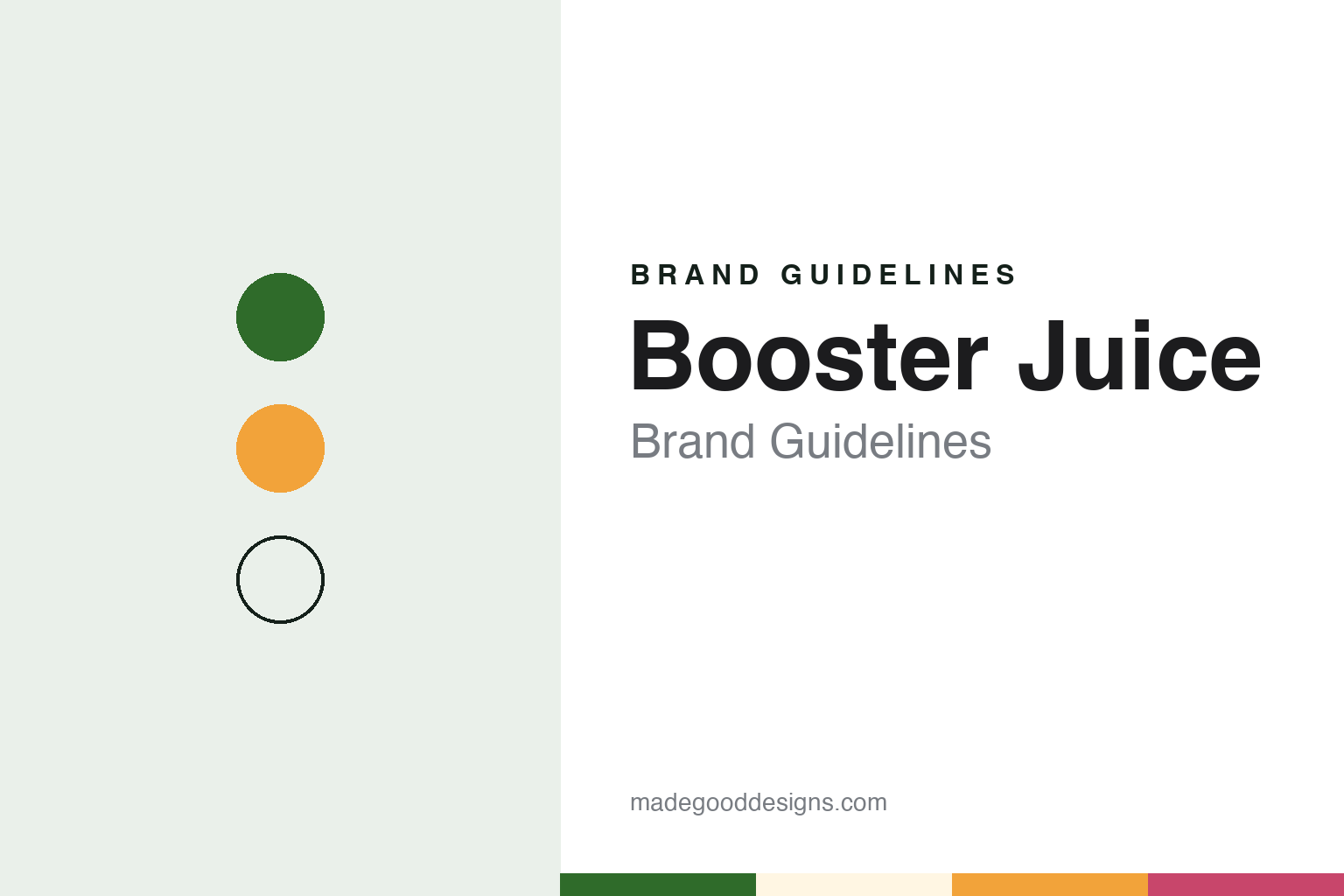
Booster Juice Brand Guidelines
The Alberta smoothie bar built to be franchised.
Aa
Two constants: a Booster Juice green, mango and berry palette and a friendly grotesque register. Abstract homage — not a Booster Juice product or mark; no logo, cup or sign is reproduced.
Sherwood Park, 1999
Four months from idea to opening.
Booster Juice is an Alberta company, but its first bar was not in Edmonton itself. The first Booster Juice opened on 13 November 1999 in Sherwood Park, a community just east of Edmonton, according to both the Edmonton Journal, in a 2017 profile by Juris Graney, and the company’s own story page. The head office and test kitchen are in Edmonton, the Journal reported, and English Wikipedia lists the company, Booster Juice Inc., as a private firm based there.
The founder is Dale Wishewan, a mechanical engineering graduate of Portland State University who had worked in international technical sales for the Edmonton firm Edmonton Exchanger, according to the company and the Journal. The company’s own account names only Wishewan. The Journal adds a second founder: it reported that a friend Wishewan had met in Oregon, Jon Amack, asked him in 1999 about the size of Canada’s health-food market, and that the two opened the first store together about four months later. Wishewan later bought out Amack’s share, the paper said, and he remains president and chief executive; CTV News described him in January 2026 as Booster Juice’s president, CEO and founder.
The pace was set from the start. The Journal wrote that in those four months the pair created the smoothie recipes, the product names, the operating manuals and the design and decor of the stores, because franchising was the goal from the outset. The company says Wishewan tested smoothies in his own home kitchen first, and that several of those early recipes remain on the menu.
Growth was quick. The Journal reported that a second store opened five months after the first, a third in May 2000 and a fourth soon after. By the paper’s account the chain had 15 stores by the end of its first year and 50 by the end of its second, then slowed slightly, adding 22 in its third year and passing 125 by the end of its fourth.
Colour
Bright stores, small footprints.
The look of Booster Juice is part of the format. The Edmonton Journal described the chain’s early outlets as “outrageously brightly coloured stores,” and opened its 2017 profile by contrasting the plain exterior of the company’s holding firm, AW Holdings Corp., with the bright hues of its stores across the country. The company’s franchising page uses similar language about itself: it says its store designs are “engineered to be bright and energetic.”
That design is tied to the menu. The company says most of its sales come from smoothies and juices, which lets its outlets work in very small spaces, with few staff, and alongside other food-service units rather than in competition with them. English Wikipedia describes the core product as smoothies made with juice, fruit sorbet or vanilla frozen yogurt, frozen fruit, yogurt and ice. The company’s story page lists the wider menu today as smoothies, wraps, paninis, its rolled Booster Balls, and freshly prepared shots and drinks.
The menu’s language leans on activity. The company describes its customers as people with an active lifestyle, and its loyalty scheme is called Booster Rewards. The Journal noted that the founders came up with “clever names” for the drinks before the first store opened.
The newest store format is a building of its own. In January 2026 CTV News reported that Booster Juice had opened its first-ever drive-thru on Amy Croft Drive in Lakeshore, Ontario, next to Windsor, with a soft opening on 5 January. The franchise partners, who CTV said had been with the chain for about 20 years, told the broadcaster the project had taken more than five years, and Wishewan said a standalone pad site was chosen rather than a corner unit shared with other tenants. The franchise partner said most early orders came through the drive-thru window.
Typography
Design and documentation.
Canada’s home-grown restaurant chains grew up alongside the American franchises that crossed the border, and many still introduce themselves by where they began. Harvey’s dates its first restaurant to Richmond Hill, Ontario, in 1959; Mary Brown’s traces its first to St. John’s, Newfoundland and Labrador, in 1969. Their corporate and franchising pages tell those founding stories, name founders and owners, and describe their franchise networks in their own words.
The chains in this group cover burgers, fried and rotisserie chicken, subs, pizza, juice, salads, Thai dishes and burritos. On their own websites they present themselves through shopfronts, signage, packaging and a handful of named dishes, such as a lead burger or a chicken sandwich, repeated across their restaurants. In Quebec, names and menus appear in French, written as the companies write them.
Ownership is often grouped. Several of these brands belong to larger restaurant companies that run many chains at once: Recipe Unlimited, taken private by Fairfax Financial in October 2022, lists Harvey’s, Swiss Chalet and St-Hubert among its brands, according to the law firm Torys, and Mary Brown’s parent, MBI Brands, bought a Toronto burrito chain in 2022, The Telegram reported. Some restaurants share a building with a sibling brand, as some Harvey’s and Swiss Chalet locations do.
Some of these chains also trade abroad, at times under a shorter name, as Mary Brown’s does with MB Chicken. This guide sets out what can be checked about each brand: who founded it, who owns it and how many restaurants a dated source gives it. It marks clearly what rests only on the company’s own word, and its palettes and typefaces are our own interpretation, not the brands’ official ones.
Aa
A friendly grotesque — bright stores and drink names. (Specimen set in Bricolage Grotesque, a sans STAND-IN; NOT the Booster Juice logo.)
Booster Juice
A franchise network from coast to coast.
The chain grew outward from Alberta and then east. The Edmonton Journal reported in 2017 that the company began to gain ground in eastern Canada after its early western growth, and quoted Wishewan as saying that Booster Juice then had more stores in Ontario than in the rest of the country combined. English Wikipedia, citing a 2006 Canadian Business article, says the bulk of the early stores were in western Canada.
It has also tried other countries. The Journal reported that the first Booster Juice in the United States opened on 25 October 2003 in Boise, Idaho, with a second in Utah a few days later. The company’s franchising pages still carry a section on international franchise opportunities.
The company remains private and founder-led. The Journal named its holding company as AW Holdings Corp., and the company’s website, as read in November 2026, says Booster Juice has more than 470 locations in every province and territory of Canada. CTV News gave the same figure of more than 470 Canadian locations in January 2026.
For a design guide, Booster Juice shows how a small-footprint format can make colour and naming do most of the work: bright stores, named drinks and a counter that fits into a very small space. Compare Freshii, another Canadian quick-service franchise, and Tim Hortons, another Canadian franchise network. For this guide we use a wheatgrass green, a mango and a berry with a sans, an unofficial interpretation; no product or logo is reproduced.
Explore & save
Keep Booster Juice’s identity on hand — save it to a board in the Made Good inspiration library.
Booster Juice identity set
Pin the Booster Juice green, mango and berry palette and the friendly grotesque register to your own board.
Source & notes
Frequently Asked Questions
What font can I use to match the Booster Juice look?
This guide describes Booster Juice’s type as “A friendly grotesque — bright stores and drink names”. Its type specimen is set in Bricolage Grotesque from Google Fonts as a stand-in; Bricolage Grotesque is not Booster Juice’s own lettering.
What colours are in the Booster Juice palette?
This guide’s Booster Juice palette is Wheatgrass green #2F6B2A, Forest ink #14201A, Mango #F2A33A, Berry #C8466B and Yogurt #FFF6E3. The tones are the guide’s own unofficial interpretation, not official Booster Juice hex codes.
When was Booster Juice founded?
Booster Juice was founded in 13 November 1999, in Sherwood Park, Alberta.
Who founded Booster Juice?
Booster Juice was founded on 13 November 1999 by Dale Wishewan, with Jon Amack.