Mucho Burrito Brand Guidelines
A pita chain’s founders build a burrito grill.
Aa
Two constants: a chipotle red, tortilla cream and lime palette and a condensed grill caps register. Abstract homage — not a Mucho Burrito product or mark; no dish, logo or sign is reproduced.
Mississauga, 2006
The Extreme Pita team tries Mexican.
Mucho Burrito is a Canadian fast-casual Mexican chain, and it began in Mississauga, the city on Toronto’s western edge. Fast Casual reported in July 2010 that the first restaurant opened its doors on 13 June 2006 in Mississauga, Ontario, and that the chain was founded by the brothers Mark and Alex Rechichi, who had already founded the Extreme Pita sandwich chain, together with Sean Black, who had served as Extreme Pita’s vice-president of real estate and franchise development.
The founders came to burritos from pitas. English Wikipedia says the Rechichi brothers founded Extreme Pita in 1997, with its first shop near Wilfrid Laurier University in Waterloo, Ontario, and that the pita chain began expanding into the United States in 2003, starting with Arizona. The same entry says Extreme Brandz was formed as a holding company in 2006, when the owners of Extreme Pita decided to move into Mexican fast food by launching Mucho Burrito, and that a smoothie add-on called PurBlendz followed in 2008 for existing Extreme Pita operators.
The new chain grew quickly at home. In April 2010 Nation’s Restaurant News put it at 26 units in Canada, describing it as a concept developed by Mississauga-based Extreme Brandz, which at the time operated and franchised 275 Extreme Pita locations, 34 of them in the United States. The magazine reported that a first US Mucho Burrito was then under construction in the Seattle area, with a local Extreme Pita franchisee as the developer there. By July 2010, Fast Casual wrote, the chain had grown to nearly 30 restaurants across Canada.
The two trade reports differ slightly on age: Nation’s Restaurant News described the chain in April 2010 as founded three years earlier, while Fast Casual gave the June 2006 opening date. The Mississauga opening in 2006 is the date given with the most detail, and it matches the year English Wikipedia gives for the creation of Extreme Brandz.
Colour
Three tortilla sizes and a house hot-sauce line.
In the 2010 interview with Nation’s Restaurant News, Alex Rechichi, then president and chief executive of Extreme Brandz, described Mucho Burrito as a fresh-Mex grill concept “with a twist,” and said the team had looked at how filling burritos tend to be and how that affects how often people return. The answer was choice of size. The chain offered burritos on 10-inch, 12-inch or 14-inch tortillas, in white or whole wheat, and quesadillas in two sizes, with every order customisable.
The same interview listed the proteins as white-meat chicken breast and steak, with a charbroiled chorizo sausage and an herb-and-chipotle tilapia added to the line-up. It also described a house range of hot sauces sold in the restaurants under the name Johnny Mucho, five sauces in all, which Rechichi said had become popular as customers sought more heat. Fast Casual described the setting in 2010 as contemporary and casual, with a menu of hand-rolled burritos, tacos, quesadillas, nacho plates and salads alongside the Johnny Mucho sauces.
The chain’s current voice, on its own website in November 2026, writes the name as MUCHO Burrito, with the first word in capitals, and leans on two phrases: “Made-in-Casa,” for ingredients it says are prepared in the restaurants each day, and “Modern Mexicana,” for the style of food. The company says chicken breast is grilled fresh daily and vegetables are roasted every day, and its menu is built around burritos, bowls, quesadillas and tacos, each assembled in front of the customer. It also runs a loyalty programme and catering, and publishes its site in English and French.
The capitalised first word does a lot of the brand’s work. “Mucho” is Spanish for “a lot,” and the name sets up a promise about portion and choice that the 2010 tortilla sizes made literal. For a designer, that makes the wordmark’s emphasis a documented choice rather than an accident of styling.
Typography
Design and documentation.
Canada’s home-grown restaurant chains grew up alongside the American franchises that crossed the border, and many still introduce themselves by where they began. Harvey’s dates its first restaurant to Richmond Hill, Ontario, in 1959; Mary Brown’s traces its first to St. John’s, Newfoundland and Labrador, in 1969. Their corporate and franchising pages tell those founding stories, name founders and owners, and describe their franchise networks in their own words.
The chains in this group cover burgers, fried and rotisserie chicken, subs, pizza, juice, salads, Thai dishes and burritos. On their own websites they present themselves through shopfronts, signage, packaging and a handful of named dishes, such as a lead burger or a chicken sandwich, repeated across their restaurants. In Quebec, names and menus appear in French, written as the companies write them.
Ownership is often grouped. Several of these brands belong to larger restaurant companies that run many chains at once: Recipe Unlimited, taken private by Fairfax Financial in October 2022, lists Harvey’s, Swiss Chalet and St-Hubert among its brands, according to the law firm Torys, and Mary Brown’s parent, MBI Brands, bought a Toronto burrito chain in 2022, The Telegram reported. Some restaurants share a building with a sibling brand, as some Harvey’s and Swiss Chalet locations do.
Some of these chains also trade abroad, at times under a shorter name, as Mary Brown’s does with MB Chicken. This guide sets out what can be checked about each brand: who founded it, who owns it and how many restaurants a dated source gives it. It marks clearly what rests only on the company’s own word, and its palettes and typefaces are our own interpretation, not the brands’ official ones.
Aa
Condensed capitals for a grill-line menu board. (Specimen set in Bebas Neue, a condensed STAND-IN; NOT the Mucho Burrito logo.)
Mucho Burrito
From Extreme Brandz to MTY.
The founders sold the business in 2013. On 28 May 2013 The Globe and Mail reported that MTY Food Group of Montreal, through its subsidiary MTY Tiki Ming Enterprises, had agreed to buy the assets of the three Extreme Brandz banners, Extreme Pita, PurBlendz and Mucho Burrito, from the three co-founders, Alex Rechichi, Mark Rechichi and Sean Black. The paper reported that Extreme Brandz had offices in Toronto, Calgary and Scottsdale, Arizona, and that MTY said the 40 American stores in the deal would be its first in the United States.
The purchase went through. MTY’s own published history records the acquisition of Extreme Brandz, covering Extreme Pita and Mucho Burrito, in May 2013, and English Wikipedia lists MTY as Extreme Pita’s parent from 2013. As of November 2026, MTY’s brand list includes Mucho Burrito alongside Thaï Express, Mr. Sub, Papa Murphy’s and Cold Stone Creamery, and the company website links to the group’s privacy policy, which names MTY.
Inside MTY, Mucho Burrito sits in a portfolio that includes several other counter-service chains with their own origin stories, including Thai Express, the Montreal Thai chain MTY bought in 2004. The burrito brand has kept its founders’ formula of a grill line and a customised order, and its website, muchoburrito.com, is the official one; a Barcelona design studio called Mucho is an unrelated business.
For a design guide, Mucho Burrito shows how one capitalised word can carry a whole promise about size and choice. Compare Thai Express, a sibling MTY chain built around a counter, and Mr. Sub, a Canadian sandwich chain in the same group. For this guide we use chipotle red, tortilla cream and lime with a condensed sans, an unofficial interpretation; no product or logo is reproduced.
Explore & save
Keep Mucho Burrito’s identity on hand — save it to a board in the Made Good inspiration library.
Mucho Burrito identity set
Pin the Mucho Burrito chipotle red, tortilla cream and lime palette and the condensed grill caps register to your own board.
Source & notes
Frequently Asked Questions
What font can I use to match the Mucho Burrito look?
This guide describes Mucho Burrito’s type as “Condensed capitals for a grill-line menu board”. Its type specimen is set in Bebas Neue from Google Fonts as a stand-in; Bebas Neue is not Mucho Burrito’s own lettering.
What colours are in the Mucho Burrito palette?
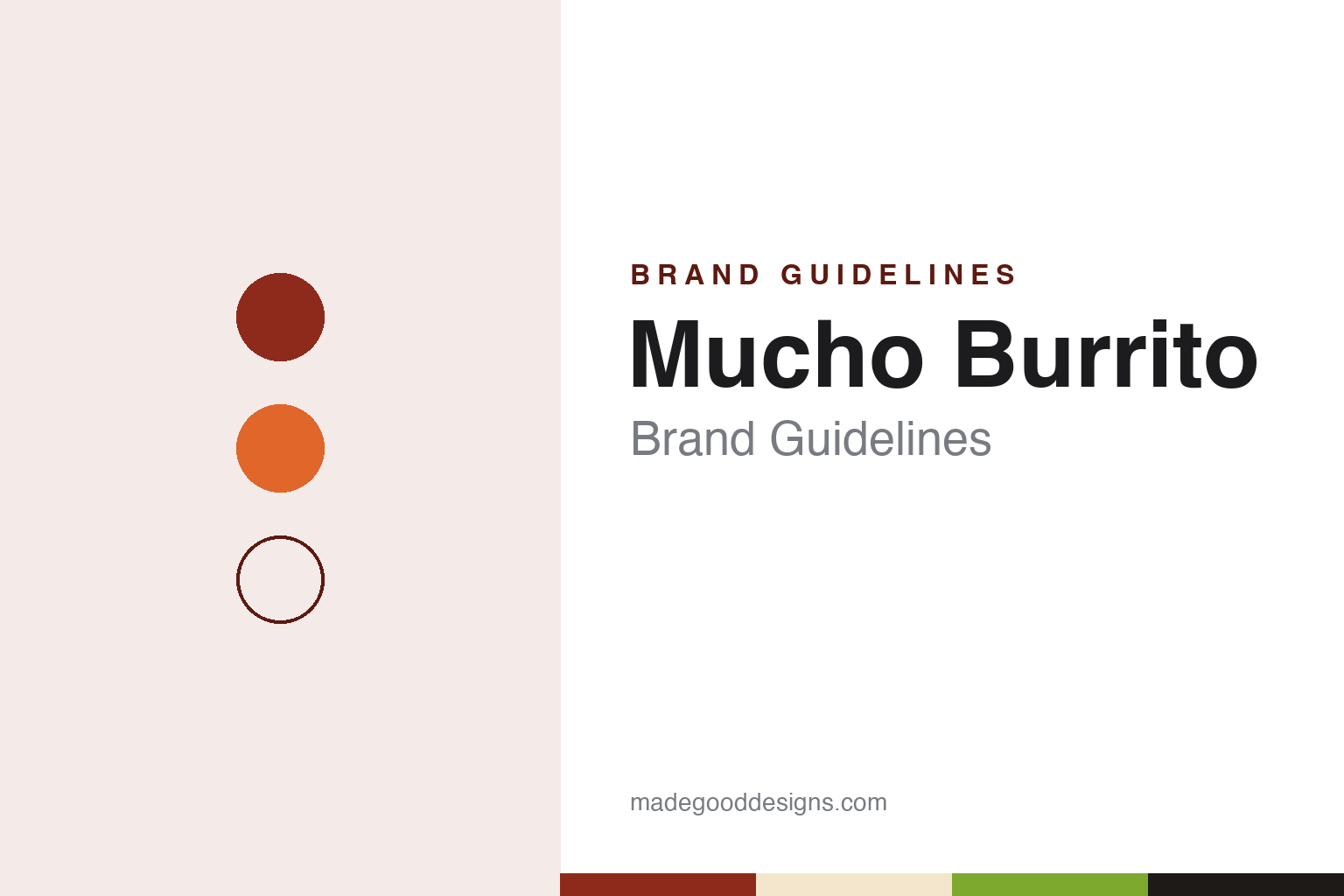
This guide’s Mucho Burrito palette is Chipotle red #8E2A1B, Charred black #1E1A18, Tortilla cream #F3E6CC, Lime #7DAA2E and Salsa orange #E0662A. The tones are the guide’s own unofficial interpretation, not official Mucho Burrito hex codes.
When was Mucho Burrito founded?
Mucho Burrito was founded in 13 June 2006, in Mississauga, Ontario.
Who founded Mucho Burrito?
Mucho Burrito was founded by Mark Rechichi, Alex Rechichi and Sean Black on 13 June 2006.