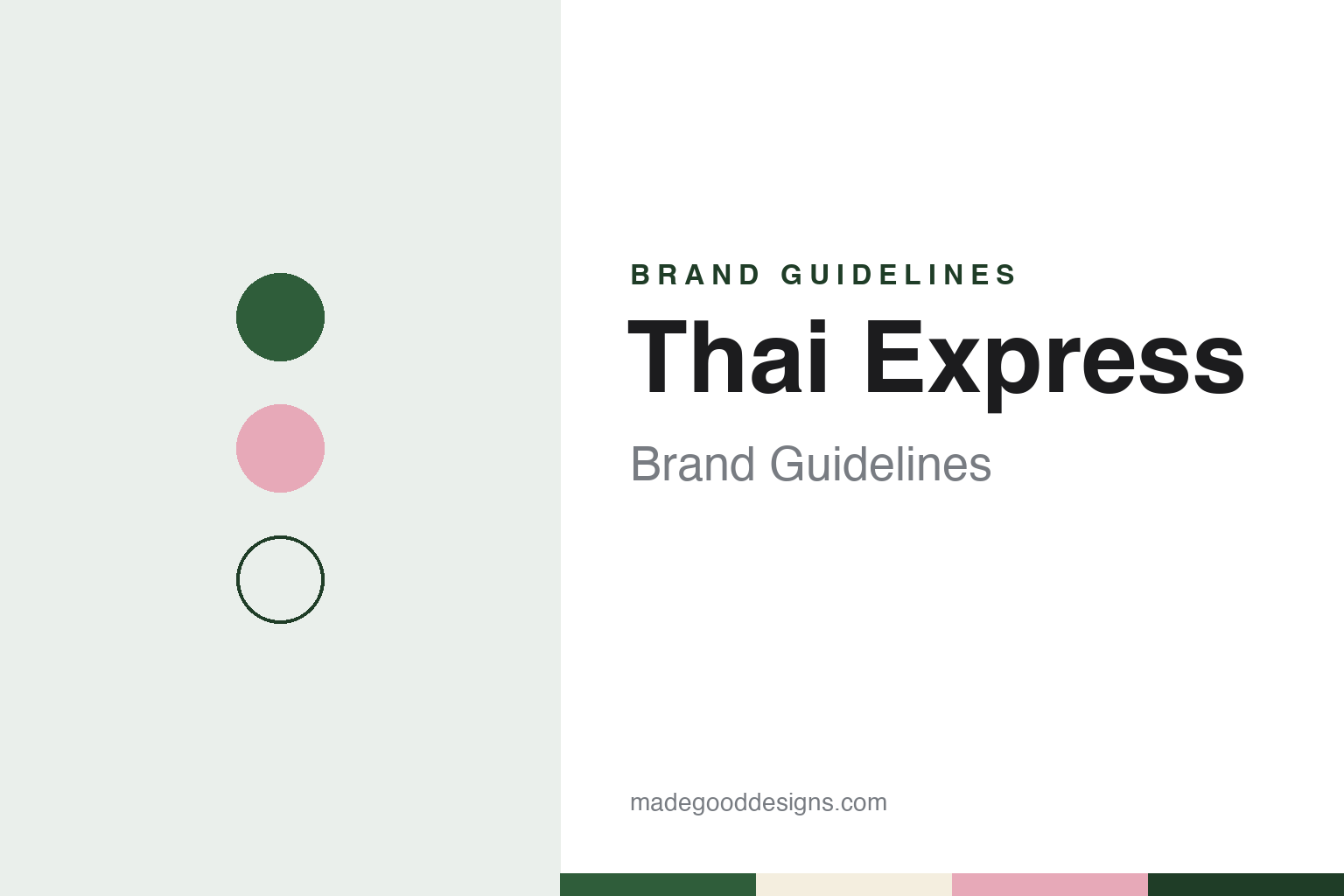
Thai Express Brand Guidelines
A downtown Montreal Thai counter that became a food-court chain.
Aa
Two constants: a basil green, lotus pink and rice cream palette and a rounded counter sans register. Abstract homage — not a Thai Express product or mark; no dish, logo or sign is reproduced.
Downtown Montreal, 1999
A Thai counter that a franchisor bought early.
Thai Express is a Montreal chain of quick-service Thai restaurants, and its story starts several years before the deal that made it part of a large franchise group. English Wikipedia gives its founding as 1999 in Montreal, and the company’s own account agrees. On its website the company says the idea took shape in 1998, when a Montreal businessman, whom the site does not name, wanted to bring Thai cooking to North American diners, and that four sisters who had come to Canada from south-east Asia, Loune, Line, Khay and Loy Thongvan, turned that idea into a working restaurant business.
According to the same account, Loune Thongvan worked in operations, adapted family recipes for a North American market and developed an identity for the concept before opening her own Thai Express in downtown Montreal in 1999, with her sisters working behind the scenes to keep it running. The company says that Dennis Ng later took on business development, and that Loune Thongvan and Dennis Ng are still involved with the brand. Those details come from the company itself; the independent record picks up with the sale of the chain.
That sale came within five years. English Wikipedia says MTY Food Group, the Montreal franchisor founded by Stanley Ma, bought Thai Express in May 2004 from the Montreal company Tara Fung Holding, through its then subsidiary Matoyee Enterprises, for an undisclosed amount. At that point the chain had six outlets, all of them franchised, and five of them were in shopping-mall food courts. MTY’s own published history gives the deal a single line, saying the group bought the concept because it saw its potential, and records it in the same year as the purchase of Mrs. Vanelli’s, a chain of Italian food-court restaurants.
Under MTY the formula has stayed close to the mall. English Wikipedia describes most Thai Express locations as counters in shopping-mall food courts, with some sit-down restaurants among them, and lists locations in all ten Canadian provinces, from British Columbia to Newfoundland and Labrador. The brand is still headquartered in Montreal, the same city as its parent, whose head office is in the borough of Saint-Laurent.
Colour
White rooms, pale green and pink, and a diaeresis.
The Thai Express format is built around the food-court counter. English Wikipedia sets out the routine: customers order and pay at a counter, wait while the dish is cooked in front of them, and then carry it to a table, or take it away where an outlet has no seating of its own. The same entry calls the restaurants’ style “modern” and says the colour schemes are mostly white with pale green and pink, together with wooden textures. That is the nearest thing to a documented brand palette, and it describes rooms rather than a published colour specification.
The name carries a small typographic detail of its own. MTY Food Group and the chain’s website write it Thaï Express, with a diaeresis over the i, and the company uses the same spelling in “Thaï food” and “Thaïland” in its English copy. In French spelling a diaeresis marks two vowels that are sounded separately. The company runs its website in English and French, as many Quebec businesses do, and the dotted letter appears in both versions and in the trademarked dish name General Thaï.
The menu, as listed on the company’s website in November 2026, is organised into soups, curries, noodles, fried rice and stir-fries, plus appetizers and desserts and a build-your-own bowl it calls the Shak-a-Bowl. Among the named dishes are Pad Woon Sen, crystal noodles stir-fried with vegetables, egg and a choice of protein, and a Holy Basil stir-fry topped with a fried egg. The site also has a page for a Thai poutine, putting a Quebec staple on a Thai menu, and it shows a trademark symbol beside General Thaï on its menu headings.
For a designer, the documented elements are therefore few but distinct: a name written with an accent, rooms described as white with pale green and pink and wood, and a menu that mixes Thai dish names with a couple of local jokes. Everything else in this guide is our own interpretation.
Typography
Design and documentation.
Canada’s home-grown restaurant chains grew up alongside the American franchises that crossed the border, and many still introduce themselves by where they began. Harvey’s dates its first restaurant to Richmond Hill, Ontario, in 1959; Mary Brown’s traces its first to St. John’s, Newfoundland and Labrador, in 1969. Their corporate and franchising pages tell those founding stories, name founders and owners, and describe their franchise networks in their own words.
The chains in this group cover burgers, fried and rotisserie chicken, subs, pizza, juice, salads, Thai dishes and burritos. On their own websites they present themselves through shopfronts, signage, packaging and a handful of named dishes, such as a lead burger or a chicken sandwich, repeated across their restaurants. In Quebec, names and menus appear in French, written as the companies write them.
Ownership is often grouped. Several of these brands belong to larger restaurant companies that run many chains at once: Recipe Unlimited, taken private by Fairfax Financial in October 2022, lists Harvey’s, Swiss Chalet and St-Hubert among its brands, according to the law firm Torys, and Mary Brown’s parent, MBI Brands, bought a Toronto burrito chain in 2022, The Telegram reported. Some restaurants share a building with a sibling brand, as some Harvey’s and Swiss Chalet locations do.
Some of these chains also trade abroad, at times under a shorter name, as Mary Brown’s does with MB Chicken. This guide sets out what can be checked about each brand: who founded it, who owns it and how many restaurants a dated source gives it. It marks clearly what rests only on the company’s own word, and its palettes and typefaces are our own interpretation, not the brands’ official ones.
Aa
A rounded counter sans for a food-court menu board. (Specimen set in Kanit, a sans STAND-IN; NOT the Thai Express logo.)
Thai Express
A Montreal concept inside a Montreal group.
Thai Express has grown as part of MTY. When The Globe and Mail reported MTY’s agreement to buy Extreme Brandz in May 2013, it named Thai Express among the group’s brands, alongside Cultures, Yogen Früz and Country Style, in a portfolio it put at 26 banners and about 2,200 units. Later that year MTY added a second Quebec Thai chain, Thai Zone; English Wikipedia says MTY took 80 percent of it in October 2013, when Thai Zone had 25 franchised stores in the province.
The brand crossed into the United States in May 2017. QSR Web reported on 17 May 2017 that Thai Express had opened its first US location in the food court of the Mall of America in Bloomington, Minnesota, and noted that, despite its name, the chain is a Canadian concept owned by MTY Food Group. English Wikipedia also lists locations in Dubai, the United Kingdom and Guyana. As of November 2026, the company’s website said the chain had grown from a single downtown Montreal restaurant to more than 300 locations worldwide; English Wikipedia’s infobox gives a figure of about 300.
One name trap is worth knowing. A Singapore chain of Thai restaurants also trades as Thai Express, and English Wikipedia treats it in a separate article; it is a different business. This guide is about the Canadian chain owned by MTY Food Group, whose website is thaiexpress.ca.
For a design guide, Thai Express shows how a small food-court concept can keep a clear name through two decades inside a large franchisor, with a single accent mark as its most distinctive typographic detail. Compare Mucho Burrito, another MTY chain built around a counter, and Mr. Sub, the Canadian sandwich chain MTY bought in 2011. For this guide we use basil green, lotus pink and a rice cream with a rounded sans, an unofficial interpretation; no product or logo is reproduced.
Explore & save
Keep Thai Express’s identity on hand — save it to a board in the Made Good inspiration library.
Thai Express identity set
Pin the Thai Express basil green, lotus pink and rice cream palette and the rounded counter sans register to your own board.
Source & notes
Frequently Asked Questions
What font can I use to match the Thai Express look?
This guide describes Thai Express’s type as “A rounded counter sans for a food-court menu board”. Its type specimen is set in Kanit from Google Fonts as a stand-in; Kanit is not Thai Express’s own lettering.
What colours are in the Thai Express palette?
This guide’s Thai Express palette is Basil green #2F5D3A, Lotus pink #E7A9B8, Jasmine rice #F4EEDF, Chili red #B5322A and Teak brown #6B4A2F. The tones are the guide’s own unofficial interpretation, not official Thai Express hex codes.
When was Thai Express founded?
Thai Express was founded in 1999, in Montreal, Quebec. Thai Express is known for Pad Woon Sen, Holy Basil, Shak-a-Bowl.
Who owns Thai Express?
Thai Express is owned by MTY Food Group (since May 2004).