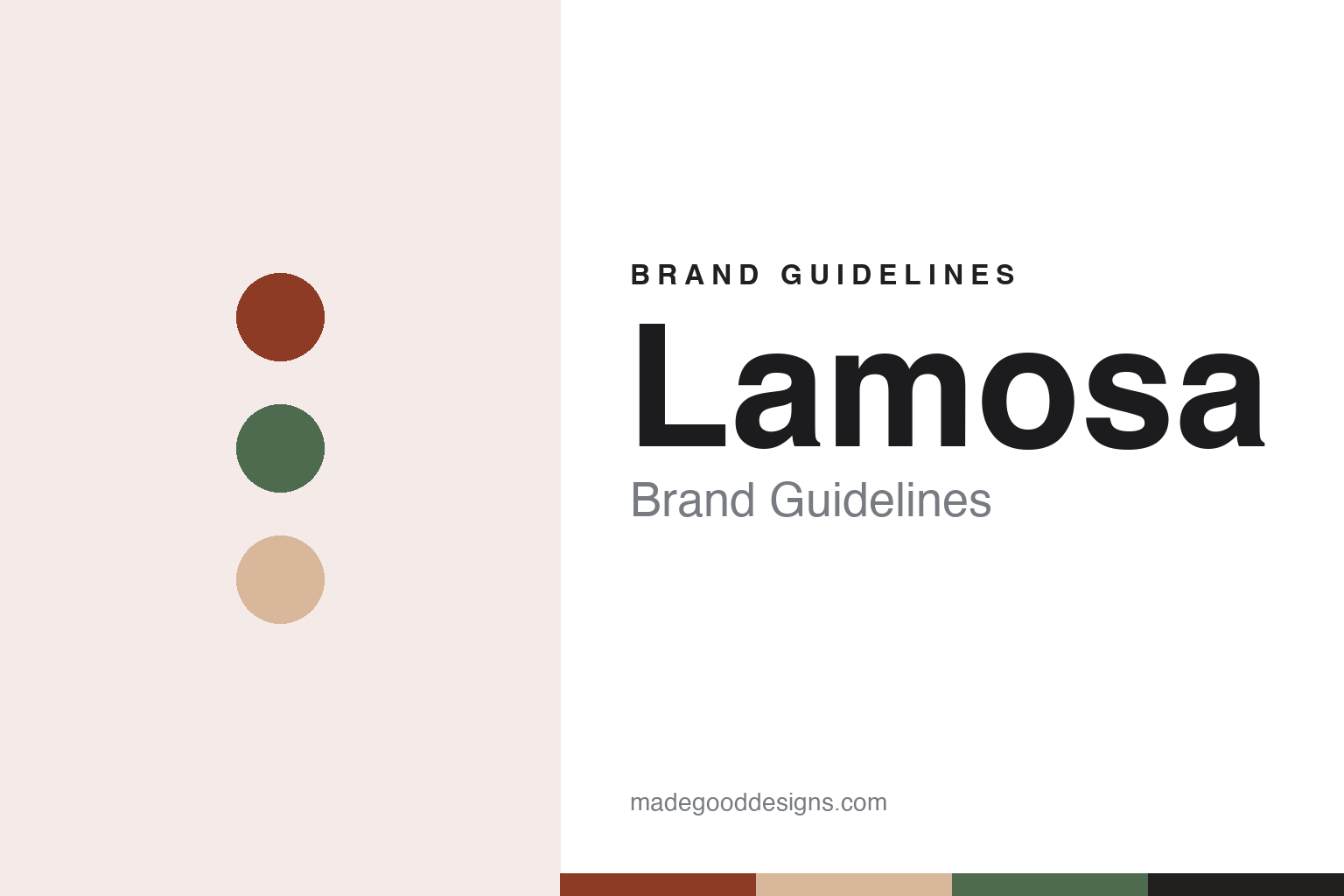
Lamosa Brand Guidelines
The Monterrey brick works that became a tile group across the Americas and Spain.
Aa
Two constants: a brick, clay and agave palette and a warm serif register. Abstract homage — not a Lamosa product or mark; no tile, logo or pattern is reproduced.
Ladrillera Monterrey
A brick works in northern Mexico.
Grupo Lamosa traces its history to 1890 and a small brick works in Monterrey, in northern Mexico. According to the group’s own history, the Compañía Manufacturera de Ladrillos de Monterrey was set up by shareholders of North American descent and started with 75 workers. On 24 December 1929, the same history says, it was bought by the engineers Bernardo Elosúa Farías and Viviano L. Valdés, who reorganised it as Ladrillera Monterrey, S.A.; the brand’s consumer website instead places their purchase in 1890.
The move into tiles came in 1933, when Ladrillera Monterrey added wall tiles, floor tiles and clay blocks to its bricks, which the company says made it the first Mexican maker of those products, and switched its kilns from firewood to natural gas. Its shares have been listed on the Bolsa Mexicana de Valores since 1951, the group says. Over the following decades it added a tile-adhesive business under the Crest name in 1957, sanitaryware through Sanitarios Azteca in 1963 and a floor and wall tile plant in Tlaxcala, called Kerámika, in 1974. Around 1984, the history adds, it began converting its tile kilns to fast-firing roller kilns, while a property arm developed land in the Valle Oriente district of Monterrey.
In 1995, the group’s history says, Ladrillera Monterrey changed its legal name to Grupo Lamosa, during a decade in which it closed non-strategic plants and worked towards international quality standards after Mexico opened its trade. In 2004, the group says, it adopted a new corporate identity, which it describes as reflecting quality, innovation and differentiation.
The adhesive side grew alongside the tiles. The group says it bought Adhesivos de Jalisco in 1998, opened a new Crest plant in Tizayuca, Hidalgo, the following year and acquired Industrias Niasa in 2001. Around 2002 it added a sanitaryware plant in Benito Juárez, Nuevo León, and a tile plant in San Luis Potosí, which it says doubled its capacity in 2005. For a time it also ran shopping centres in Monterrey, opening Galerías Valle Oriente in 2003 and Plaza Cumbres in 2005, before selling both in 2007.
Colour
From bricks and basins to tiles.
Tiles are now the core. Early in 2015 Grupo Lamosa sold its entire sanitaryware division to the Colombian manufacturer Corona; El Economista reported on 4 May 2015 that the sale had closed with clearance from Mexico’s competition authority, Cofece, and that Sanitarios Lamosa dated from 1963. The group says the sale let it concentrate on ceramic tiles and tile adhesives in Mexico and abroad.
Many of its tile brands came through acquisitions. In 2007 the group bought the tile maker Porcelanite, which it says made it one of the largest ceramic manufacturers in the world. In October 2016 La Tercera reported that Lamosa had closed the purchase of the ceramics business of the Belgian building-materials group Etex, bringing in Cerámica San Lorenzo and Cerámicas Cordillera; the group says this gave it plants and distribution centres in Argentina, Chile, Colombia and Peru. It added Eurocerámica in Colombia in 2020, the company says.
Spain followed. On 2 August 2021 Europa Press reported that Grupo Lamosa had agreed to buy the flat-ceramics division of Roca, including two factories in Brazil and Cerámicas Belcaire in Vall d’Uixó, Castellón, which together produced 23.4 million square metres of tiles in 2020 and sold mainly in the United States, Brazil and Spain; the group’s history lists the business as acquired in 2021, and Roca Tiles and Roca Cerámica Brasil now appear among its brands. In November 2023 El Financiero reported that Lamosa had completed the purchase of the Spanish tile maker Baldocer, which brought the Baldocer, Azulejos Benadresa and ETILE brands; the paper said the deal would strengthen the group in Europe and in higher-end products.
Beyond tiles, the group makes tile adhesives, and early in 2022 it bought FANOSA, a Mexican maker of expanded polystyrene used for insulation and lightweight fill in construction and in packaging, the company says.
Typography
Design and documentation.
Ceramic tile makers sell surfaces that people mostly meet as rooms, so their own material leans heavily on finished spaces. Pamesa’s website, for example, offers downloadable catalogues, moodboards, “by effect” and “by space” product searches and a BIM library for architects, and Porcelanosa’s 2026 showrooms in Vila-real presented its large-format porcelain through furnished settings, Interempresas reported. Room-set photography, in which a collection is laid across a kitchen, a bathroom or a terrace, is a common way to show a range.
Naming follows the surface. Pamesa’s 2026 ranges carry names such as Heritage, Trevi and Taj Mahal, and makers sort them by finish, format and thickness. Trade reports in 2026 described Porcelanosa adding 160 cm by 160 cm floor pieces and 3 mm slabs for furniture cladding, and Pamesa grouping its new ranges into four families, each defined by the kind of material effect it shows.
Trade fairs are the other main stage. Cersaie, held at BolognaFiere in Italy, reached its 43rd edition from 21 to 25 September 2026, according to Castellón Información. Both companies built their 2026 stands as furnished settings: Pamesa called its 2026 space The Gallery, and Porcelanosa printed a magazine to guide visitors around its stand. Pamesa’s website also keeps virtual tours of its stands at Cersaie and at Cevisama from 2017 to 2022, while Porcelanosa stages its own annual show in Vila-real, which reached its 32nd edition in 2026.
Behind the collections sit corporate pages that read quite differently. They list group companies, plants, acquisitions and leadership teams, and they are often the clearest public record of who owns which brand. This guide relies on those pages only for what the companies say about themselves, and on press reports and encyclopedias for dated facts.
Aa
A warm serif for a brick-and-clay heritage. (Specimen set in Fraunces, a serif STAND-IN; NOT the Lamosa logo.)
Lamosa
A Mexican tile brand and the group behind it.
Lamosa itself is the group’s Mexican floor and wall tile brand. Its website presents collections with names such as Bordini, Celari, Mármol Picasso and Nájera, and leans on the line “Hecho en México”, describing the company as fully Mexican and more than 135 years old. In 2005 the group launched Firenze Tecnoarte, a glazed porcelain line, and in March 2011, the group says, its tile business took the top show award at the Coverings fair in Las Vegas, its fourth such recognition in six years.
Today Grupo Lamosa is based in San Pedro Garza García, in the Monterrey metropolitan area, and lists a presence in Argentina, Brazil, Chile, Colombia, Guatemala, Mexico, Peru, Spain and the United States. Europa Press named Federico Toussaint as its chairman and chief executive at the time of the Roca deal in 2021. The group publishes an integrated annual report, the most recent covering 2025.
For a design guide, Lamosa shows how a brick maker’s name can carry a tile group that grew by buying other makers’ brands. Compare Roca, whose former tile division it took on, and Pamesa, another Spanish tile maker. For this guide we use a brick red, fired clay and an agave green with a warm serif, an unofficial interpretation; no product or logo is reproduced.
Explore & save
Keep Lamosa’s identity on hand — save it to a board in the Made Good inspiration library.
Lamosa identity set
Pin the Lamosa brick, clay and agave palette and the warm serif register to your own board.