Gustav Stickley built more than furniture. From a workshop outside Syracuse he produced oak chairs, tables and settles, copperwork and textiles, then sold them through a monthly magazine, catalogues and books of house designs. Goods and publishing made one argument: a plain, solid, well-made object suits a household better than a carved one. For designers, he is a case study in how a product line, a visual identity and an editorial voice can reinforce each other.
This guide looks at the forms, materials and marks to study, gives a short sourced career outline, and ends with ideas you can borrow. For the wider movement behind him, see our guide to the Arts and Crafts movement.
Who was Gustav Stickley?
The Metropolitan Museum of Art records Stickley as American, born in Osceola, Wisconsin, in 1858 and died in Syracuse, New York, in 1942; the Art Institute of Chicago gives the same years. An essay by the German Historical Institute’s Immigrant Entrepreneurship project traces his early career in family furniture businesses, a partnership called Stickley & Simonds, and its replacement in 1898 by the Gustave Stickley Company. The same essay places a trip to Europe in 1895, where he saw British Arts and Crafts design, and notes that he read John Ruskin and William Morris but never met either.
The Met’s Heilbrunn Timeline essay on the American Arts and Crafts movement describes him as the founder of the United Crafts, later known as the Craftsman Workshops, and as a proselytiser of the craftsman ideal. Met catalogue entries add that the firm was called United Crafts before 1904. In 1901 he launched The Craftsman, a monthly magazine, a date given both in a Columbia University archival record and in other biographical sources.
Growth came quickly and so did strain. According to the Columbia University record, Stickley opened the Craftsman Building in Manhattan in 1913 and was declared bankrupt on 24 March 1915. Biographical accounts date the end of the magazine to 1916. His country estate, Craftsman Farms in New Jersey, was built between 1908 and 1917, according to the Stickley Museum at Craftsman Farms, which now runs the site; the museum gives 1917 as the year the property was sold.
Key works, with dates
- Table, 1900. The Met holds a small oak table made in Syracuse, possibly retailed by the Tobey Furniture Company.
- Sideboard Table, about 1901. White oak and poplar with cast-iron hardware, made in Eastwood, according to the Met.
- Chips from the Workshop of Gustave Stickley, 1901. The Met holds this illustrated trade catalogue, an early example of Stickley selling the idea alongside the object.
- Hall Clock (no. 3), 1902. The Art Institute of Chicago lists this oak and brass clock as made by United Crafts in Eastwood, with works by the Seth Thomas Clock Company. The Met holds a tall clock of about 1902 in the same materials.
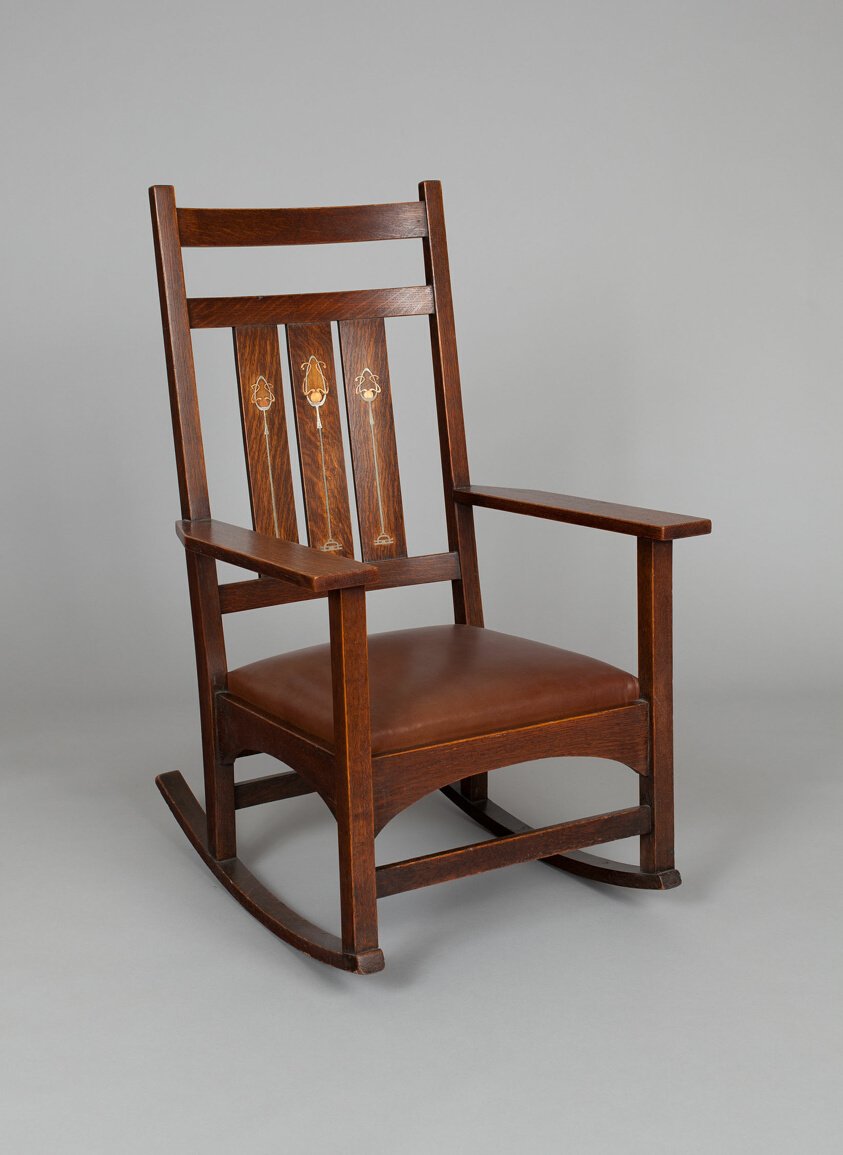
- Armchair and Rocking Chair, 1903. The Met holds an armchair of about 1903 in oak with pewter, copper and wood inlays; the Art Institute’s rocking chair shown above, designed by Harvey Ellis and made by United Crafts, is dated 1903.
- Humidor, 1904–5, and Plaque, 1904–10. Copper and wood at the Met, and a copper plaque from the Craftsman Workshops at the Art Institute, show the metal shop beside the furniture.
- Library Table, about 1906. A large round oak table with leather at the Met, about 140 centimetres across.
- Settle, about 1909. Oak, with replacement leather, designed by Stickley and made by the Craftsman Workshops, according to the Art Institute.
- Craftsman Homes, 1909. A book of house designs in the Met’s library collection, extending the furniture into architecture.
What to look at in Gustav Stickley furniture
The rocking chair is a compact lesson in the Craftsman vocabulary. Square posts run straight from floor to arm. The arms are flat boards, wide enough to rest a cup on. The seat rail curves gently upward at the front, the only arc in a frame of straight lines apart from the rockers. A leather seat sits inside the frame instead of on top of it.
- Rectilinear structure. Posts, rails and slats are plain rectangles in section. The parts that hold the chair together are the parts you see.
- Repetition with a single change. Three equal back slats carry three matching inlays, a rhythm broken only by the curve of the apron.
- Grain as decoration. On the slats, the flecked figure of the oak does the work that carving did in Victorian furniture.
- Restrained metal. Copper, brass and pewter appear in small, deliberate amounts: hinges, pulls, clock faces and inlay.
- A maker’s mark. The Art Institute records a red decal reading “Als ik kan / Stickley” under the left arm of this chair. The Flemish phrase, roughly “as I can”, was Stickley’s motto, and design writers describe it set inside a joiner’s compass in his trademark.
Measured from the Art Institute’s scan of this chair, the main tones run from a deep oak brown, #472417, through the slat mid-tone #6e3d25 and a warm highlight #946244, to the leather seat at #654133. The pale inlay reads at about #d9ad7c, with a copper note near #b7763b. These are values from the museum’s photograph, not original finishes.
Harvey Ellis and the inlaid line
Harvey Ellis was a designer whom the Met records as born in Rochester, New York, in 1852 and died in Syracuse in 1904. His time with Stickley was short, between 1903 and his death the following year, yet the inlaid designs associated with him are easy to recognise. The Met also holds an Ellis-designed desk in oak, poplar and copper, manufactured by Stickley in 1912–13, years after the designer’s death.
The inlays on the rocking chair show what Ellis brought. Each slat carries a slender vertical stem rising to a small, stylised flower head, drawn in pale wood and metal. The motif is narrow enough to sit within one slat, so it never fights the structure. It softens the frame without hiding it, and it echoes the elongated plant forms of British and Glasgow design of the same years. Compare the flatter, denser repeats in our guide to William Morris patterns, which Stickley knew through his reading.
Technique: workshop, magazine and catalogue
The museum records name a narrow set of materials: oak and white oak above all, with elm, poplar, cedar, willow, leather, copper, brass, pewter and wrought iron. The Met’s willow armchair of about 1907–13 shows that the line also included lighter woven pieces, and an embroidered linen table scarf of about 1906, attributed to Stickley, shows the textile side.
The other half of the technique was publishing. The Craftsman, the 1901 Chips catalogue and the 1909 furniture catalogue and Craftsman Homes presented furniture, metalwork, textiles and houses in one consistent voice, with the motto and mark repeated across products and print. Architects of the same years worked toward a similar unity of building and interior; our profile of Frank Lloyd Wright follows that idea in the Prairie houses.
One practical note when you study Craftsman furniture: other Stickley family firms made similar work. The Art Institute lists L. and J.G. Stickley as a separate maker, and the Met holds a 1904 desk by Stickley Brothers. Check the mark and the museum record before attributing a piece to Gustav.
How designers can borrow Gustav Stickley’s ideas
- Show the structure. In a layout, let the grid, rules and columns stay visible and treat them as the design, the way Stickley left posts and rails plain.
- Use one material well. Pick a single texture, stock or photographic surface and let its grain carry the page instead of adding ornament.
- Build a warm, narrow palette. Start from the measured oak, leather and copper tones above and test them with the MGD colour palette generator.
- Add one slim accent. Like Ellis’s inlays, keep decoration narrow and vertical, sitting inside a structural unit rather than across it.
- Make the mark part of the product. A short motto and a simple emblem, repeated on goods, packaging and print, give a small studio a consistent identity.
For more public domain furniture, metalwork and pattern to study, browse the MGD museum inspiration collection.
Frequently asked questions
What is Gustav Stickley known for?
For Craftsman furniture made at his workshops in Eastwood, outside Syracuse, for founding The Craftsman magazine in 1901, and for promoting the Arts and Crafts movement in the United States through furniture, metalwork, house plans and catalogues.
What does “Als ik kan” mean on Stickley furniture?
It is a Flemish phrase meaning roughly “as I can”, used by Stickley as a motto. The Art Institute of Chicago records it on a red decal under the arm of its 1903 rocking chair.
Did Gustav Stickley design all Craftsman furniture himself?
No. Museum records credit some pieces to Harvey Ellis, who designed inlaid furniture for the firm in 1903, and other Stickley family companies such as L. and J.G. Stickley and Stickley Brothers made similar furniture under their own names.
Where can I see Gustav Stickley’s work?
The Met holds tables, clocks, chairs, a cabinet, metalwork and catalogues; the Art Institute of Chicago holds a settle, a hall clock and the Ellis rocking chair. The Stickley Museum at Craftsman Farms in New Jersey preserves his estate. Not every piece is on view.