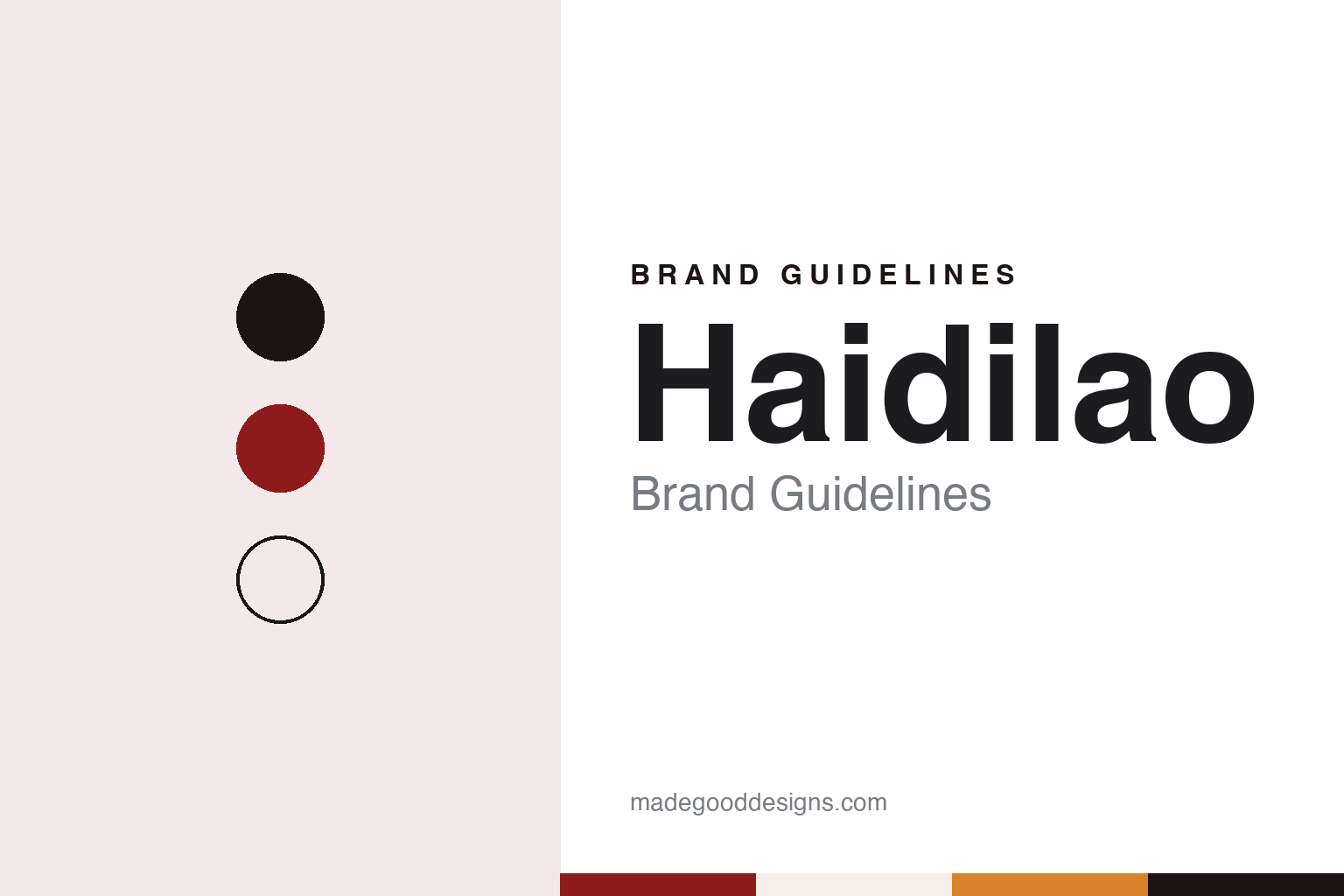
Haidilao Brand Guidelines
A Sichuan hot pot shop that built a brand on service.
Aa
Two constants: a chilli red, cream and ember palette and a warm grotesque sans register. Abstract homage — not a Haidilao product or mark; no logo, sign or menu is reproduced.
Jianyang, 1994
Four tables in a Sichuan county town.
Haidilao began in Jianyang, a town in Sichuan province, in 1994. Vulcan Post, in a 2019 profile, describes the first outlet as a small room with four tables, and says the business was founded by two couples: Zhang Yong and Shu Ping, and Shi Yonghong and Li Haiyan. According to that profile, Zhang had worked as a welder at a tractor factory in Jianyang and had no cooking background; his three partners put up most of the starting money, and he became general manager. A second outlet followed in 1998. A 2013 article on the Forbes contributor network also names Zhang Yong as the founder and dates the start to Jianyang in 1994. Chinese Wikipedia gives the opening date as 20 March 1994 and says the shop first sold malatang, the spicy skewered broth dish, before it turned to Sichuan hot pot.
The name has an old source. English Wikipedia says that haidilao can be read as “scooping the sea floor,” from the idiom about fishing a needle out of the bottom of the sea, a phrase for a near-impossible task; it is also a mahjong term for winning on the last tile. Chinese Wikipedia says the name comes from Sichuan mahjong.
From Sichuan the chain spread across China. Chinese Wikipedia records a restaurant in Xi’an opening in 1999, and English Wikipedia says the company expanded into other provinces in the late 1990s and early 2000s. It added home delivery early: English Wikipedia says the “Hi to send” service began in 2003, with staff bringing an induction cooker and pot to the customer’s home and collecting them afterwards. In 2010, Vulcan Post reported, Haidilao set up its own university to train restaurant managers, most of them promoted from inside the company.
Colour
Service as the signature.
English Wikipedia says Haidilao is widely known for its customer service. Vulcan Post listed what waiting customers are offered: drinks and snacks, card and board games, manicures and shoulder massages. Diners get hot towels, aprons and protective bags for their phones, and the meal can come with a live noodle-pulling performance and the Sichuan face-changing mask dance, in which a performer swaps masks almost too fast to see. English Wikipedia adds children’s play areas in some waiting rooms and small gifts for birthday parties. Customers can choose up to four soup bases in one pot and help themselves from a sauce bar of more than twenty dips, English Wikipedia says.
Technology has featured too. The 2013 Forbes contributor article described the chain’s first United States restaurant, in a Westfield mall in Arcadia, California, in December 2013, three months after English Wikipedia dates its opening: customers ordered on iPads, and a separate room could be booked for video conferences. At that time, the article said, Haidilao had 75 locations in Asia. In 2018 the company and the Japanese electronics maker Panasonic opened a “smart” restaurant in Beijing, with robotic arms preparing dishes in the kitchen and machines carrying food to the floor, according to both English and Chinese Wikipedia.
The chain went abroad from 2012. English Wikipedia dates its first restaurant outside mainland China to Clarke Quay, Singapore, in 2012, followed by the United States in 2013, South Korea in 2014, Taiwan and Japan in 2015, Hong Kong in 2017 and Canada in 2018. Chinese Wikipedia adds a Malaysian opening in March 2019. The overseas restaurants later include outlets in Thailand, Vietnam, Indonesia, the Philippines, the United Arab Emirates, Australia and the United Kingdom, English Wikipedia says.
Behind the restaurants sits a wider group. Vulcan Post and Dao Insights both name Yihai International, a hot pot seasoning and ingredients supplier, separately listed in Hong Kong, and Chinese Wikipedia names Shuhai, a supply-chain business that handles sourcing, production and logistics.
Typography
Hot pot as a chain business.
Korean fried-chicken and hot-pot chains tend to present themselves through what happens to the food, not through a mascot. A chicken chain’s company pages will often explain a sauce before they explain a logo: a soy-and-garlic glaze, a chilli version, a honey version, each with its own year of launch and its own name on the menu. Kyochon, for example, describes sauce brushed on piece by piece and has carried the brush into its wordmark; bb.q points to a training centre it calls Chicken University. Hot-pot chains put the pot itself at the centre of the table, so the broth, the burner and the plates of raw ingredients around it become part of how the brand is seen.
Shop interiors and menus are where these identities become consistent. As franchise networks grew into the hundreds and then the thousands, the companies describe bringing in uniform interiors, standard menu boards and set colour schemes; Kyochon, for one, dates uniform shop interiors and orange-based menu boards to 1999, the year it passed 100 shops. Delivery boxes, sauce packs and takeout bags carry the same marks, and some chains have built whole shop formats around delivery and takeout.
Names are usually plain. Menus are organised by sauce or cooking method, and side brands are given short, descriptive names of their own; several groups now run cafés, bars or noodle formats under separate names alongside the main chain. Some write their names in Korean characters, some in Latin letters, and some with punctuation or a founding year built into the mark.
Corporate pages fill in the rest: who founded the company and when, which group owns it, where it is listed, and how many shops and countries it reports. Those figures come from the companies, and dated press reports are the way to check them. This guide reads each brand through those pages and through independent reporting, and treats colour and type as an interpretation, not a copy.
Aa
A warm grotesque sans for a service-led chain. (Specimen set in Archivo, a sans STAND-IN; NOT the Haidilao logo.)
Haidilao
One brand, two listed companies.
Haidilao went public in September 2018, when its shares listed on the Hong Kong Stock Exchange, Vulcan Post reported; Chinese Wikipedia gives the stock code as 6862. The listed parent, Haidilao International Holding Ltd., is based in Beijing, English Wikipedia says. In March 2024, Chinese Wikipedia says, the company opened its restaurants to franchising for the first time.
The overseas business was split off in 2022. Super Hi International Holding Ltd., which runs Haidilao’s Sichuan hot pot restaurants overseas, listed on the Hong Kong Stock Exchange by way of introduction, meaning no new shares were issued and no money was raised, Asia Business Law Journal reported in January 2023. That report said the brand had 110 overseas restaurants at the end of 2022, half of them in Singapore, Malaysia and Vietnam, and that three-quarters of overseas customers were in Southeast Asia. In May 2024 Super Hi added a listing on the Nasdaq in New York, less than eighteen months after its Hong Kong debut, Dao Insights reported. English Wikipedia says Super Hi is incorporated in the Cayman Islands and based in Singapore, and that as of 2025 it ran more than 110 restaurants in 14 countries and regions; the same source puts the combined count for Haidilao and Super Hi at more than 1,400 restaurants.
The split leaves the Haidilao name under two listed companies: Haidilao International for the restaurants at home, and Super Hi for those overseas.
For a design guide, Haidilao shows how a restaurant brand can be carried by a service routine as much as by a logo: the waiting-room games, the phone bags and the noodle-pulling show are the parts customers remember. Compare Xiabuxiabu, a Beijing hot pot chain founded four years later, and Little Sheep, the Mongolian hot pot chain. For this guide we use a chilli red, a peppercorn brown, a sesame cream and an ember orange with a sans, an unofficial interpretation; no product or logo is reproduced.
Explore & save
Keep Haidilao’s identity on hand — save it to a board in the Made Good inspiration library.
Haidilao identity set
Pin the Haidilao chilli red, cream and ember palette and the warm grotesque sans register to your own board.