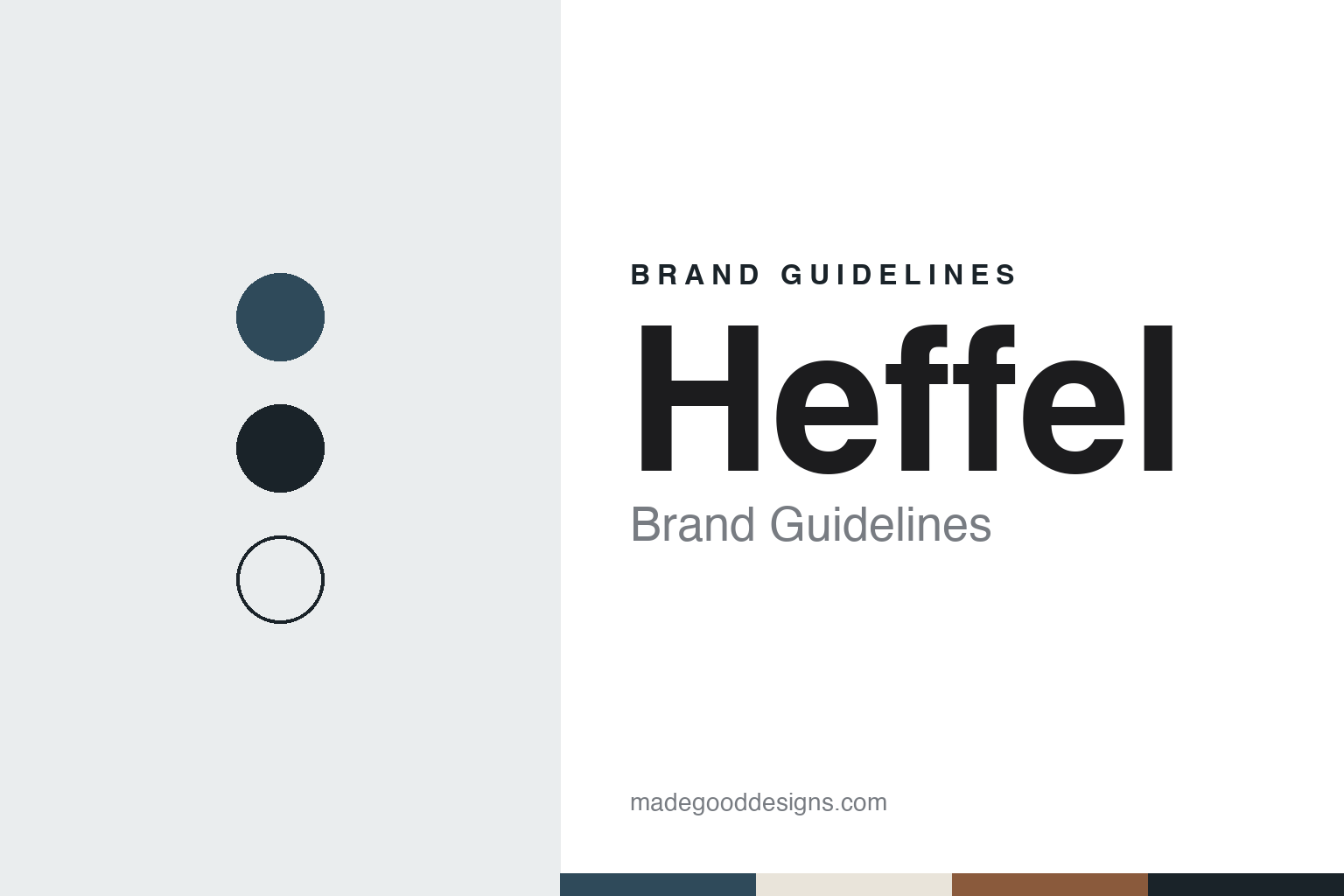
Heffel Brand Guidelines
From a Vancouver gallery to a Toronto saleroom and a screen.
Aa
Two constants: a slate, stone and cedar palette and a gallery serif register. Abstract homage — not a Heffel asset or mark; no logo, catalogue or artwork is reproduced.
South Granville
A gallery first, then an auction house.
Heffel began as a gallery. In 1978 the industrialist and collector Kenneth G. Heffel founded Kenneth G. Heffel Fine Art Inc. in Vancouver, in a former Royal Bank of Canada building on South Granville Street, English Wikipedia says; the company describes the spot as a heritage building on the city’s South Granville gallery row. It dealt in Canadian painting and, the company says, built its stock from a small group of works by Canadian masters.
In 1987 his sons David and Robert Heffel took over the business, and the company was renamed Heffel Gallery the same year. Through the late 1980s and the early 1990s the brothers held exhibitions of artists such as B.C. Binning, Emily Carr, Lawren Harris and E.J. Hughes, the company says. English Wikipedia gives the company name as Heffel Gallery Limited and describes the auction house as a division of it.
The auction side came in 1995, when the brothers set up Heffel Fine Art Auction House and held an inaugural live sale in Vancouver the same year. In September 1999 the company launched an online auction platform for fine art and began monthly online sales alongside its twice-yearly live auctions, the company says; English Wikipedia dates the house’s opening online auction to the same month.
Colour
Toronto, Montreal and named sessions.
The firm then spread east. English Wikipedia says Heffel opened an Ottawa office and a Toronto gallery in the Yorkville district in 2002, set up Galerie Heffel in Montreal in 2005 and took on a Calgary representative in 2007; the company dates its Calgary office to 2016. Its opening Toronto live auction was held in 2003, and for years the twice-yearly sales were split between Vancouver and Toronto. English Wikipedia lists offices in Vancouver, Calgary, Toronto, Ottawa and Montreal; in November 2026 the company’s contact page named office directors and managers in Vancouver, Calgary, Toronto and Montreal, including a manager of imaging in Montreal.
The sales were shaped into named sessions. From 2008, the company says, it divided each live auction into two sessions, then titled Canadian Post-War & Contemporary Art and Fine Canadian Art. In October 2015 it added Heffel Online 2, or HO2, a second online platform for large collections, in particular corporate ones; the company says its opening sale offered works from the collection of Imperial Oil. Today the company says its live auctions take place in Toronto in May and November, with online auctions every month.
The spring 2026 sale shows the format in practice. The Art Newspaper reported on 22 May 2026 that the auction, held at Heffel’s premises in Toronto’s Yorkville district on 21 May, offered 80 works across two back-to-back sessions, postwar and contemporary art followed by Old Master, Impressionist and Modern art, and that five went unsold. Its star lot, Coastal Boats Near Sidney, BC, a 1948 seascape by E.J. Hughes consigned by Emily Carr University of Art and Design, had a separate catalogue of its own; the evening also offered a portrait of Prince Rupert by Peter Lely, from about 1665, from the collection of the Hudson’s Bay Company. The paper named David Heffel as president and Robert Heffel as vice president. It also listed works by Jean Paul Riopelle, Emily Carr, Tom Thomson and Takao Tanabe, and an early Alex Colville, Cattle Show of 1955, which had hung in the 1964 exhibition Fifteen Canadian Artists at the Museum of Modern Art in New York.
Typography
Catalogues, salerooms and screens.
Auction houses and online auction platforms sell other people’s objects, so most of what they publish is about the lots rather than about themselves. The catalogue is the core document: a printed or online book for each sale, with a cover image chosen from the lots, a number and a description for each piece, and notes on where it came from. Many houses now publish the same catalogue as a web page and as a download, and some give a single important lot a catalogue of its own.
Lot photography sets much of the tone. Paintings are usually shown flat and square to the camera, furniture and objects against a plain ground, and jewellery and small pieces close up, so that a bidder in another city can judge them from a screen. The saleroom itself is the other stage: a rostrum, rows of chairs, a wall or screen for the lot on sale and a bank of telephones for absent bidders, as the houses show it in their own photographs and broadcasts.
Online bidding has added a third face. Houses and platforms publish apps and web pages for live and timed sales, with a lot image, the current bid, a countdown or a live video feed, and buttons for bidding and watching lots. Their sites also carry the practical pages, such as viewing hours, addresses of offices and salerooms, and how to consign or collect.
Corporate pages are usually short. They give a founding date, the offices and salerooms, and sometimes the names of owners or of the group a house now belongs to. This guide sets out what can be checked about each house — who founded it, who owns it and where it sells — and marks clearly what rests only on the company’s own word.
Aa
A calm text serif in the spirit of a sale catalogue. (Specimen set in Source Serif 4, a serif STAND-IN; NOT the Heffel logo.)
Heffel
Old hammers and a digital sale room.
Heffel has sold through screens for years. On 19 October 2020 the Vancouver Sun reported that the house had moved to what it called a “digital sale room,” after an all-digital auction in July 2020: its December sale was broadcast from the Vancouver Convention Centre while most of the art was in Toronto, with previews by appointment in Vancouver, Montreal and Toronto, and with real-time digital bidding alongside telephone and absentee bids. The paper also noted that the house had held monthly online auctions for several years. David Heffel told the Sun that the house was still using “the auctioneer hammers we used in some of our first sales, and our lucky podium.” He described the change as turning “a physical ballroom full of people” into a digital one “in many locations, using digital tools to watch, hear and bid,” and said the house had long sold to bidders who were not in the room, many of them on the telephone.
The company’s own pages tell its story through people and places: a founder who was a collector, two brothers who run the business, a gallery building on South Granville, and painters such as Emily Carr, Lawren Harris and E.J. Hughes. It describes itself as Canada’s leading fine art auction house. The family name is the brand: the gallery, the auction house, Galerie Heffel in Montreal and the HO2 platform all carry it.
For a design guide, Heffel shows how a family gallery can carry its name into an auction house that sells both in a saleroom and on screen. Compare Sotheby’s, the auction house that traces its roots to a London bookseller of 1744, and Hindman, a Chicago house founded in 1982. For this guide we use a slate blue, a warm stone and a cedar brown with a serif, an unofficial interpretation; no product or logo is reproduced.
Explore & save
Keep Heffel’s identity on hand — save it to a board in the Made Good inspiration library.
Heffel identity set
Pin the Heffel slate, stone and cedar palette and the gallery serif register to your own board.