Hetzner Brand Guidelines
The Gunzenhausen host that kept its founder’s name and a single red.
Aa
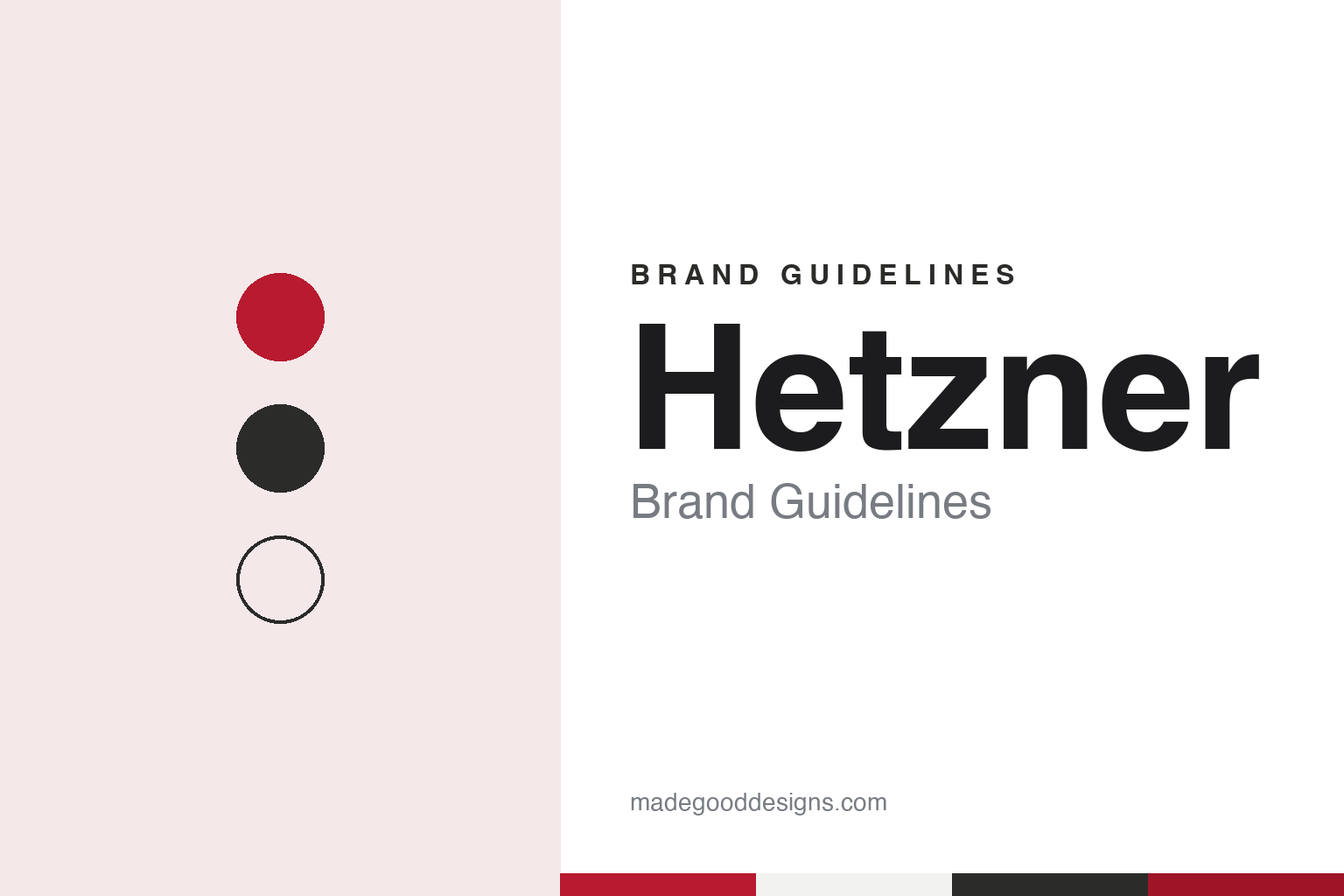
Two constants: a Hetzner red, charcoal and pale grey palette and a plain grotesque register. Abstract homage — not a Hetzner product or mark; no logo, interface or server is reproduced.
Gunzenhausen
A founder’s surname and a Bavarian town.
Hetzner began in 1997 in Gunzenhausen, in Bavaria. German Wikipedia says Martin Hetzner founded it that year under the name “Hetzner Online Service,” and English Wikipedia says the company is named after him. Both encyclopedias say it operated as a stock corporation, an AG, from 2000 to 2015 and has been a GmbH since. Gunzenhausen is still its home: the company’s website lists Hetzner Online GmbH there, with a Finnish company, Hetzner Finland Oy, at Tuusula.
The name carries one trap. In 1999, German Wikipedia says, an independently run partner company, Hetzner (Pty) Ltd, was set up in South Africa; since July 2019 it has traded as xneelo. Material about that South African business concerns a separate company, not the German Hetzner described in this guide.
The German company built up its place in the internet’s plumbing step by step. German Wikipedia lists its memberships: DENIC, the registry for .de domains, from June 2001; the European network body RIPE NCC from April 2002; nic.at, the Austrian registry, from August 2003; ICANN from November 2005; and eco, the association of the German internet industry, from March 2006. In 2016 it set up a subsidiary, Hetzner Cloud GmbH, based in Munich, to run the Hetzner Cloud platform.
English Wikipedia says Stephan Konvicka and Günther Müller joined the executive team at the start of 2019, and a Hetzner press release of October 2026 names Müller as chief executive. German Wikipedia gives a workforce of 306 people in 2021.
Colour
Rented servers in its own buildings.
Hetzner’s business is renting out servers that it runs in its own buildings. German Wikipedia describes the core product as physical machines rented with full root access — “dedicated root servers” in Hetzner’s wording — alongside web hosting, domain registration, cloud servers, network storage sold as the Storage Box, a managed Nextcloud service called Storage Share, and SSL certificates. The company’s website groups its dedicated machines into lines such as the AX-Line, built on AMD processors, the EX-Line on Intel, the SX-Line for large amounts of data and a DX-Line using Dell servers.
A long-running feature is the Server Auction, in German the “Serverbörse.” German Wikipedia explains that older servers which have already been rented out are offered for rent again in a Dutch auction, with the asking amount falling step by step over a set period down to a fixed floor. Hetzner’s website presents these machines as refurbished servers.
The company’s own data-centre parks are at Nuremberg and Falkenstein in Germany and at Tuusula, near Helsinki, in Finland, according to English Wikipedia. Outside Europe it rents space instead: German Wikipedia dates colocation sites at Ashburn, Virginia, to autumn 2021 and Hillsboro, Oregon, to December 2022, and a Hetzner press release of 6 August 2024 announced cloud servers in Singapore. German Wikipedia adds that only virtual cloud machines are offered at those rented sites, while physical servers are offered in the European parks. At Nuremberg, Falkenstein and Helsinki customers can also place their own hardware in Hetzner’s buildings as colocation. English Wikipedia says the company plans and carries out its data-centre projects in-house, with as little outsourcing as possible.
The European sites are linked by Hetzner’s own fibre network, German Wikipedia says, and English Wikipedia says the company co-invested in C-Lion1, the Cinia submarine cable of about 1,100 kilometres between Rostock and Helsinki. German Wikipedia also says the data centres are certified to ISO/IEC 27001, a scope that does not include Hetzner Cloud GmbH. In March 2025, English Wikipedia says, Hetzner and MHB Montage launched HT Clean Energy, a solar initiative for data centres, and in the same year began upgrading its core network with Nokia routers.
Typography
How hosts present themselves.
Web hosting and cloud companies sell something their customers rarely see: machines in buildings far away. Their identities therefore lean on what can be shown — the customer interface, the data-centre building, the names on the order page and the corporate page that says who owns the business.
The control panel is often the part of the brand customers use most. Providers give these interfaces names of their own and place them in the main menu beside the product lines: Hetzner’s website links to customer interfaces called Robot, Console and konsoleH, and OVHcloud’s to a customer account and webmail. Documentation, status pages and programming interfaces sit in the same menus, so the brand reaches into technical writing as much as into advertising.
Data-centre photography carries the physical side of the business: rows of racks, cabling and building exteriors. Hetzner’s company pages include a 360° tour of a data centre, and its press kit sets out logos and colours for journalists. Plan names do similar work in text. Some providers use letter codes for server lines, as Hetzner does with its AX and EX lines; others use words, as OVHcloud does with ranges named Kimsufi, Advance, Game and Scale. A mascot is a further option for a host’s brand.
Corporate pages answer the questions that buyers of infrastructure ask: who owns the company, and where its machines stand. Hetzner lists data-centre parks in Germany and Finland and further sites in the United States and Singapore; OVHcloud’s corporate site gives counts of data centres, customers and countries. This guide sets out what can be checked about each brand — founding, ownership and locations — and marks clearly what rests on the company’s own word.
Aa
A plain grotesque — a register for product-line codes. (Specimen set in Archivo, a sans STAND-IN; NOT the Hetzner logo.)
Hetzner
A campus in the shape of an H.
Hetzner is still building at home. On 1 October 2026 the company held the groundbreaking for a new head office in the Nord industrial park in Gunzenhausen, its press release says: a “Hetzner Campus” on a plot of about 70,000 square metres, with 13,500 square metres of floor space designed for more than 500 employees and planned in the shape of an “H” for Hetzner. A month later, on 3 November 2026, the regional newspaper Freie Presse reported that the town council of Falkenstein had decided to enlarge the Falkenstein-Siebenhitz industrial area and had sold a further plot so that Hetzner could keep expanding there.
The visual identity is spare. The press kit on Hetzner’s website sets out a primary red alongside a dark grey, a very light grey and white. The customer interfaces carry their own names: the site’s main menu links to three of them, called Robot, Console and konsoleH, next to documentation, a status page and an API. The company pages add a 360° tour of a data centre, so the buildings themselves become part of the presentation.
Recognition has come mostly from the trade. German Wikipedia lists the eco Internet Award of the German internet industry association in 2007 and 2011, PC Welt’s “brand of the year” in 2012 and 2014, and a Deloitte Technology Fast 50 “Sustained Excellence” award in 2015.
For a design guide, Hetzner shows how a hosting brand can keep a founder’s surname, one strong red and a set of plain product-line codes for nearly three decades. Compare IONOS, another German host, and STRATO. For this guide we use a deep red, charcoal and a pale grey with a sans, an unofficial interpretation; no product or logo is reproduced.
Explore & save
Keep Hetzner’s identity on hand — save it to a board in the Made Good inspiration library.
Hetzner identity set
Pin the Hetzner red, charcoal and pale grey palette and the plain grotesque register to your own board.