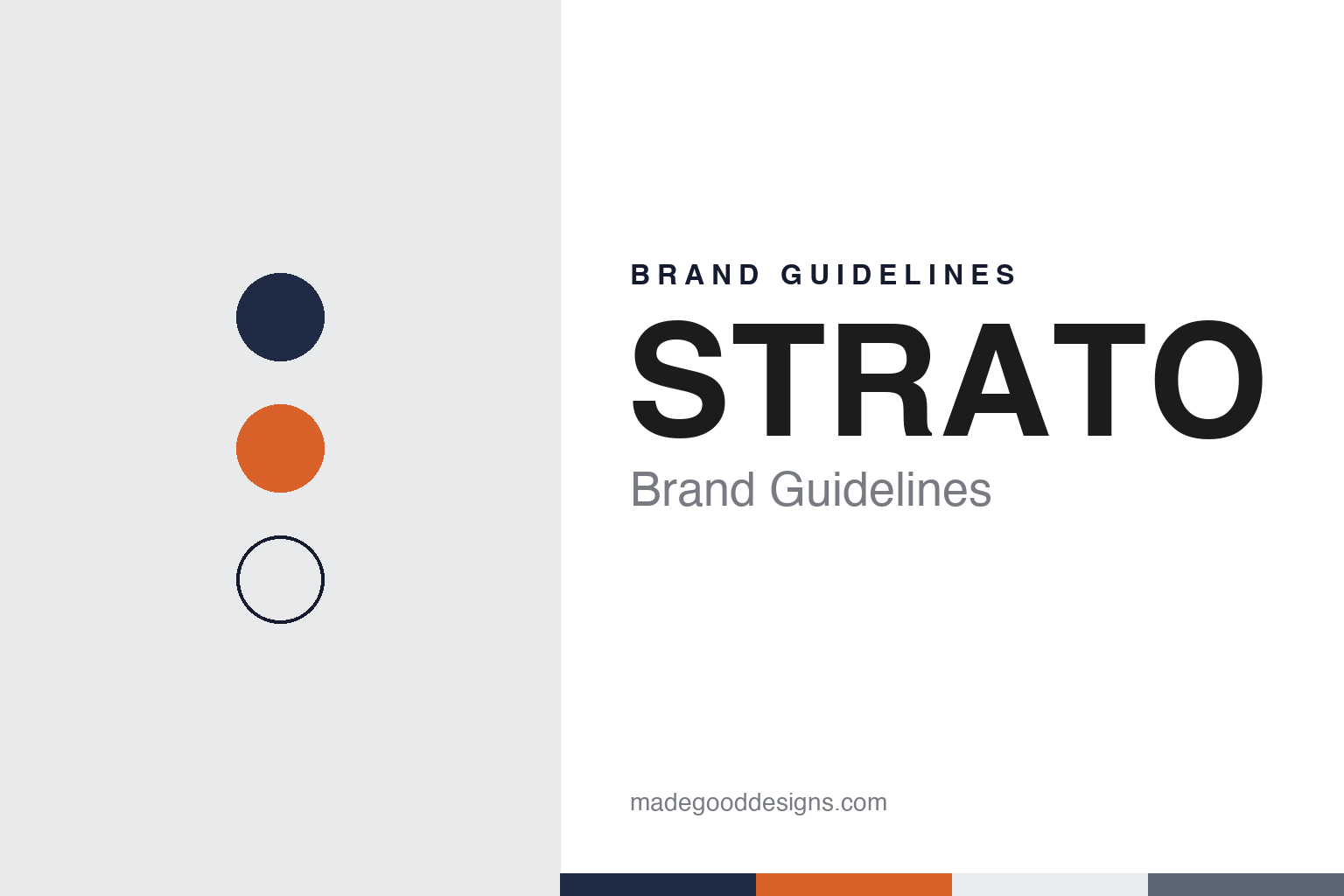
STRATO Brand Guidelines
The Berlin web host that sold homepages in a box.
Aa
Two constants: an ink blue, ember orange and cloud grey palette and a plain grotesque register. Abstract homage — not a STRATO product or mark; no logo, interface or screenshot is reproduced.
Berlin, 1997
A homepage in a box, sold from Berlin.
STRATO began in Berlin in 1997. German Wikipedia names its founders as Marc Alexander Ullrich, a former board member at Escom, and Norbert Stangl, a former managing director of 1&1; English Wikipedia spells the first founder’s surname Ulrich. A July 2024 profile in the Tagesspiegel describes the founding idea plainly: in the days of dial-up modems, the founders wanted to make websites available to private people and small firms, by turning the complex technology of web hosting into a simple, affordable do-it-yourself package.
The early product was standardised. From May 1998, German Wikipedia says, STRATO sold web-hosting packages that came with their own domain under the campaign name wunschname.de, roughly “the name you want.” In the same year the two founders sold the company to Teles, another Berlin business. At first STRATO concentrated on marketing while its partner Xlink, later KPNQwest Deutschland, ran the technology, German Wikipedia says. In 2002 STRATO bought the Karlsruhe data centre of the insolvent KPNQwest and so became independent of outside technical partners; a sister company, Strato Rechenzentrum AG, ran the technical side at first and was later merged into the main company.
Ownership then changed hands several times. Teles sold STRATO to Freenet on 12 December 2004, according to German Wikipedia. In November 2009 heise online reported that Freenet’s board had decided to sell all of its shares in Strato AG and Strato Rechenzentrum AG to Deutsche Telekom. The report described a bidding contest in which United Internet, which had already bought Freenet’s DSL business, missed out; Telekom said the purchase would make it the number two in German web hosting, and competition approval was still outstanding when heise wrote. English Wikipedia records that Telekom acquired STRATO in November 2009 to expand the hosting business of T-Online.
Colour
Shared hosting, servers and HiDrive.
Shared hosting has always been the core of the business. German Wikipedia describes STRATO’s focus as shared web hosting, in which several customers share one physical server, and says that after 1&1 it is the second-largest provider of such products in Europe. The range widened step by step: dedicated servers from the end of 2003, virtual servers from 2005 and, later, managed servers, German Wikipedia says. For a few years the company also sold DSL internet access; English Wikipedia says that business was sold to United Internet in 2009, and German Wikipedia says STRATO no longer offers its own DSL lines.
Outside hosting, its most widely reported product is HiDrive, an online storage service launched in March 2010, which German Wikipedia describes as reachable through a web interface, common file-transfer protocols and apps for phones and desktop computers. Since August 2021 a free variant, HiDrive Share, has let users send large files through a link and an eight-digit code, German Wikipedia says. On its own website STRATO now groups its offer under domains and email, website and shop, hosting and WordPress, servers, cloud storage and a set of AI tools, including a homepage builder and a STRATO GPT assistant.
The company grew outside Germany from April 2006, German Wikipedia says; English Wikipedia lists Italy, France, the Netherlands, Poland and the United Kingdom as markets entered from that year. In October 2022 CloudComputing-Insider reported that STRATO had entered Sweden through strato.se, after Spain, France, the United Kingdom and the Netherlands. At that launch, the trade site said, Swedish customers could buy classic and WordPress hosting, more than 120 domain endings including .se and .nu, the homepage builder, the Webshop Now e-commerce product, HiDrive, HiDrive Share and STRATO Mail; the chief executive at the time, Claudia Frese, pointed to the company’s 25 years in hosting.
On scale, STRATO’s own figures are the ones usually quoted. Its website says it manages more than four million domains, holds more than two million customer contracts and runs more than 100,000 physical and virtual servers in TÜV-certified data centres in Germany and elsewhere in Europe. The company says its data centres have been certified annually under ISO 27001 by TÜV since 2004, and that its HiDrive service carries the German economy ministry’s Trusted Cloud label.
Typography
Design and documentation.
Web hosting and cloud companies sell something their customers rarely see: machines in buildings far away. Their identities therefore lean on what can be shown — the customer interface, the data-centre building, the names on the order page and the corporate page that says who owns the business.
The control panel is often the part of the brand customers use most. Providers give these interfaces names of their own and place them in the main menu beside the product lines: Hetzner’s website links to customer interfaces called Robot, Console and konsoleH, and OVHcloud’s to a customer account and webmail. Documentation, status pages and programming interfaces sit in the same menus, so the brand reaches into technical writing as much as into advertising.
Data-centre photography carries the physical side of the business: rows of racks, cabling and building exteriors. Hetzner’s company pages include a 360° tour of a data centre, and its press kit sets out logos and colours for journalists. Plan names do similar work in text. Some providers use letter codes for server lines, as Hetzner does with its AX and EX lines; others use words, as OVHcloud does with ranges named Kimsufi, Advance, Game and Scale. A mascot is a further option for a host’s brand.
Corporate pages answer the questions that buyers of infrastructure ask: who owns the company, and where its machines stand. Hetzner lists data-centre parks in Germany and Finland and further sites in the United States and Singapore; OVHcloud’s corporate site gives counts of data centres, customers and countries. This guide sets out what can be checked about each brand — founding, ownership and locations — and marks clearly what rests on the company’s own word.
Aa
A plain grotesque for a plain promise. (Specimen set in Archivo, a sans STAND-IN; NOT the STRATO logo.)
STRATO
From Telekom to the IONOS Group.
The current ownership dates from a deal announced in December 2016. On 15 December that year United Internet said it had signed an agreement with Deutsche Telekom to buy Strato AG. Its announcement described a Berlin company with more than 500 employees, operations mainly in Germany and the Netherlands, more than two million customer contracts and two data centres of its own, in Berlin and Karlsruhe, and a product range running from domains and email to websites, webshops, servers and online storage. German Wikipedia says the takeover was completed in April 2017, after clearance by the competition authorities. So the bidder that lost out in 2009 ended up owning the business seven years later.
Today STRATO sits inside the IONOS side of United Internet. German Wikipedia places it in United Internet’s group of companies and, within that, in the IONOS group; STRATO’s own website describes STRATO GmbH as part of the listed IONOS Group SE, with about 350 employees. Since September 2025, the company says, its managing director has been Jens Reich. United Internet’s brand list names STRATO alongside IONOS, Fasthosts, Arsys, home.pl and World4You as hosting brands under the same owner.
The way the company talks about itself has stayed close to the 1990s idea. Its website promises web hosting that is “fair, simple and affordable” and frames the offer around flexible contract terms, a money-back period and customer service; the name is set in capital letters, STRATO, in the company’s own pages, while much of the press writes Strato. The company’s website cites customer-service awards and a CHIP test rating for its homepage builder among its distinctions. The Tagesspiegel profile of 2024 still described homepage builders as the core business, more than a quarter-century after the early wunschname.de packages.
For a design guide, STRATO shows how a hosting brand can keep a simple consumer promise while its owners change four times. Compare IONOS, its sister brand under the same owner, and Hetzner, another German host. For this guide we use ink blue, ember orange and cloud grey with a sans, an unofficial interpretation; no product or logo is reproduced.
Explore & save
Keep STRATO’s identity on hand — save it to a board in the Made Good inspiration library.
STRATO identity set
Pin the STRATO ink blue, ember orange and cloud grey palette and the plain grotesque register to your own board.