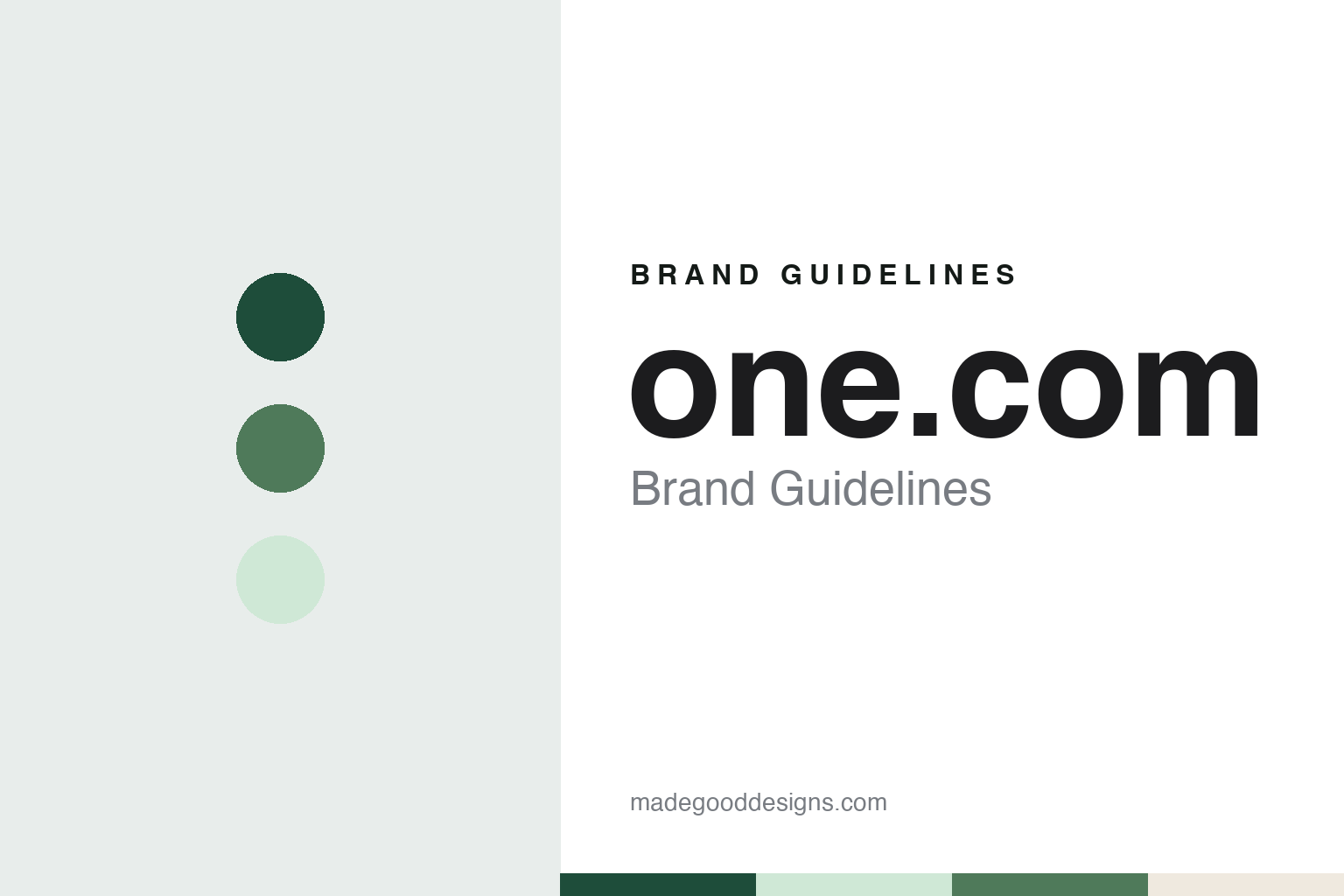
one.com Brand Guidelines
The Danish web host that grew into group.one.
Aa
Two constants: a fjord green, moss and mint palette and a friendly geometric sans register. Abstract homage — not a one.com product or mark; no logo, interface or screenshot is reproduced.
b-one, 2002
A small Danish hosting start-up.
one.com began in Denmark in 2002. Computerworld Denmark, writing in October 2020, describes it as founded that year by Jacob Jensen, and the private-equity firm Cinven, announcing its investment in December 2018, quoted Jensen as founder and chief executive; a later Cinven announcement gives his full name as Jacob Nordestgaard Jensen. The company’s present-day parent, group.one, tells the story in its own history: one.com started as a small web-hosting start-up, was first called b-one, with the web address b-one.net, and grew out of a plan by two school friends to leave school and build a software company.
Danish Wikipedia gives the corporate detail. It says the present company, One.com A/S, was established in 2006, with the forerunner B-One set up by Jensen in 2002, and that its headquarters are in Copenhagen. The group.one history says the early product was plain web space, with a maximum of 500 MB of storage, and describes the founding mission as making it easy and affordable for anyone to be online.
The name is the web address. one.com writes its name in lower case, as a web address, and its Danish “about” page now presents it as a European hosting and domain provider “since 2002,” founded in Denmark. Between 2011 and 2015, according to the group.one history, the investment firm Accel-KKR invested in one.com to support its growth, and the company expanded across key European markets. Cinven’s 2018 announcement described one.com at that point as a business with 270 employees and more than one million customers, with a focus on Northern Europe.
Colour
Hosting, domains and a website builder.
The offer has widened from web space into a set of tools for small businesses. Danish Wikipedia lists web hosting, webshops, website-builder software, email and domain registration among the company’s products. The group.one history adds that one.com launched a managed WordPress service and an advanced website builder in 2017, offered its own website builder for small businesses from 2019, and by 2025 sold booking and scheduling tools based on Shore, a booking-software company the group bought in 2024.
Customers manage those services through a single control panel. group.one names it oneHome, alongside a customer-relationship system called oneCRM and an ordering platform called oneWebshop, and describes it as an integrated platform that brings its products together. On its Danish site, one.com says it has more than two million customers, offers round-the-clock support and keeps data in data centres inside the European Union; those are the company’s own figures.
The workforce is split between Denmark and India. Danish Wikipedia says one.com had about 300 employees in 2024, around 200 in Denmark and around 100 at its Indian subsidiary.
The acquisitions came quickly after 2019. Computerworld reported in October 2020 that one.com had bought five companies in a year and a half since Cinven took a majority in February 2019, and that a sixth, the Finnish web host Zoner Oy, was its entry into Finland; the purchases spread across Norway, the Netherlands, Denmark and Finland. An earlier one, reported that summer, was Larsen Data, which had run the Danish free DNS service GratisDNS.dk since 2001. The group.one history adds Hostnet in the Netherlands, Profihost and Checkdomain in Germany, easyname in Austria and Metanet in Switzerland to the purchases of 2019 to 2022. In September 2022 Kapwatch reported that the owners of SimpleSite had sold the company to the private-equity-owned, Swedish-based one.com group.
Typography
Design and documentation.
Web hosting and cloud companies sell something their customers rarely see: machines in buildings far away. Their identities therefore lean on what can be shown — the customer interface, the data-centre building, the names on the order page and the corporate page that says who owns the business.
The control panel is often the part of the brand customers use most. Providers give these interfaces names of their own and place them in the main menu beside the product lines: Hetzner’s website links to customer interfaces called Robot, Console and konsoleH, and OVHcloud’s to a customer account and webmail. Documentation, status pages and programming interfaces sit in the same menus, so the brand reaches into technical writing as much as into advertising.
Data-centre photography carries the physical side of the business: rows of racks, cabling and building exteriors. Hetzner’s company pages include a 360° tour of a data centre, and its press kit sets out logos and colours for journalists. Plan names do similar work in text. Some providers use letter codes for server lines, as Hetzner does with its AX and EX lines; others use words, as OVHcloud does with ranges named Kimsufi, Advance, Game and Scale. A mascot is a further option for a host’s brand.
Corporate pages answer the questions that buyers of infrastructure ask: who owns the company, and where its machines stand. Hetzner lists data-centre parks in Germany and Finland and further sites in the United States and Singapore; OVHcloud’s corporate site gives counts of data centres, customers and countries. This guide sets out what can be checked about each brand — founding, ownership and locations — and marks clearly what rests on the company’s own word.
Aa
A friendly geometric sans, set in lower case like a web address. (Specimen set in DM Sans, a sans STAND-IN; NOT the one.com logo.)
one.com
From a Cinven buyout to group.one.
The ownership story runs through two private-equity deals. On 20 December 2018 Cinven announced that its Sixth Cinven Fund had agreed to acquire one.com, for an undisclosed sum, and Cinven later said that fund acquired the business in February 2019. Cinven explained the choice through its earlier hosting investment, Host Europe Group, which it had bought in 2013 and sold to GoDaddy in January 2017. Under Cinven, the hosting group took the name group.ONE; Cinven’s December 2022 announcement calls it “group.ONE (formerly one.com),” headquartered in Sweden, with brands including one.com, Hostnet and WP Media, about 1.6 million customers and more than 650 employees.
On 5 December 2022 Cinven announced two linked steps: its Sixth Fund agreed to sell group.ONE, and its Seventh Fund, with the Ontario Teachers’ Pension Plan, agreed to acquire and combine group.ONE with the German hosting group dogado. Jensen, described by Cinven as founder and a non-executive director who had remained a significant minority shareholder, reinvested in the combined group. The group.one history records that dogado and one.com merged to form today’s group.one, and that Daniel Hagemeier, previously chief executive of dogado, became its chief executive in 2023. Cinven still lists group.one in its portfolio, and Danish Wikipedia says Cinven owns the Swedish parent, One.com Group AB.
one.com is now the flagship of a much larger family. group.one says it has more than two million customers in 15 countries, more than 1,500 employees in 20 offices and 20 local brands; its history names acquisitions such as Hostnet, Zoner, Checkdomain and the Austrian media company HEROLD, and also lists the WordPress plug-in Rank Math, the compliance software Termly and the performance-monitoring service GTmetrix among later additions. In 2022 Cinven described the group’s strongest positions as being in the Nordic and Benelux hosting markets, where one.com and Hostnet trade.
For a design guide, one.com shows how a web address can work as a whole brand, from a lower-case wordmark to the name of a group. Compare GoDaddy, which bought Cinven’s earlier hosting group, and STRATO, another European mass-market host. For this guide we use fjord green, moss and mint with a sans, an unofficial interpretation; no product or logo is reproduced.
Explore & save
Keep one.com’s identity on hand — save it to a board in the Made Good inspiration library.
one.com identity set
Pin the one.com fjord green, moss and mint palette and the friendly geometric sans register to your own board.