PayU Brand Guidelines
One name for many gateways, Prosus and an India focus.
Aa
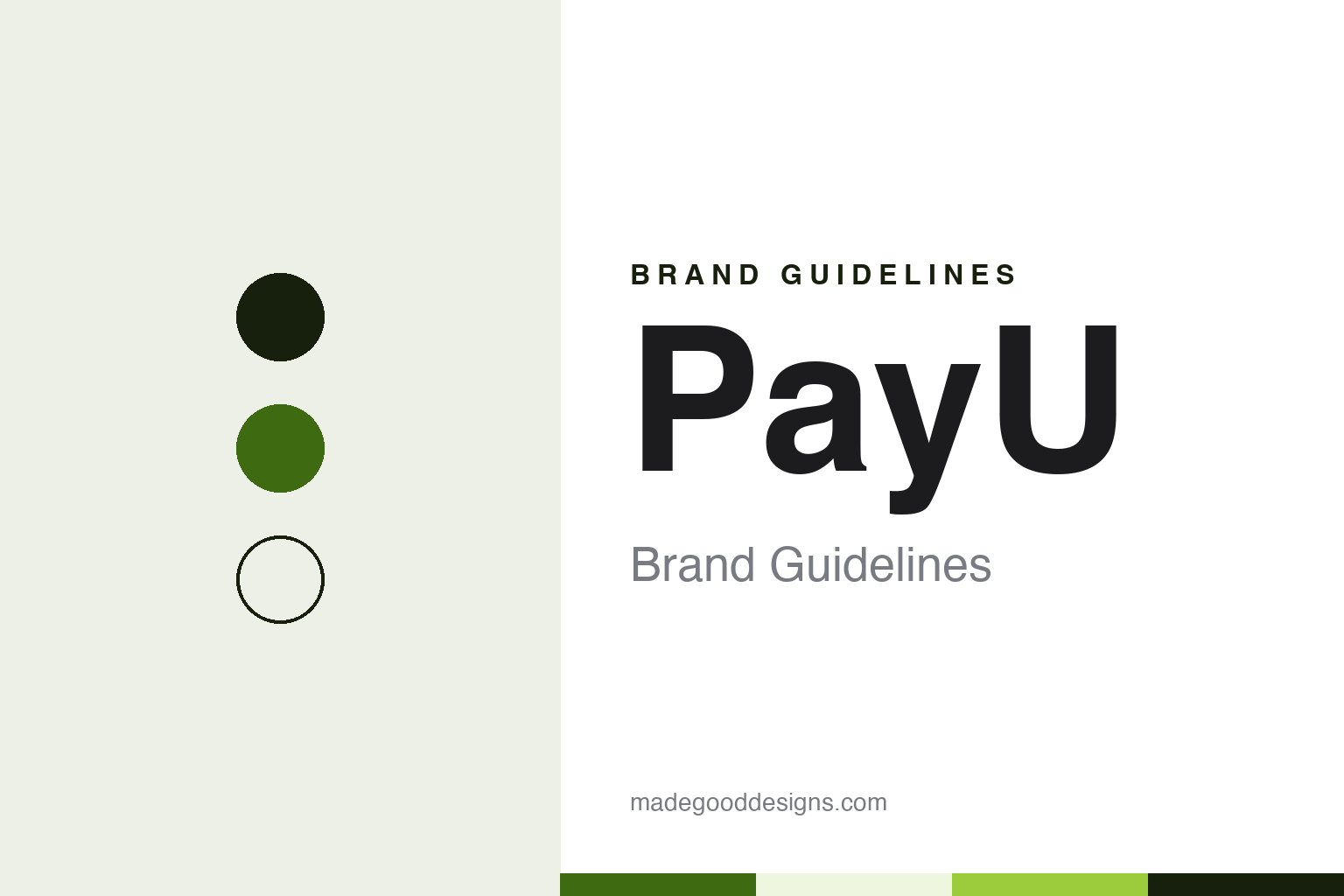
Two constants: a PayU lime and leaf green palette and a Rounded sans register. Abstract homage — not a PayU product or mark; no checkout, logo or screen is reproduced.
One name, many gateways
Assembled rather than founded in one place.
PayU is a payment service provider for online merchants. English Wikipedia describes it as a Dutch company, gives its founding year as 2002 and its headquarters as Hoofddorp in the Netherlands, and says it is owned by the South African group Naspers. PayU’s Indian website describes it as “the payments and fintech business of Prosus,” the consumer internet group with a primary listing on Euronext Amsterdam and a secondary listing on the Johannesburg Stock Exchange, majority owned by Naspers.
The brand was assembled rather than founded in one place. English Wikipedia calls PayU the result of payment gateways in various regions that were acquired and brought into the group, and says that in 2014 all of Naspers’ online payment companies began operating under the PayU brand. It also dates the Colombian gateway Pagosonline, which later became part of PayU Latam, to 2002.
In Europe, English Wikipedia says, PayU SA was established in November 2006, when the Polish firm Platnosci.pl was merged into the group. The company expanded to the Czech Republic in 2010, to Romania in 2011, the year it bought the Romanian online payments company GECAD ePayments, and in 2012 to markets including Turkey, Slovakia and Hungary.
Elsewhere the same pattern repeated. In South Africa, PayJar, set up in 2010 to process online payments for other Naspers companies, was renamed PayU in 2011, and PayU expanded to Nigeria in 2015. In Latin America, Naspers took control of Pagosonline and DineroMail, which were combined into what became PayU Latam, and in Brazil, Bcash and PayU were merged under the PayU brand in 2016, English Wikipedia says.
Colour
India at the centre.
India became the centre of the business. PayU’s Indian site dates the launch of the PayU payment gateway to 2011, when the internet company ibibo rolled it out so that websites could take payments online; English Wikipedia names its co-founders as Nitin Gupta, Narendra Nandal and Shailaz Nag. PayU India says it was demerged from ibibo in 2014, bought Citrus Pay in 2016, launched the credit product LazyPay in 2017, obtained a non-bank finance licence for its credit business in 2018 and acquired the card-authentication firm Wibmo in 2019. English Wikipedia adds the purchase of the Turkish payments company iyzico in 2019 and of the lender PaySense in 2020.
The shape of the group changed after 2023. On 1 August 2023 the payments company Rapyd announced that it would acquire PayU’s Global Payment Organisation, or GPO, from Prosus: the business outside India, Turkey and Southeast Asia, which Rapyd said operated in more than 30 countries. On 14 March 2025 Rapyd said it had completed the acquisition of PayU GPO in Latin America and Africa, adding card acquiring in six Latin American countries and markets including Nigeria and South Africa. PayU’s corporate website in 2026 still lists PayU GPO services in the Czech Republic, Hungary, Poland, Romania, Nigeria and South Africa under the PayU name.
In India the business kept building. MediaNama reported in July 2026, citing Prosus’ annual report, that PayU raised its stake in the payments infrastructure company Mindgate Solutions, founded in 2008, from 43.5% to 70.7% during the year to March 2026, and that it had received approval from the Reserve Bank of India in 2025 to operate as a payment aggregator across online, offline and cross-border transactions. Prosus said that through Mindgate and Wibmo, PayU helps banks in India process one in every two UPI transactions, the report added; that is the owner’s figure.
Typography
Design and documentation.
Payment processors and wallets present themselves in more than one place at once. A merchant meets them at the counter and in the checkout, a developer meets them in documentation, and an investor meets them on corporate pages about owners and listings. Each of those surfaces carries the brand in a different register.
At the counter, the brand is often a device. Global Payments, for example, described a modular countertop terminal for its Genius platform in November 2025, with a 15.6-inch merchant display, hidden cable management and stand, kiosk and wall-mount configurations, according to its release. Online, the brand shows up as a list of methods: PayU’s European corporate site sorts its offer into cards and digital wallets, online bank transfers, deferred payments and local schemes such as BLIK.
For developers, processors publish their own entry points. PayU’s Indian site links documentation and an API Playground, and its European site links a Developer Portal and a public status page. The Indian site also lists a mobile app SDK, a software kit for adding payments to apps, among its payment products.
Corporate pages tell the ownership story. PayU’s Indian site describes the business as part of Prosus, listed in Amsterdam and Johannesburg and majority owned by Naspers, while Global Payments’ investor site gives its New York Stock Exchange ticker, GPN, and its releases record deals such as the Worldpay purchase completed in January 2026. This guide sets out what can be checked about each company: who founded it, who owns it, and what its own pages say about its products and markets.
Aa
A rounded sans for a short, two-part name. (Specimen set in Outfit, a sans STAND-IN; NOT the PayU logo.)
PayU
Plain product names for merchants.
The products PayU shows Indian merchants carry plain names. Its Indian site groups them under accepting, managing and international payments, with a Payment Gateway, a Point of Sale range, QR payments and Payment Links alongside a UPI stack, an Affordability Suite and WhatsApp Commerce. The site says PayU serves more than 450,000 businesses in India with more than 100 payment methods; those are the company’s own figures. MediaNama listed UPI Bolt and Soundboxes among its UPI services. English Wikipedia describes PayU as a regulated financial institution holding licences from central banks and local regulators, with products including a payment gateway certified to the PCI-DSS card-data standard, an anti-fraud system and an online card acquirer for Visa and Mastercard.
Developers get their own entry points. The Indian site links documentation and an API Playground, while the European corporate site links a Developer Portal and a public status page. The corporate site organises its offer by payment method and by market, with cards and digital wallets, online bank transfers, deferred payments and local payment schemes such as BLIK, and a language switcher for each country it lists.
The company describes itself as a financial services provider in “global growth markets,” with a stated mission to let anybody make or receive payments. Its Indian site places the Prosus ownership and listings on its About page, next to a timeline of launches and acquisitions running from 2011 to 2019.
For a design guide, PayU shows how one short name can stand over gateways bought in different countries, and how that name can stay in use in markets where the business has changed hands. Compare Razorpay, another payments company from India, and dLocal, another payments company in this series. For this guide we use a lime and a leaf green with a sans, an unofficial interpretation; no product or logo is reproduced.
Explore & save
Keep PayU’s identity on hand — save it to a board in the Made Good inspiration library.
PayU identity set
Pin the PayU lime and leaf green palette and the Rounded sans register to your own board.