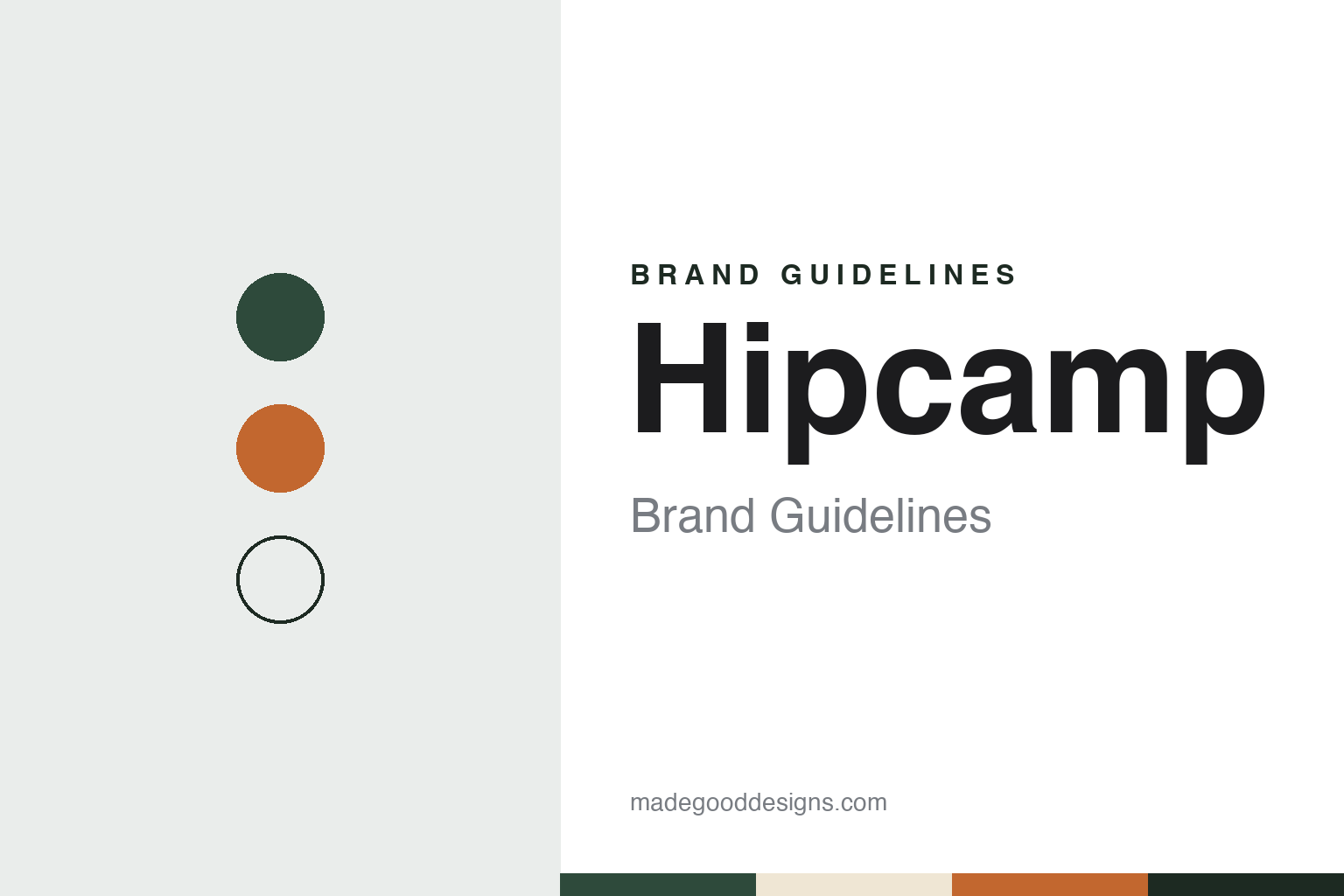
Hipcamp Brand Guidelines
The San Francisco campsite marketplace built on private land.
Aa
Two constants: a pine green, campfire orange and dry grass palette and a friendly sans register. Abstract homage — not a Hipcamp product or mark; no logo, listing or photograph is reproduced.
A campsite search
From a New Year’s trip to a booking marketplace.
Hipcamp is an online marketplace for booking campsites, RV parks, glamping stays and camping on private land, run by Hipcamp, Inc. of San Francisco. English Wikipedia gives its founder as Alyssa Ravasio and its founding year as 2013. The idea came from a camping trip: The New Yorker reported in December 2019 that Ravasio had planned to spend New Year’s Eve 2012 in Big Sur and found the business of booking a campsite maddening. The company tells the same story on its own site, placing it at Andrew Molera State Park on California’s Central Coast, where she wanted a beach spot to watch the opening sunrise of 2013.
Ravasio then taught herself to code. The company says she attended Dev Bootcamp, a coding course in San Francisco, and built a basic version of Hipcamp in 2013, and that a co-founder, Eric Bach, joined later that year. The New Yorker adds that her sisters sourced campground photographs and a friend wrote the campground descriptions for that early version.
At first Hipcamp worked more like a guidebook than a marketplace. When TechCrunch reported its seed funding in September 2014, in a round led by O’Reilly AlphaTech Ventures and Slow Ventures, the site covered only California and gave details for more than 16,000 campsites, gathered by hand from government and park websites. Campers could search by amenities such as picnic tables and running water, by features such as caves, oceans and lakes, and by activities such as biking, surfing and boating. Bookings still had to be made elsewhere. The New Yorker reported that Hipcamp joined the Sierra Club, Code for America, REI and dozens of other organisations in the Access Land coalition, which pressed for open data on public campground bookings.
The turn came in 2015, when Hipcamp launched a land-sharing programme that opened the platform to private landowners, The New Yorker reported. One of the first private properties listed was Oz Farm, a former commune in Mendocino County that rented out its cabins, cottages and geodesic domes.
Colour
“Get more people outside.”
That change made Hipcamp a two-sided marketplace: hosts list tent sites, RV pitches and lodging, and campers search by place, scenery, activity and amenity. By late 2019, The New Yorker reported, the site listed about three hundred thousand campsites, of which around eighty per cent were on government land and could not be booked directly; the privately owned remainder was where the bookings came from. The minimum land requirement for a site was generally about two acres, and listings ranged from off-grid plots and farm stays to Airstreams, yurts, tiny homes and tree houses.
The same article set out the company’s language. Its mission was “Get more people outside,” its core value “Leave it better,” and its main measure of success “nights outside.” Its blog was called Journal, and its tone was gentle and inclusive, aimed less at backcountry experts than at families and mixed groups of friends. The writer described the website as clean and cheerful, with filters for swimming holes and restrooms and high-resolution photographs of blankets and tin mugs. The company’s own about page keeps that voice: it calls Hipcamp a community of “good-natured people,” lists values that borrow the words Kaizen and Ikigai, and frames land sharing as a way for landowners to keep land undeveloped while earning from it.
The New Yorker placed the head office in San Francisco’s SoMa district and reported that Andreessen Horowitz led the company’s Series B round, with other investors from the technology and entertainment worlds. A host summit was held at a ranch in Livermore, one of the properties on the site.
Typography
Cottages, cabins and campsites.
Holiday cottage agencies sell places rather than products, and their pages are built around the property photograph. A typical listing opens on an exterior shot of a cottage, a cabin or a tent in its landscape, followed by interiors, the view from the door and, increasingly, the hot tub or the log burner. The companies publish these images themselves, usually taken for the agency or supplied by the owner, and the look of a brand is set as much by that photography as by any logo.
Naming follows the way people plan a break. Agency menus are organised by region (the Lake District, Cornwall, the Scottish Highlands, North Wales) and by collection: dog-friendly cottages, cottages with a hot tub, coastal cottages, large houses for groups, last-minute breaks. Sykes Holiday Cottages, for example, lists collections of this kind alongside its region pages, and glamping and campsite platforms apply the same logic to shepherd’s huts, yurts, treehouses and pitches.
Search is the core interface. Guests enter a place, dates and party size, then filter by features and browse results as a list or on a map. Some groups now add conversational search: in February 2026 Awaze said it had launched an app within ChatGPT that starts with Cottages.com and returns live availability from a plain-language request.
Behind the consumer brands sits a second audience: property owners. Most agencies run separate pages that invite owners to let their home through them, and corporate sites describe group structures. Several of the names in this guide belong to larger groups: Cottages.com to Awaze, and Sykes Holiday Cottages to Forge Holiday Group, the parent brand Sykes launched in 2023. This guide sets out who founded each brand, who owns it, and what it publishes, and marks what rests only on the company’s own word.
Aa
A friendly sans for a campsite marketplace. (Specimen set in DM Sans, a sans STAND-IN; NOT the Hipcamp logo.)
Hipcamp
Australia, Canada, the UK and RV parks.
Hipcamp grew abroad by buying local platforms. In August 2020 it bought Youcamp, an Australian site that let landowners host campers, Skift reported that month; Youcamp later redirected to Hipcamp. English Wikipedia records the purchase of Pitched, a Canadian marketplace, in 2021.
In the UK, Skift reported in January 2022 that Hipcamp had acquired Cool Camping, according to regulatory documents. In May 2022 Short Term Rentalz reported that Hipcamp had announced the purchase of the London company behind it, Tripadee Ltd, and the full folding of the Cool Camping brand into Hipcamp; Tripadee, which began in 2006 as the publisher of the Cool Camping guidebooks and set up its booking site in 2015, was to operate as Hipcamp UK Ltd. English Wikipedia dates that acquisition to 2023. At the time Hipcamp was reported to list more than 470,000 campsites across the United States, Canada, Europe and Australia.
In October 2024 Hipcamp announced the acquisition of BookOutdoors, a booking platform for campgrounds, RV parks, cabins and glamping resorts, RVBusiness reported; the company said campers had booked more than 3.3 million nights through it in the previous year. English Wikipedia says that in May 2025 Hipcamp roughly doubled its inventory by adding RV parks, camping resorts and public lands, reaching 565,000 campsites. In March 2026 4X4 Australia reported new Australian filters for four-wheel-drive access and rooftop tents, with the “RV Type” filter renamed “Rig type,” and said the platform had reported 18 million unique visitors in 2025. Ravasio remained founder and chief executive, that report said.
For a design guide, Hipcamp shows how a booking platform can build a voice around land, light and the outdoors rather than around rooms. Compare Airbnb, the marketplace The New Yorker compared it to in 2019, and Canopy & Stars, a UK collection of outdoor stays. For this guide we use pine green, campfire orange and dry grass with a sans, an unofficial interpretation; no product or logo is reproduced.
Explore & save
Keep Hipcamp’s identity on hand — save it to a board in the Made Good inspiration library.
Hipcamp identity set
Pin the Hipcamp pine green, campfire orange and dry grass palette and the friendly sans register to your own board.