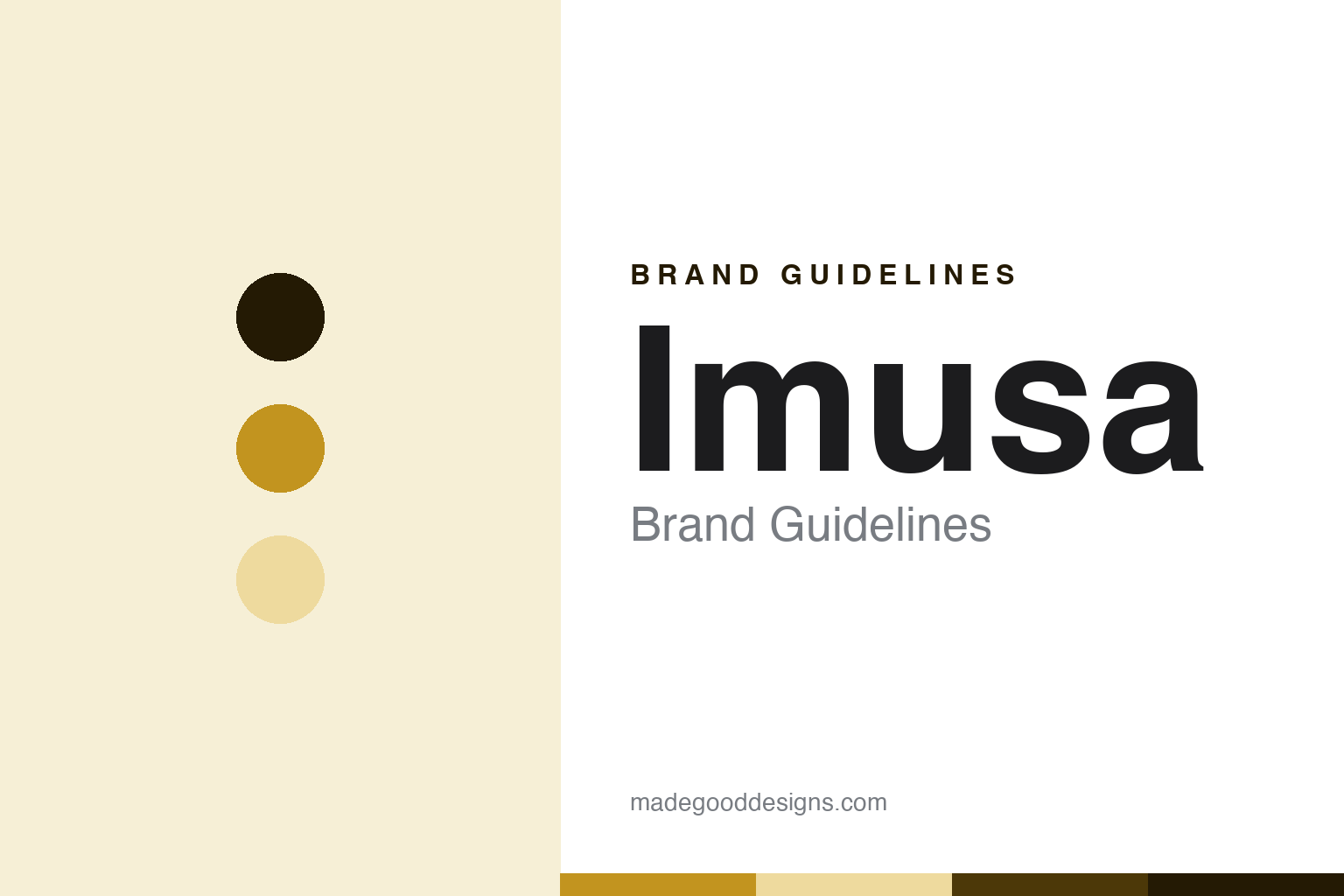
Imusa Brand Guidelines
The Latin-kitchen staple.
Aa
Two constants: a Latin-marigold palette and a staple-sans register. Abstract homage — not an Imusa product or mark; no cooker, pot or logo is reproduced.
The Latin-kitchen staple
Imusa is the Colombian-origin, French-owned cookware brand that stocks Latin kitchens with affordable rice cookers and staples.
Imusa brings the round its Latin-kitchen node — the affordable cookware brand that stocks Hispanic and Latin American kitchens with the everyday tools they actually use. Its answer to a round about who owns the rice cooker and where it is made is a cross-border one: a Colombian-origin brand, now French-owned, made across Latin America and Asia.
Its identity is the Latin-kitchen staple. The Colombian origin, the French ownership and the Latin-market focus are the story here. A cooker, a staple. The Latin-kitchen staple.
(Honest notes, so the origin, the ownership and the market are framed accurately, with one date hedged. Imusa sells budget and value cookware and appliances aimed at the Hispanic and Latin American market as its heroes — rice cookers alongside caldero Dutch ovens, moka pots, and arepa and tortilla tools — styling itself a leading Hispanic and ethnic cookware brand, and we report its language as its own. On origin: Imusa, from Industrias Metalúrgicas Unidas, originated in Medellín, Colombia, and dates itself to 1934, with US operations as IMUSA USA. On ownership, the point that matters: Imusa is owned by Groupe SEB, the French appliance and cookware giant, and is listed among its brands; the acquisition is widely reported around 2011, a year we flag as one to verify while treating the ownership itself as confirmed. On the identity: Imusa is Latin American in origin but French-owned, not an Asian or US-born brand, and its cookers are budget and mass-market for Latino households. On where it is made: Latin America and Asia, depending on the product. Its designs and the Imusa name, a Groupe SEB asset, are IP we describe but do not reproduce; these tones are an unofficial interpretation.)
Colour
Imusa lives in a Latin marigold. Click a swatch to copy the hex.
Imusa’s identity is affordable, warm and Latin-kitchen — a Latin marigold, an ink, a pale straw, a deep amber, and a paper. The palette leans Latin marigold and pale straw: a warm, homey register that nods to a busy Latin kitchen rather than a loud logo colour. It signals the Latin-kitchen staple — affordable, warm and Latin-kitchen. The honest caveat: with no published brand hex, these values are an original, unofficial interpretation, not first-party colours.
The lesson is a Latin marigold signals an affordable, warm identity. Imusa’s world is the everyday cookware in a Latino household. For designers, it is a reminder that a warm Latin marigold and a soft pale straw can carry a hardware brand — a homey tone held as colour, not a product shot. Because these tones can fail as small text, keep type dark and let the colour live in the accents, palette and band. The takeaways: keep the origin Colombian and the owner Groupe SEB; date the founding to 1934 and flag the ~2011 acquisition year; lead with the Latin-market focus; and place manufacturing across Latin America and Asia.
Typography
The register is a staple sans — affordable, warm, Latin-kitchen.
Imusa’s identity carries an affordable, warm, Latin-kitchen spirit — an everyday staple brand, not a premium house. A staple sans captures the mood: clean, plain and friendly, the register of the cookware a household reaches for daily. Set in a Latin-marigold palette, the staple sans feels affordable and warm — exactly the personality Imusa carries. It behaves like a made, functional thing rather than a loud logo, mirroring a steam plume and a grain scatter. (Imusa’s real products and the name are things we describe but do not reproduce, and the exact typeface is not ours to use.) Because it is not ours to use, the honest description is “a staple-sans brand,” shown here in a stand-in. The type behaves like the brand: affordable, warm and Latin-kitchen.
Aa
A staple-sans brand — affordable and warm. (Specimen set in Archivo, a staple-sans STAND-IN; NOT the Imusa logo or livery.)
The rice cooker
Imusa stands for the Latin-kitchen staple.
Imusa brings the round its Latin-kitchen node. A Latin-marigold palette, a staple sans and a 1934 founding make one thing — the Latin-kitchen staple — the whole identity: affordable, warm and Latin-kitchen. The Colombian origin is the root, and the French ownership is the frame. The point is an affordable brand built for Latin kitchens, in a round about who owns the rice cooker and where it is made.
Put to work, the identity is the brand told straight, the origin kept and the ownership named. A brand in this spirit would keep the origin Colombian and the owner Groupe SEB, date the founding to 1934 and flag the acquisition year, and lead with the Latin-market focus. A reader in this spirit would keep the facts right: Imusa sells affordable rice cookers and Latin-kitchen staples as heroes; it originated in Medellín, Colombia, in 1934; it is owned by France’s Groupe SEB; it serves the Hispanic and Latin American market; and it is made across Latin America and Asia. Imusa sits sixth in the round, after Midea. The honest editorial moves are to keep the origin Colombian and the owner Groupe SEB, to date the founding and flag the acquisition year, to lead with the Latin-market focus, and to place manufacturing across Latin America and Asia.
For designers and brand-builders, Imusa continues the rice cooker: serve a specific culture’s kitchen — and state a cross-border ownership honestly. The lessons: a brand can own a cultural market, here the Latin kitchen, as its whole identity; an origin and an owner can be in different countries — Colombian-born, French-owned — and both should be stated; hedge an acquisition year the record does not settle while confirming the ownership; and lead with the market a brand actually serves. It is also a reminder to stay precise: Imusa is the Colombian-origin, French-owned cookware brand that stocks Latin kitchens with affordable rice cookers and staples — with the palette here an unofficial interpretation. The hook is that identity: Imusa is the brand a Latino household reaches for — affordable rice cookers next to calderos, moka pots and arepa tools — a Colombian name from 1934 now owned by France’s Groupe SEB, serving a cultural market the round’s Japanese and Chinese giants do not. Read that way, Imusa is less a generic cookware brand than a Latin-kitchen staple: affordable, warm, Latin-kitchen. The lesson for a brand is that a cultural market focus and honest cross-border ownership reinforce each other, and naming Groupe SEB keeps the story earned. Imusa made the-Latin-kitchen-staple the identity — proof that a cultural focus can carry a round.
Explore & save
Keep Imusa’s identity on hand — save it to a board in the Made Good inspiration library.
Imusa identity set
Pin the Latin-marigold palette and the staple-sans register to your own board.