Julio Brand Guidelines
Mexico City womenswear that began with office coordinates.
Aa
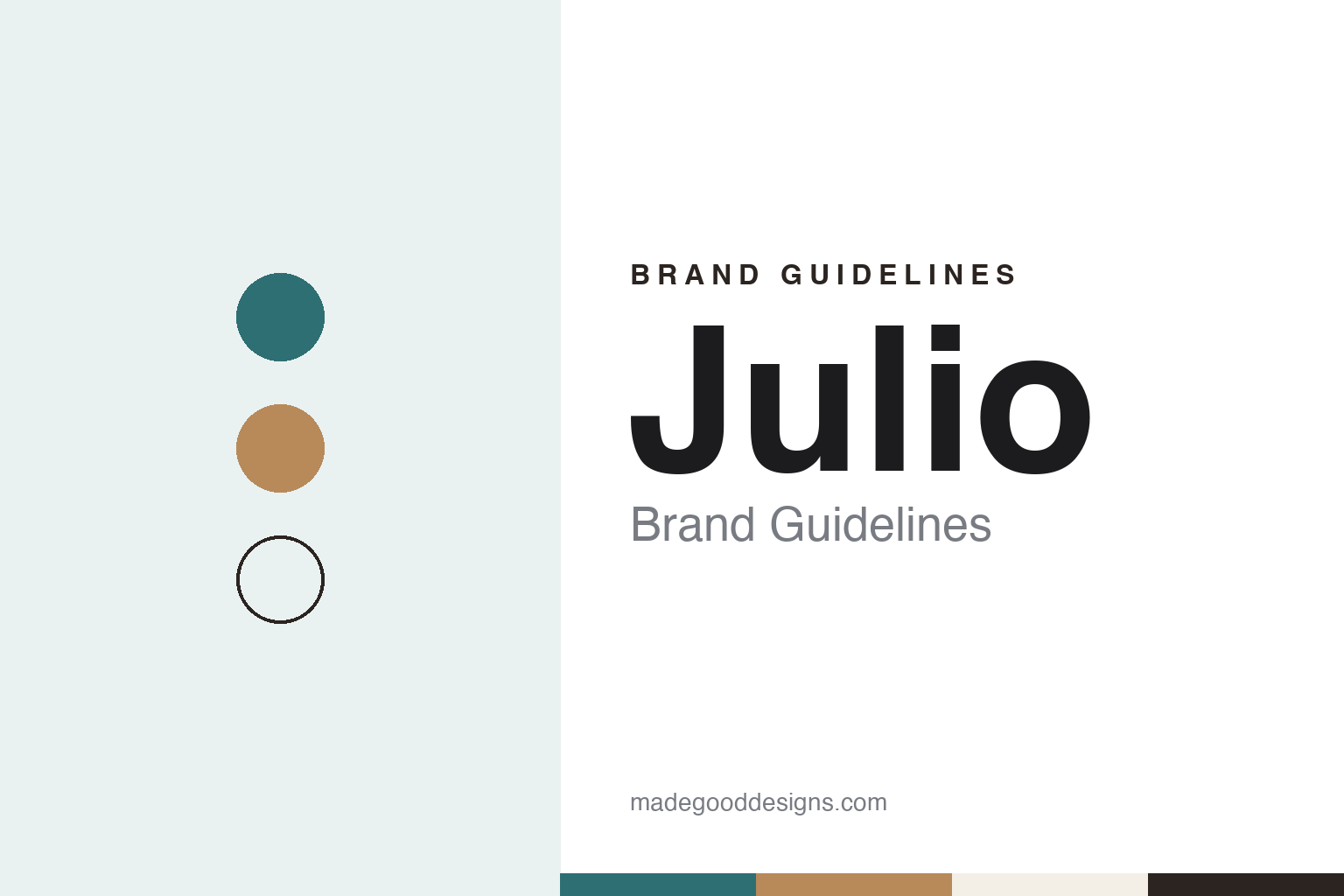
Two constants: a deep turquoise, camel and ivory palette and a boutique serif register. Abstract homage — not a Julio product or mark; no garment, label or logo is reproduced.
Coordinates
Office outfits sold without a label.
Julio is the womenswear brand of Grupo Julio, a Mexican company whose story begins in the capital in the mid-1970s. Dates differ slightly. A column published by Forbes México in April 2014 gives the start as 1976, when, it says, two brothers saw an opening in making coordinated outfits for women who worked in corporate offices, banks and department stores. The Peruvian retail news site Perú Retail, citing the Mexican newspaper El Financiero, gave the founding year as 1975 in December 2015.
For the first years there was no Julio label at all. According to the Forbes México column, the coordinated sets and corporate uniforms were sold through department stores and established shops without their own brand for eleven years. The column adds that Julio was still associated with corporate coordinates when it was written, nearly four decades on.
The change came in 1986. The same column describes a second idea: to make fashion for a whole way of life, covering all the roles of Mexican women rather than only office wear. That year the company opened its first store under the Julio name at Perisur, the shopping centre in the south of Mexico City. From that point the brand was sold through its own boutiques as well as through other retailers.
The name itself is written in capitals with a registered-trademark sign, JULIO®, on the company’s website and in its terms of sale.
Colour
Boutiques, outlets and an online shop.
By the spring of 2014 Julio had become a chain. The Forbes México column counted 118 points of sale, including the online shop, department-store spaces, outlets and eight boutiques in Colombia. It said the brand was aimed at women aged 25 to 45, and that the company employed about 1,000 people: some 700 in its boutiques and 300 in head office. The column reported the company’s account of where its clothes come from — fabrics imported from Italy, made up in Mexico — and that is the company’s claim as reported, not an independent finding.
Online selling started in 2012. According to the column, the online shop had been planned for about five years before it opened in October 2012. Collections were uploaded before they reached the boutiques, and orders could be exchanged in stores. The column said the shop delivered only within Mexico, apart from a few one-off sales to customers in Australia and France who already knew the brand. That remains the rule today: Julio’s terms of sale say the company accepts and sends online orders only within the Mexican Republic, and that items bought online can be exchanged at any JULIO boutique.
In December 2015 Perú Retail reported that Grupo Julio had about 120 points of sale in Mexico and Colombia. Beyond Mexico City and its metropolitan area, the report listed branches in states including Aguascalientes, Campeche, Durango, Guerrero, Hidalgo, Morelos, Sinaloa, Veracruz and Quintana Roo. It quoted the group’s marketing director as its source.
The brand crossed into Central America in 2017. Forbes México reported in September of that year that Julio had opened its first store in Guatemala, after Mexico and Colombia. The company’s public-relations manager described Julio to the magazine as a “100% Mexican” company, and said its collections — of 40 to 50 different garments — were renewed constantly, with more attention than before on accessories such as shoes, bags and jewellery.
Typography
Mexican fashion and footwear.
Mexican fashion and footwear brands reach their customers in several different ways, and their identities follow from that choice. Some sell mainly through printed and digital catalogues carried by networks of independent sellers; others sell through chains of their own stores, department-store counters or, in a few cases, museum and hotel shops. A catalogue brand’s pages, a sportswear maker’s team kits and a silk house’s scarf prints each do the work that a shop window does elsewhere.
León, in the state of Guanajuato, is the centre of much of the footwear trade. Business titles such as Alto Nivel and El CEO describe the city as home to shoe and sportswear makers including Andrea, Charly and Pirma, and to many small and medium producers of leather goods. Several companies started elsewhere and moved there: Andrea began in Mexico City in 1973 and moved its making to a León factory in 1981, according to Alto Nivel.
Ownership is usually private, and often in the hands of founders or families. Company pages and the business press describe founders, holding companies and store networks in different levels of detail, and branch, affiliate and outlet counts change from year to year, so each figure in these guides carries the date of the source that gave it. Where a brand’s own website is the only source for a statement, the guide says so.
This guide sets out what can be checked about each brand: who founded it and when, who owns it, where its products are made as far as dated sources say, and how it presents itself through catalogues, kits, prints and stores. The colours and typefaces shown are an unofficial interpretation, not the brands’ own.
Aa
A refined serif for a boutique wordmark. (Specimen set in Cormorant Garamond, a serif STAND-IN; NOT the Julio logo.)
Julio
A wardrobe sorted by occasion.
Julio’s website today is organised like a wardrobe. Its clothing sections cover sweaters, dresses and jumpsuits, blazers and jackets, vests, blouses, trousers and leggings, jeans, skirts and coats, with separate sections for shoes — boots, sandals, heels and flats — and for accessories including bags, scarves, belts, gloves and jewellery. The site also has a make-up section and a corporate-sales page, an echo of the business’s start in coordinated outfits for working women.
Seasonal ranges are presented as named collections rather than numbered drops. Among the collection names on the site in November 2026 were Marrakesh, Toulouse, Terra and Onix, with others such as Aura, Kira and Lido. Several of the names refer to places or materials. The site’s description of itself speaks of feminine fashion, dresses, sweaters, blazers and vests, and leads with sweaters in a turquoise blue.
The way Julio tells its own story is also consistent across the sources used here. In 2014 the company stressed the women it dresses — the professional, the mother, the woman with many roles; in 2015 it spoke of its branches across the country; in 2017 it spoke of being Mexican-owned and of bringing global trends to the figure of the Latin American woman. All three accounts reached readers through company spokespeople quoted in the press, so they describe how the brand presents itself rather than independent findings.
For a design guide, Julio shows how a brand born making unbranded office coordinates can turn its own name, set in plain capitals, into the main signal of a boutique chain. Compare Dorothy Gaynor, another Mexican womenswear label, and El Palacio de Hierro, the Mexico City department store. For this guide we use a deep turquoise, a camel and an ivory with a serif, an unofficial interpretation; no product or logo is reproduced.
Explore & save
Keep Julio’s identity on hand — save it to a board in the Made Good inspiration library.
Julio identity set
Pin the Julio deep turquoise, camel and ivory palette and the boutique serif register to your own board.
Source & notes
Frequently Asked Questions
What font can I use to match the Julio look?
This guide describes Julio’s type as “A refined serif for a boutique wordmark”. Its type specimen is set in Cormorant Garamond from Google Fonts as a stand-in; Cormorant Garamond is not Julio’s own lettering.
What colours are in the Julio palette?
This guide’s Julio palette is Deep turquoise #2E6F73, Camel #B88A5A, Ivory #F3EEE6, Espresso #2B2420 and Paper #F9F7F3. The tones are the guide’s own unofficial interpretation, not official Julio hex codes.
When was Julio founded?
Julio was founded in 1975 or 1976, in Mexico City.