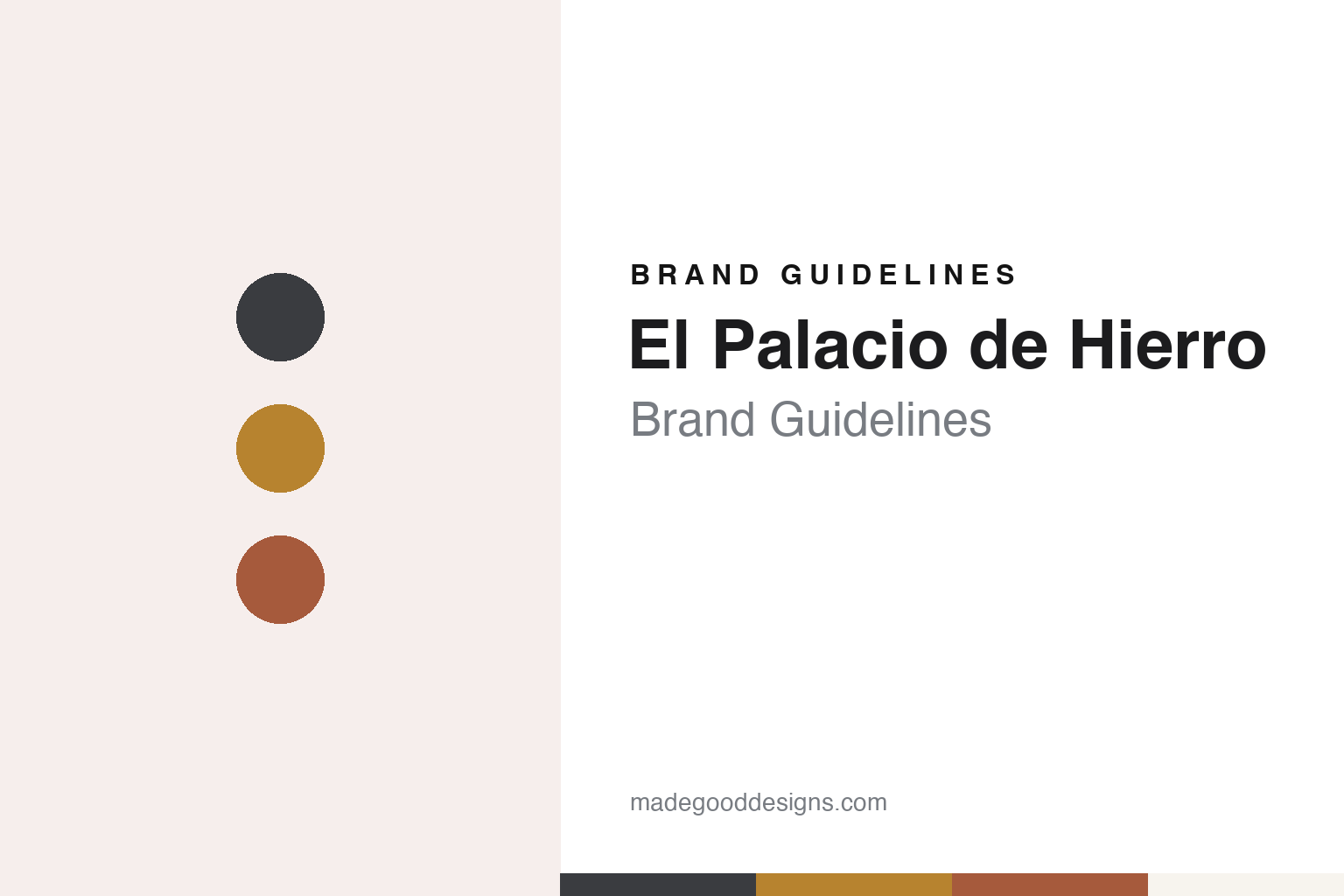
El Palacio de Hierro Brand Guidelines
An iron-and-steel store of 1891 and the glass ceiling of 1921.
Aa
Two constants: a cast-iron grey, stained-glass amber and terracotta palette and a Belle Époque serif register. Abstract homage — not an El Palacio de Hierro product or mark; no logo, window or shopping bag is reproduced.
Las Fábricas de Francia
A French clothing shop and an iron building.
El Palacio de Hierro grew out of a clothing shop called Las Fábricas de Francia. English Wikipedia says the French immigrant Victor Gassier opened it in the 1850s, joined Alexander Reynaud in 1860, and that in 1876 José Tron, his brother Henri and José Leautaud bought into the business, which from 1879 was formally J. Tron y Cía. Spanish Wikipedia tells the story from the shop floor: Tron and Leautaud, who had met on the crossing from France, worked at the shop on the Portal de las Flores beside the Zócalo until they bought it in 1876. It places the store in a long line of businesses started by merchants from the Barcelonnette area of the Ubaye valley in the south of France, whose trade in Mexico gave rise to many Mexican shops.
The partners wanted something larger, a store on the lines of the great Paris shops such as Le Bon Marché. Both Wikipedia articles give 30 January 1888 as the date the deed of incorporation was signed. The firm bought land at the corner of what are now Venustiano Carranza and 20 de Noviembre, and English Wikipedia says it hired the Mexican architect Ignacio de la Hidalga for a five-storey building of iron and steel. The name has two versions. English Wikipedia says passers-by asked what “iron palace” was going up and the owners adopted the phrase; Spanish Wikipedia calls that a legend and says the store already bore the name in its deed.
The store opened on 1 July 1891. Spanish Wikipedia quotes a contemporary description of the building, with a rooftop sign in large gilded letters reading “Almacenes del Palacio de Hierro” and the firm’s interlaced initials carved in a stone medallion dated 1891. It also says the store sold by catalogue as well as over the counter and introduced labelled fixed prices in place of haggling. In 1898 the firm was reorganised as El Palacio de Hierro, S.A., a public limited company.
Colour
Dubois, Grüber and the Baillères years.
The downtown building that stands today opened on 14 October 1921. English Wikipedia credits its design to the French architect Paul Dubois and its stained-glass ceilings to Jacques Grüber of Nancy; Spanish Wikipedia describes a reinforced-concrete building with Art Deco touches, drawn up by Dubois with the architect Marcon, and a central court under Grüber’s glass, joined to parts of the earlier structure such as the main door’s ironwork and the carved J. Tron y Cía. medallion. The store still trades there, on Venustiano Carranza a block south of the Zócalo, English Wikipedia says.
Until the late 1950s the company ran its downtown store alone. Its first branch, on Durango street in Colonia Roma, opened in 1958; English Wikipedia says it was designed in a functionalist style by the architects José Aspe Sais and Vladimir Kaspé. Spanish Wikipedia says the company has been listed on the Mexican Stock Exchange since 1964, as El Palacio de Hierro and from 1990 as Grupo Palacio de Hierro. In October 1963, according to English Wikipedia, Raúl Baillères and his son Alberto each acquired half of the shares, and the company became part of Grupo BAL, the family’s group with interests in insurance, mining and retail, which still controls it.
The store’s advertising is part of its identity. English Wikipedia says the slogan “Soy totalmente Palacio”, or “I am totally Palacio,” came out of a 1995 brand review by the agency Terán, later Terán\TBWA, which had handled the store’s advertising since 1947. The campaign addressed women only; a teaser ran in 1995 and the full campaign in 1996, under the creative director Ana María Olabuenaga. In 2025, English Wikipedia says, it was followed by “Sí Soy,” or “Yes, I am,” presented as an evolution of the original line.
Typography
Department stores in Mexico and Chile.
The department stores of Mexico and Chile are big, city-centre and shopping-mall businesses, and their identities are carried as much by buildings as by logos. Two of the oldest, Liverpool and El Palacio de Hierro, began as nineteenth-century clothing and fabric shops in the historic centre of Mexico City, and Liverpool’s corporate history page still traces the chain back to that first shop of 1847 and lists, year by year, its moves into shopping centres and other cities.
Store naming is often plain description or a borrowed place. El Palacio de Hierro, according to English Wikipedia, took its name from the iron-and-steel building that rose in the 1880s; Liverpool, Spanish Wikipedia says, was named after the English port its imported goods were shipped from. Branches then take the name of the district or mall they anchor, so a shopper meets the brand as “Liverpool Insurgentes” or “Liverpool Polanco,” and Spanish Wikipedia writes of “Palacio Polanco.”
The flagship façade does a great deal of the work. Downtown stores keep their early buildings, and newer flagships are built as architecture in their own right — El Palacio de Hierro’s Polanco store, reopened in 2015, has floors themed on districts of the city. Seasonal campaigns are just as visible: El Financiero has described Liverpool’s recurring Venta Nocturna sales, held over two or three days several times a year, and the Christmas tree that El Palacio de Hierro raises in front of its Polanco store with a luxury partner: Dior in 2025 and Swarovski in 2026.
Store cards carrying the chain’s name are part of the picture too: El Financiero notes that Liverpool pitches some sale offers to its own cardholders, though this guide does not describe the credit products themselves. Corporate pages also set out owners and listings: both Mexican groups have long been listed on the Mexican Stock Exchange, and Liverpool’s investor site carries its annual and quarterly reports beside a year-by-year history.
Aa
A Belle Époque serif for a store named after its iron frame. (Specimen set in Cormorant Garamond, a serif STAND-IN; NOT the El Palacio de Hierro logo.)
Palacio Polanco
Malls, outlets and the Palace of Palaces.
Expansion came with the shopping malls. Spanish Wikipedia lists stores at Perisur in 1980, Centro Coyoacán in 1988, Santa Fe in 1993, a first outlet in Tlalnepantla in 1996, Polanco in 1997 and Satélite in 1998. The first store outside greater Mexico City opened in Puebla in 2002, followed by Monterrey in 2005 and Guadalajara in 2008, and the home-store format Casa Palacio opened at Antara in 2006. Later stores followed in Boca del Río, Veracruz, in 2019, at the Mítikah centre in 2022, replacing the Centro Coyoacán store, and in León in October 2024, which English Wikipedia says follows the company’s Tiendas de Comunidad, or “community stores,” idea of drawing on local culture in the design. As of 2025, English Wikipedia says, the group ran 15 full-line department stores, two Casa Palacio stores, two Boutique Palacio stores, two outlets and about 120 freestanding brand stores.
The Polanco store is the modern showpiece. La Hoja de Arena reported in November 2015 that the Polanco store had reopened, after almost two years of work that absorbed the former Plaza Molière 222, as El Palacio de los Palacios, the “Palace of Palaces,” extended by Sordo Madaleno Arquitectos with Gensler and TPG Architecture. Its floors take their themes from parts of the city: Paseo de la Reforma, Polanco and Lomas de Chapultepec, Roma and Condesa, and Jardines del Pedregal. The magazine noted a terracotta-coloured precast façade and that the building also holds the offices of Grupo BAL. Each Christmas a tree goes up in front of the store’s Avenida Moliere façade; El Financiero reported in November 2026 that Dior had worked on the 2025 tree and that the 2026 tree was a collaboration with Swarovski. English Wikipedia says Eléonore de Boysson, formerly of LVMH and DFS, became chief executive in June 2025.
For a design guide, El Palacio de Hierro shows how a building can name a brand, and how a store can keep that building at the centre of its story for well over a century. Compare Liverpool, which also began as a clothing shop in the historic centre, and Sanborns, another long-established Mexico City retailer. For this guide we use cast-iron grey, stained-glass amber and terracotta with a serif, an unofficial interpretation; no product or logo is reproduced.
Explore & save
Keep El Palacio de Hierro’s identity on hand — save it to a board in the Made Good inspiration library.
El Palacio de Hierro identity set
Pin the El Palacio de Hierro cast-iron grey, stained-glass amber and terracotta palette and the Belle Époque serif register to your own board.