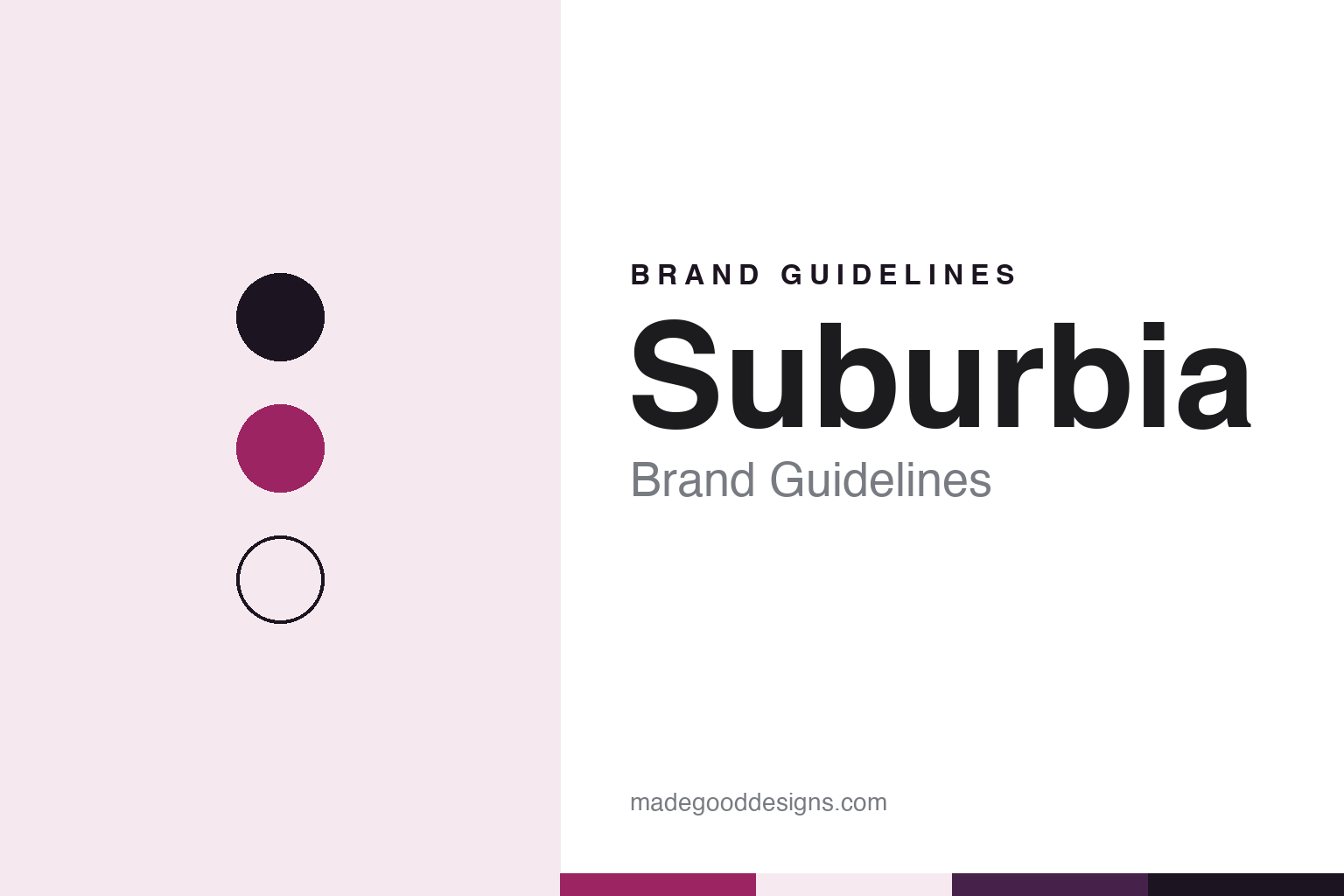
Suburbia Brand Guidelines
A 1970 Taxqueña store, a Walmart chapter and an S in a circle.
Aa
Two constants: a Suburbia berry, blush and plum palette and a Rounded sans register. Abstract homage — not a Suburbia product or mark; no logo, sign or shopfront is reproduced.
A store for the whole family
Taxqueña, October 1970.
Suburbia opened its first store on 28 October 1970 in the Taxqueña area of southern Mexico City, English Wikipedia says, as a department store selling clothing, footwear and accessories for the whole family. English Wikipedia says the chain sells clothing, appliances, electronics and mobile phones aimed at shoppers on middle and lower incomes, and the name has stayed the same for more than half a century. When Walmart de México agreed to sell the chain in 2016, El Financiero described Suburbia as a business with more than 45 years in clothing and footwear retail.
For most of its life Suburbia sat inside a larger retail group. English Wikipedia says that in 1986 it was brought together with the Aurrerá and Bodega Aurrerá stores, the Superama supermarkets and the VIPS and El Portón restaurants in Grupo Cifra. In 1994, with VIPS, it became part of the Cifra-Walmart group, which took the name Walmart de México in 2001. Over those years many Suburbia stores shared a car park or a shopping centre with a Walmart, a Bodega Aurrerá or a Sam’s Club, the same source says, so the brand grew up beside supermarkets rather than in fashion malls.
The stores themselves are mid-sized. English Wikipedia gives a sales floor of roughly 1,500 to 6,000 square metres over one to three floors, and lists two smaller variants: Zona Suburbia, a compact clothing-and-shoes shop in historic town centres, and Suburbia Liquidaciones, an outlet format. When Liverpool bought the chain, it inherited a large list of own labels; El Financiero named Weekend, Contempo, Non Stop and La Mode among them, and the deal covered the intellectual property in the Suburbia name and those brands.
Colour
From a box to an S in a circle.
Suburbia’s identity has been rebuilt twice under its new owner. The first change was the store. In September 2019 El CEO reported that the chain had reopened its store at Villa Coapa, in the south of Mexico City, as the first one in a new format, with new architecture, lighting and layout and with a wider range than clothing alone: white goods, toys, electronics, furniture, luggage and personal care. El Puerto de Liverpool’s own history page records the same step for 2019, when Suburbia added general merchandise to its offer, and says the Suburbia website began taking online orders in October 2018.
The second change was the mark. In July 2025 the marketing magazine Merca2.0 reported that Suburbia had redesigned its logo with the agency Magnify. The old design set an “Sb” monogram inside a box; the new one drops the box and the “b,” keeps a single S in a circle and sets the word Suburbia in a cleaner, more legible type. The magazine said the agency aimed for a mark that was dynamic, modern and recognisable across a network of more than 200 points of sale, and that the logo was appearing in branches as they were refitted.
For a designer, the change is a study in simplification. A two-letter monogram in a frame became one letter in a circle, and Merca2.0 said the aim was a symbol that worked in print, on signs and on digital platforms. The palette in this guide is our own: a berry, a blush and a plum chosen to sit with a rounded sans, rather than a copy of any Suburbia sign.
Typography
Design and documentation.
The department stores of Mexico and Chile are big, city-centre and shopping-mall businesses, and their identities are carried as much by buildings as by logos. Two of the oldest, Liverpool and El Palacio de Hierro, began as nineteenth-century clothing and fabric shops in the historic centre of Mexico City, and Liverpool’s corporate history page still traces the chain back to that first shop of 1847 and lists, year by year, its moves into shopping centres and other cities.
Store naming is often plain description or a borrowed place. El Palacio de Hierro, according to English Wikipedia, took its name from the iron-and-steel building that rose in the 1880s; Liverpool, Spanish Wikipedia says, was named after the English port its imported goods were shipped from. Branches then take the name of the district or mall they anchor, so a shopper meets the brand as “Liverpool Insurgentes” or “Liverpool Polanco,” and Spanish Wikipedia writes of “Palacio Polanco.”
The flagship façade does a great deal of the work. Downtown stores keep their early buildings, and newer flagships are built as architecture in their own right — El Palacio de Hierro’s Polanco store, reopened in 2015, has floors themed on districts of the city. Seasonal campaigns are just as visible: El Financiero has described Liverpool’s recurring Venta Nocturna sales, held over two or three days several times a year, and the Christmas tree that El Palacio de Hierro raises in front of its Polanco store with a luxury partner: Dior in 2025 and Swarovski in 2026.
Store cards carrying the chain’s name are part of the picture too: El Financiero notes that Liverpool pitches some sale offers to its own cardholders, though this guide does not describe the credit products themselves. Corporate pages also set out owners and listings: both Mexican groups have long been listed on the Mexican Stock Exchange, and Liverpool’s investor site carries its annual and quarterly reports beside a year-by-year history.
Aa
A rounded sans — “Clothing, footwear and accessories.” (Specimen set in Inter Tight, a sans STAND-IN; NOT the Suburbia logo.)
Suburbia
Walmart sells, Liverpool buys.
On 18 January 2016 Walmart de México announced that it would look for a buyer for Suburbia, English Wikipedia says. In August 2016, after a process of seven months, it agreed to sell the chain to El Puerto de Liverpool, the Mexico City department-store group, El Financiero reported on 11 August 2016. At the time Suburbia had 119 stores in 30 of Mexico’s 32 states, seven of them owned and the rest leased, and the sale included the Suburbia name and its own labels. In March 2017 Mexico’s Federal Economic Competition Commission, Cofece, approved the sale without conditions, FashionUnited reported on 14 March 2017. Liverpool’s history page says that at the start of the second quarter of 2017 it completed the purchase of 122 Suburbia stores from Walmex, with the intellectual property rights and other assets of the division.
Liverpool then used Suburbia to replace one of its own names. In September 2018 it announced that it would turn its Fábricas de Francia stores into Liverpool or Suburbia stores, Dinero en Imagen reported on 18 September 2018; analysts at Banorte quoted by the paper estimated that own brands made up close to 40 per cent of Suburbia’s clothing mix, against about 10 per cent at Liverpool. Liverpool’s history page says that in 2019 the 41 Fábricas de Francia stores became 24 Liverpool stores and 14 Suburbia stores, while three closed, and that Suburbia opened 17 new stores of its own that year.
The chain has grown since. English Wikipedia, citing Liverpool’s investor pages, counts 180 Suburbia stores in December 2023, all in Mexico; in November 2026 the group’s investor site listed 186 Suburbia stores. It remains a format of Liverpool, run beside the group’s Liverpool department stores and boutiques.
For a design guide, Suburbia shows how a value fashion chain can change owners and still keep its name, while slimming its mark to a single letter. Compare Liverpool, its parent since 2017, and Walmart, its owner for more than two decades. For this guide we use a berry, a blush and a plum with a sans, an unofficial interpretation; no product or logo is reproduced.
Explore & save
Keep Suburbia’s identity on hand — save it to a board in the Made Good inspiration library.
Suburbia identity set
Pin the Suburbia berry, blush and plum palette and the Rounded sans register to your own board.