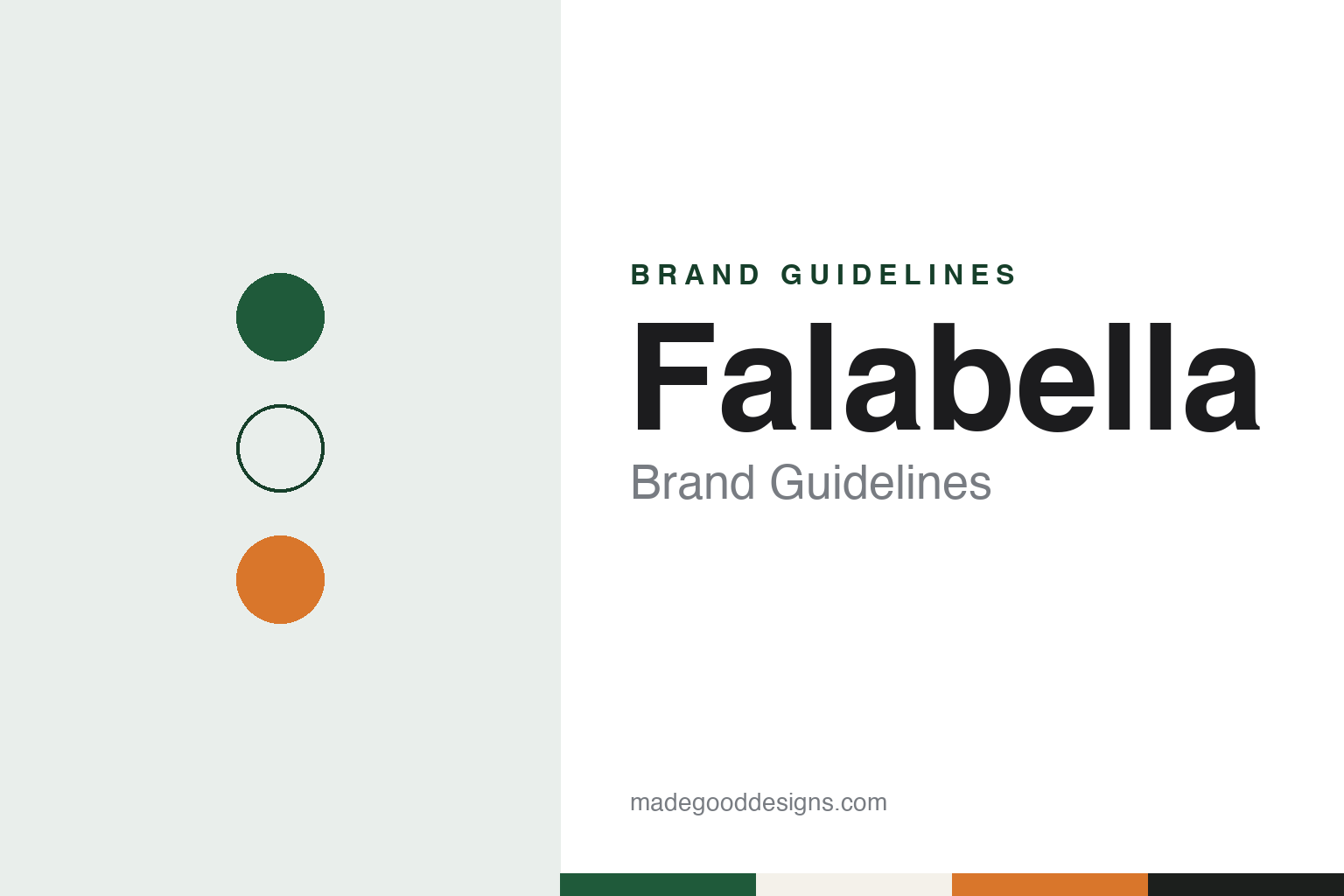
Falabella Brand Guidelines
An 1889 tailor’s shop on calle Ahumada that became a three-country department store.
Aa
Two constants: a deep green, warm white and soft orange palette and a friendly sans register. Abstract homage — not a Falabella product or mark; no logo, sign or store design is reproduced.
Calle Ahumada
An Italian tailor’s shop in central Santiago.
Falabella traces its start to 22 October 1889, when the Italian immigrant Salvatore Falabella opened a tailoring shop, the Gran Sastrería Económica Italiana, on calle Ahumada in central Santiago, Spanish Wikipedia says. The company’s investor site gives the same year and the same street, and describes the shop as the starting point of the group that now carries the family name.
The business stayed with the family through the twentieth century. Spanish Wikipedia says that in the 1920s the brothers Arnaldo and Roberto Falabella, descendants of the founder, shaped its strategy; that Eliana Falabella, Arnaldo’s daughter, proposed adding womenswear and household goods; and that in the 1930s her husband, Alberto Solari, joined the company, which then took the form of a department store in which sales staff no longer stood behind a counter. In the 1960s his brother Reinaldo Solari led a national expansion, according to the same article.
That expansion began in the south. In 1962 Falabella opened its first store outside Santiago, in the centre of Concepción, on the site of the former Gath & Chaves department store, Spanish Wikipedia says. By 1967 the company had eight shops on Ahumada, each aimed at a particular customer — from women’s couture to youth fashion, homeware and a tea room — and the street became known as “la calle de Falabella,” the street of Falabella. In October 1983 it opened its first store in a shopping centre, at Parque Arauco in Santiago, in a unit that had been a Gala-Sears store.
Chilean stores followed in Temuco in 1986 and Viña del Mar in 1987, and through the 1990s the chain opened in the Mallplaza shopping centres that the group itself had begun to build; the company dates its first Mallplaza centre to 1990. In 1996, the company says, Falabella listed its shares on the Santiago stock exchange, and in 2003 it merged with the home-improvement chain Sodimac.
Colour
Peru, Argentina and Colombia.
Falabella’s department stores now trade in Chile, Peru and Colombia. In September 2024 the Lima business daily Gestión put the network at 102 stores in those three countries, 31 of them in Peru. The wider group reaches further: its investor site, in November 2026, listed operations in Chile, Peru, Colombia, Brazil, Mexico, Uruguay and Argentina, with offices in India and China, covering the Sodimac home-improvement stores, the Tottus supermarkets, the Mallplaza shopping centres and the IKEA franchise as well as the department stores.
The Peruvian business has the longest back story. Gestión reported in 2024 that the company was constituted in November 1953 as Sears Roebuck del Perú, which sold by catalogue before opening its first store, in Lima’s San Isidro district, in September 1955; branches on the Jirón de la Unión and in Miraflores followed in 1958. In March 1984 the company was renamed Sociedad Andina de los Grandes Almacenes — SAGA — and in 1989 Sears sold its stake. Falabella bought a majority of SAGA in 1995, and in September 1999 the company took the name Saga Falabella, Gestión reported. Spanish Wikipedia says the Saga name was dropped from the stores in January 2018, after a Christmas advertisement in December 2017 had already left it out, so that the Peruvian stores became simply Falabella, as in the other countries.
Argentina went the other way. Falabella arrived there in 1993, opening its first store in Mendoza and later reaching Buenos Aires, La Nación reported in April 2021, when the company announced that its last three stores — in Rosario, at the Unicenter shopping centre and on calle Florida in Buenos Aires — would close within 60 days, after a search for a buyer for the Argentine business had not produced a sale. The company said at the time that it would keep selling online; Spanish Wikipedia says the online store closed at the end of May 2021, while the group’s Sodimac stores stayed in the country.
Colombia came later. Spanish Wikipedia dates the first Colombian store to 8 November 2006, at the Santafé shopping centre in Bogotá, followed by Medellín in 2007, and the company’s own timeline also gives 2006 for the arrival of its department stores in the country.
Typography
Department stores in Mexico and Chile.
The department stores of Mexico and Chile are big, city-centre and shopping-mall businesses, and their identities are carried as much by buildings as by logos. Two of the oldest, Liverpool and El Palacio de Hierro, began as nineteenth-century clothing and fabric shops in the historic centre of Mexico City, and Liverpool’s corporate history page still traces the chain back to that first shop of 1847 and lists, year by year, its moves into shopping centres and other cities.
Store naming is often plain description or a borrowed place. El Palacio de Hierro, according to English Wikipedia, took its name from the iron-and-steel building that rose in the 1880s; Liverpool, Spanish Wikipedia says, was named after the English port its imported goods were shipped from. Branches then take the name of the district or mall they anchor, so a shopper meets the brand as “Liverpool Insurgentes” or “Liverpool Polanco,” and Spanish Wikipedia writes of “Palacio Polanco.”
The flagship façade does a great deal of the work. Downtown stores keep their early buildings, and newer flagships are built as architecture in their own right — El Palacio de Hierro’s Polanco store, reopened in 2015, has floors themed on districts of the city. Seasonal campaigns are just as visible: El Financiero has described Liverpool’s recurring Venta Nocturna sales, held over two or three days several times a year, and the Christmas tree that El Palacio de Hierro raises in front of its Polanco store with a luxury partner: Dior in 2025 and Swarovski in 2026.
Store cards carrying the chain’s name are part of the picture too: El Financiero notes that Liverpool pitches some sale offers to its own cardholders, though this guide does not describe the credit products themselves. Corporate pages also set out owners and listings: both Mexican groups have long been listed on the Mexican Stock Exchange, and Liverpool’s investor site carries its annual and quarterly reports beside a year-by-year history.
Aa
A friendly sans for a store name that is also a family name. (Specimen set in Figtree, a sans STAND-IN; NOT the Falabella logo.)
Falabella
From white and green to a new look.
The look has changed twice in recent years. In April 2019, as the company marked 130 years, Falabella presented a new corporate image that left behind the white and green tones that had identified it for decades, CNN Chile reported; citing La Tercera, it added that the holding company’s name would be simplified to Falabella S.A. The change was shown at the annual shareholders’ meeting, alongside news about the arrival of IKEA stores in Chile.
In August 2021 the online store followed with an identity of its own. Diario Financiero reported that the new falabella.com mark dropped the historic green for orange, which the company said was meant to project a “modern, energetic and active personality.” Advertising professionals soon pointed to resemblances with other Chilean marks, and the company changed part of the logo to avoid possible trademark conflicts, the paper said. It named the branding agency behind the work as Panda, which it said had worked with the Falabella group for some years.
The stores themselves have been reshaped too. Spanish Wikipedia says that in November 2021 the remodelled Parque Arauco store reopened on four levels and about 25,000 square metres as the chain’s first flagship; that in December 2022 a store in Puente Alto became its first express-format shop in Chile; and that the closure of the Lyon store in Providencia, after 31 years, was announced in early 2024. In 2024, Gestión reported, the group said it would bring together the teams of its department stores and the falabella.com marketplace so that customers could find its products on a single platform.
The company has kept its connection to the founding families. In 2021 Diario Financiero described it as linked to the Solari and Del Río families, and the founder’s surname remains the name of the stores, the group and the listed company.
For a design guide, Falabella shows how a nineteenth-century shop name can carry a department store, a listed group and an online marketplace while the colours around it change. Compare Ripley, another Santiago department-store group, founded in 1956, and Sears, whose Peruvian company became Saga Falabella. For this guide we use a deep green, warm white and a soft orange with a sans, an unofficial interpretation; no product or logo is reproduced.
Explore & save
Keep Falabella’s identity on hand — save it to a board in the Made Good inspiration library.
Falabella identity set
Pin the Falabella deep green, warm white and soft orange palette and the friendly sans register to your own board.