Liverpool Brand Guidelines
A Mexico City clothing cajón of 1847, named after an English port.
Aa
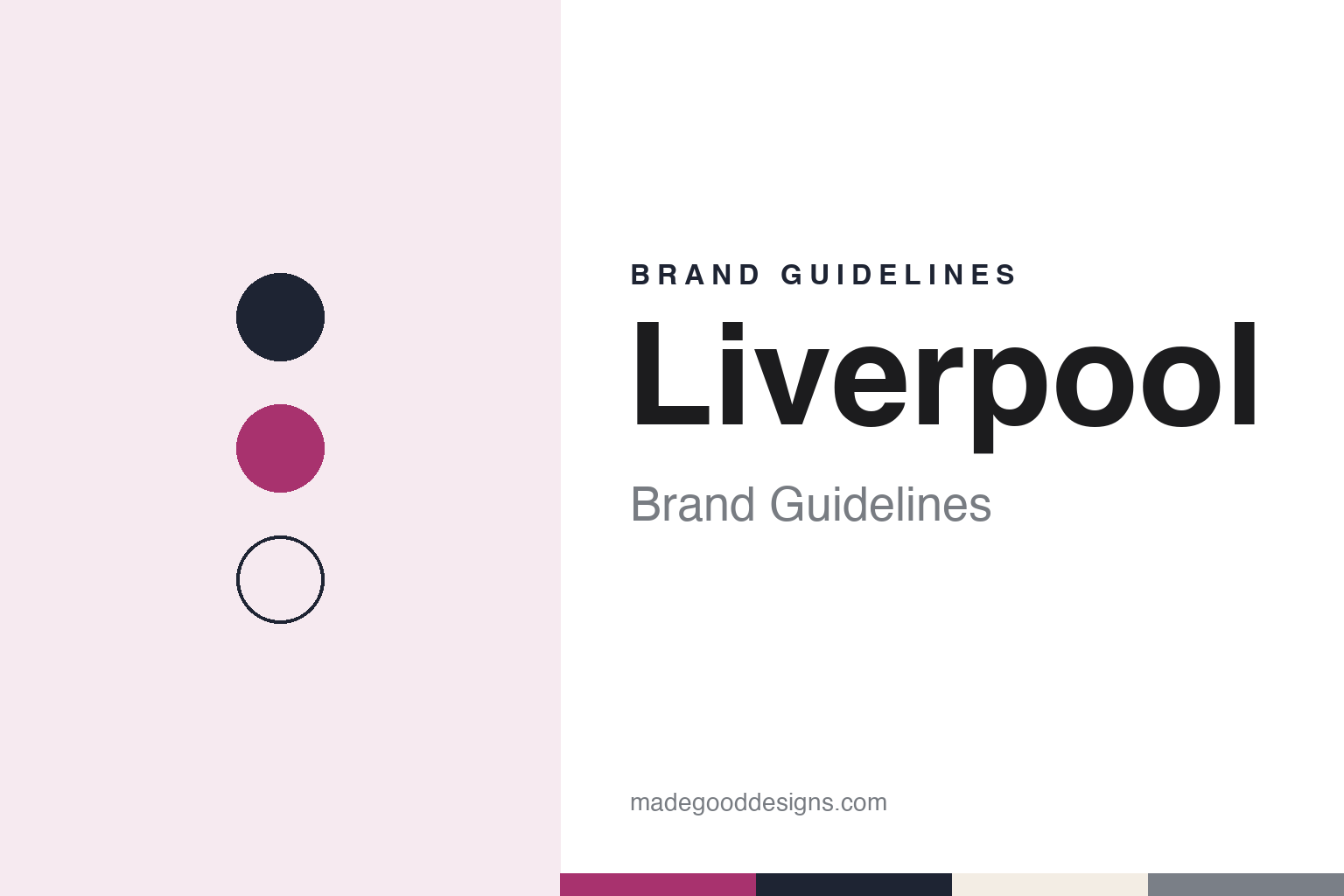
Two constants: a port magenta, harbour ink and fabric cream palette and a store-front sans register. Abstract homage — not a Liverpool product or mark; no logo, sign or shopping bag is reproduced.
A cajón in the centre
Fine cloth, imports and a borrowed port.
Liverpool dates itself to 1847. The history page of its parent company, El Puerto de Liverpool, says that in that year Jean Baptiste Ebrard set up a cajón, a small shop, selling clothing in the centre of Mexico City; Spanish Wikipedia describes the same shop as a seller of fine fabrics. The name came later. Spanish Wikipedia says that from 1872 the shop imported goods from Europe that were shipped from the port of Liverpool in England, and that the store took the port’s name. It is a plain piece of naming, a trade route turned into a shop sign, and the company has kept it for more than a century and a half.
The business grew into a proper store before it became a company. In 1936 it opened a new building for Liverpool Centro on Avenida 20 de Noviembre; Spanish Wikipedia credits the design to the architect Enrique de la Mora, and both the company and Spanish Wikipedia point to the escalators installed there as a novelty for the city. English Wikipedia says the group was legally established as a sociedad anónima, a public limited company, in 1944, and that it was listed on the Mexican Stock Exchange by 1965, the year the company’s own history gives for its listing.
Branches followed the city outwards. The company names Liverpool Insurgentes, opened in 1962, as its first branch. Spanish Wikipedia lists Liverpool Polanco in 1970 and Liverpool Satélite in 1972, the first Liverpool inside a shopping centre, at Plaza Satélite. In 1980 the group opened the Perisur shopping centre with a store of its own, the first mall it owned, and in 1982, the company says, it opened in Villahermosa, inside Galerías Tabasco, its first store outside the capital. The pattern was set early: a department store as the anchor, and a mall built or co-owned around it.
Colour
Fábricas de Francia, Suburbia and new formats.
Much of Liverpool’s growth came by buying other chains. In 1988 it bought the department stores of Fábricas de Francia, eight stores at the time, according to English Wikipedia. In 1997 it bought Comercial Las Galas from Tiendas Chedraui and converted those shops into Fábricas de Francia stores, and in the late 1990s it bought stores of the Salinas y Rocha chain; the English and Spanish Wikipedia articles give different years for that purchase, 1999 and 1996. In 2006 the company changed its legal form to a sociedad anónima bursátil, the form required of listed companies under Mexico’s securities law of that year.
A bigger step came with Suburbia, the apparel chain. In August 2016, English Wikipedia says, Liverpool agreed to buy Suburbia from Walmart de México, and the company says the purchase of 122 Suburbia stores, with the chain’s intellectual property, was completed at the start of the second quarter of 2017. Fábricas de Francia, the older name, did not survive the reorganisation that followed. In 2018, the company says, its 41 Fábricas de Francia stores became 24 Liverpool stores and 14 Suburbia stores, and the other three closed for good; English Wikipedia describes this as the end of a brand that was about 140 years old.
Liverpool has also added other companies’ shops under its own roof. English Wikipedia says it partnered with El Corte Inglés’s clothing label Sfera in 2007 to open Sfera stores in Mexico, and in 2015 with Williams-Sonoma, bringing Williams Sonoma, Pottery Barn and West Elm boutiques to Mexico; in 2023 it launched Toys “R” Us Mexico with WHP Global. The company launched a smaller format, Liverpool Express, in 2022 and says it had opened 17 of them by the end of 2023. In February 2026 El Economista reported that Liverpool had signed a long-term agreement with Authentic Brands Group for an exclusive licence to distribute Dockers clothing in Mexico, after approval by the Comisión Nacional Antimonopolio, run through a new division called Global Lifestyle & Apparel Management, or GLAM, which would sell to other retailers as well as through Liverpool’s own stores.
Typography
Department stores in Mexico and Chile.
The department stores of Mexico and Chile are big, city-centre and shopping-mall businesses, and their identities are carried as much by buildings as by logos. Two of the oldest, Liverpool and El Palacio de Hierro, began as nineteenth-century clothing and fabric shops in the historic centre of Mexico City, and Liverpool’s corporate history page still traces the chain back to that first shop of 1847 and lists, year by year, its moves into shopping centres and other cities.
Store naming is often plain description or a borrowed place. El Palacio de Hierro, according to English Wikipedia, took its name from the iron-and-steel building that rose in the 1880s; Liverpool, Spanish Wikipedia says, was named after the English port its imported goods were shipped from. Branches then take the name of the district or mall they anchor, so a shopper meets the brand as “Liverpool Insurgentes” or “Liverpool Polanco,” and Spanish Wikipedia writes of “Palacio Polanco.”
The flagship façade does a great deal of the work. Downtown stores keep their early buildings, and newer flagships are built as architecture in their own right — El Palacio de Hierro’s Polanco store, reopened in 2015, has floors themed on districts of the city. Seasonal campaigns are just as visible: El Financiero has described Liverpool’s recurring Venta Nocturna sales, held over two or three days several times a year, and the Christmas tree that El Palacio de Hierro raises in front of its Polanco store with a luxury partner: Dior in 2025 and Swarovski in 2026.
Store cards carrying the chain’s name are part of the picture too: El Financiero notes that Liverpool pitches some sale offers to its own cardholders, though this guide does not describe the credit products themselves. Corporate pages also set out owners and listings: both Mexican groups have long been listed on the Mexican Stock Exchange, and Liverpool’s investor site carries its annual and quarterly reports beside a year-by-year history.
Aa
A store-front sans for a name taken from a port. (Specimen set in Manrope, a sans STAND-IN; NOT the Liverpool logo.)
El Puerto de Liverpool
A listed group with malls, boutiques and a stake in Nordstrom.
Today Liverpool is the main brand of El Puerto de Liverpool, S.A.B. de C.V., which is listed on the Mexican Stock Exchange and has its headquarters in Santa Fe, the business district in the west of Mexico City, according to English Wikipedia. The group runs the Liverpool and Suburbia department stores, freestanding stores for fashion brands and a property arm whose shopping malls, all but Perisur, carry the Galerías name. Spanish Wikipedia gives its size at the end of 2022 as 124 Liverpool department stores, 179 Suburbia stores, 112 brand stores and 28 Galerías centres.
The group has also looked abroad. Spanish Wikipedia says that in July 2016 Liverpool announced a plan to buy into the Chilean retailer Ripley through a public share offer, and that the two companies told the Chilean securities regulator on 19 May 2017 that the agreement had been ended. English Wikipedia says the group holds half of the Unicomer Group, based in El Salvador, and that in May 2025 the Nordstrom family and El Puerto de Liverpool completed their purchase of the American department store Nordstrom, taking it private, with the family holding 50.1 per cent and Liverpool 49.9 per cent.
In the shops, the name is carried as much by campaigns as by signs. El Financiero reported in October 2026 that Liverpool runs its Venta Nocturna, or night sale, several times a year over two or three days, with an anniversary edition on the first weekend of October, and that shoppers can also buy through the website and the Liverpool Pocket app.
For a design guide, Liverpool shows how a name borrowed from a shipping route can become the name of a whole retail group, its malls and its sales calendar. Compare Suburbia, the apparel chain it bought from Walmart de México, and El Palacio de Hierro, the other old department store of central Mexico City. For this guide we use a port magenta, harbour ink and fabric cream with a sans, an unofficial interpretation; no product or logo is reproduced.
Explore & save
Keep Liverpool’s identity on hand — save it to a board in the Made Good inspiration library.
Liverpool identity set
Pin the Liverpool port magenta, harbour ink and fabric cream palette and the store-front sans register to your own board.