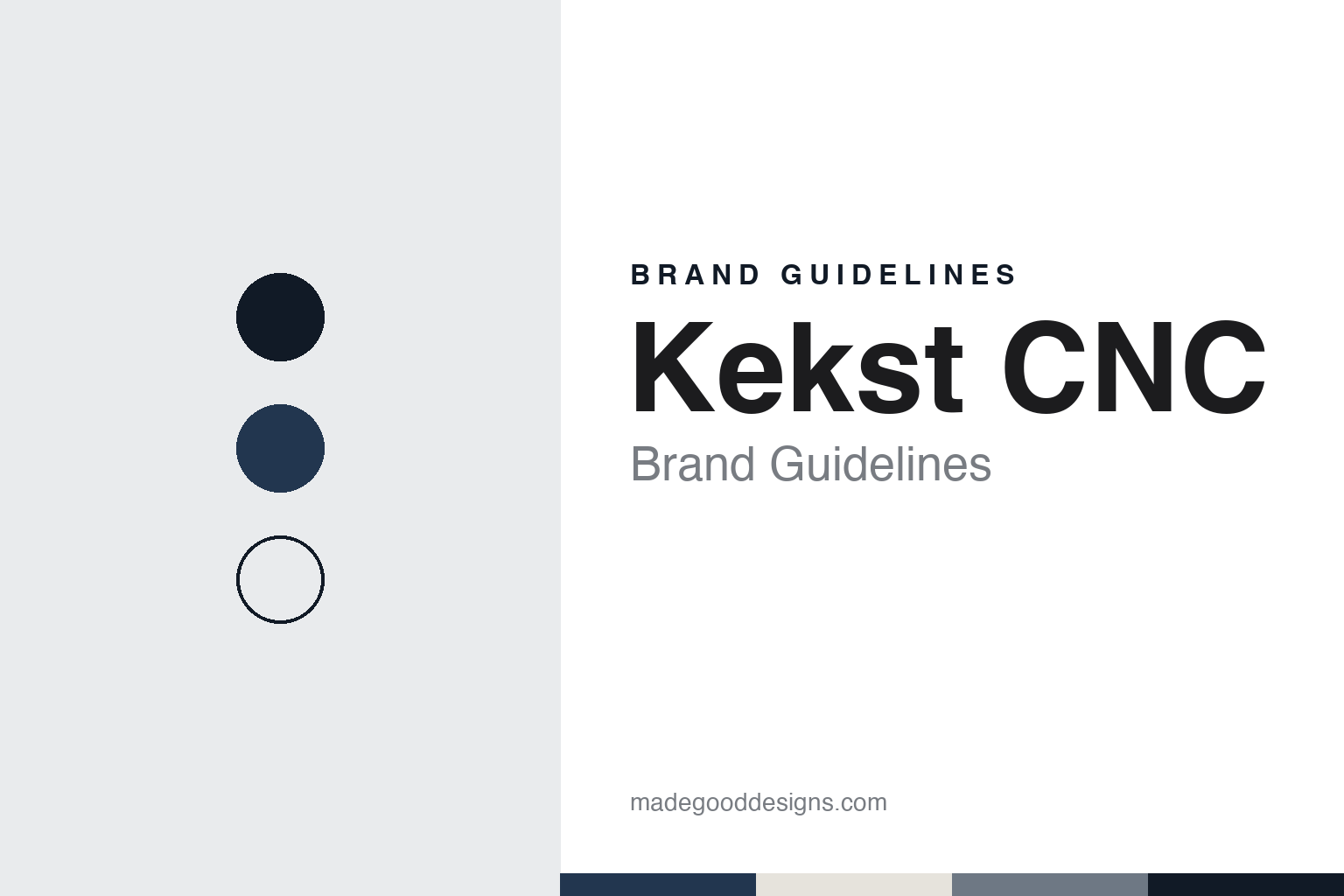
Kekst CNC Brand Guidelines
A 1970 New York firm and a Munich consultancy, merged in 2018.
Aa
Two constants: a deep ink blue, slate and stone palette and a Measured sans register. Abstract homage — not a Kekst CNC asset or mark; no logo or wordmark is reproduced.
Two firms, one name
A New York firm of 1970 and a Munich consultancy.
Kekst CNC is a strategic communications firm that joins two older businesses under one name. The American half is Kekst and Company, a New York firm whose founding year is given as 1970 both by Observer, in its PR Power 50 of December 2017, and by the firm’s own listing in O’Dwyer’s directory of public relations firms. The company’s legal-information page still names the New York entity as Kekst and Company, Incorporated, doing business as Kekst CNC. The European half is CNC – Communications & Network Consulting, a company registered in Munich as an AG, the German form of a joint-stock company, according to the same page.
Before the two were combined, Kekst had a long record in New York financial communications. In November 2014 Observer profiled Kekst & Company as one of four financial communications firms in the city, with Joele Frank and Finsbury among the others. The magazine summed Kekst up that year as an “old guy who turns out to have a black belt,” and listed its assignments that year for clients including Jos. A. Bank, Charter Communications and Annie’s. In December 2017 the same magazine ranked Kekst sixth on its PR Power 50, counted about 75 employees and more than 350 clients, and described it as a firm that companies bring in for “special situations” such as cybersecurity incidents. It credited Kekst that year with advising CVS on its takeover of Aetna.
The combination came in 2018. In its list of powerful financial PR firms published on 14 December 2018, Observer wrote that “two stalwart PR firms became one this year” when Kekst and CNC fused into a firm with 12 offices on four continents. Since then the business has traded as Kekst CNC, a single name that sets the New York founder’s surname in front of the Munich firm’s three-letter abbreviation.
Colour
Transactions, crises and shareholder contests.
The firm describes its work as counsel for “business-critical communications.” Its website lists areas of expertise that include mergers and acquisitions, crisis and issues management, cybersecurity, shareholder activism, litigation support, restructuring and initial public offerings, as well as research, analytics and a creative unit. Newer practice names on the list include private capital, people communications, science and innovation, and sustainable reputation, and the firm runs a separate website for its creative studio under the Kekst CNC name. Its stated values are four short phrases: Integrity First, Critical Judgement, Uncompromising Excellence and Globally Connected Thinking, the last of which also serves as the headline on its home page.
Much of the firm’s public record comes from the deals it works on. Observer, in its December 2018 list, said Kekst CNC continued to handle very large transactions, naming the CVS–Aetna merger together with Fujifilm–Xerox and Dow–DuPont, and said it remained strong in crisis management. In its PR Power 50 of December 2019, Observer placed Kekst CNC fifth and listed client mandates that included LVMH’s bid for Tiffany and Merck’s acquisition of Versum.
Its listing in O’Dwyer’s directory, which is supplied by the firm, names specialties from strategic and financial communications and investor relations to restructuring and corporate governance, and gives a count of 15 locations, about 300 employees and some 600 clients. The firm’s own about page gives the same figures of 300 professionals in 15 offices. In June 2026 Kekst CNC said it had again been ranked Band 1 worldwide for both crisis communications and cybersecurity communications in the Chambers and Partners Crisis & Risk Management guide, a ranking that the company says draws on interviews with clients, lawyers and peers.
Typography
How communications agencies present themselves.
Public relations and communications agencies sell advice, so their visual identity is mostly carried by what they publish about themselves. Case-study pages, award announcements and research reports do much of the work that a product range does for a manufacturer. FleishmanHillard, for example, announced in October 2026 that a campaign it made with Icelandair had been named the top entry in PRovoke Media’s Global SABRE Awards, and the guides in this set treat such pages as the agency’s own dated claims.
Names change more often than logos in this field, usually after a merger. Founders’ surnames are joined, shortened or dropped, and a hyphen can disappear: FleishmanHillard closed up its two founders’ names in 2013, English Wikipedia says. When holding groups rearrange their agencies, one firm may also keep another as a dedicated brand inside it, as FleishmanHillard did with Porter Novelli in February 2026.
Many firms present their offices and their people rather than objects. Partner profiles, office lists and pages on how the firm is owned and run take the place of a catalogue; Brunswick’s site, for instance, gives a page to each of its offices and describes the firm as a partnership. Some firms also publish magazines or research series under their own names, which become a second visible identity beside the logo.
Ownership and leadership are recorded on corporate pages, in company registers and in trade and business press, and they change with each acquisition, investment or appointment. The guides in this set give office, staff and partner counts only as a dated source states them, name the owner as of that source, and treat colours and typefaces as an unofficial interpretation unless the agency has published its own.
Aa
A measured sans for a two-part name. (Specimen set in Libre Franklin, a sans STAND-IN; NOT the Kekst CNC logo or wordmark.)
Kekst CNC
A Publicis firm with New York and Munich roots.
Kekst CNC is part of Publicis Groupe, a line that appears in the footer of every page on its website. Its offices, by its own list, run across four regions: Dallas, New York and Washington, D.C. in the United States; Berlin, Brussels, Frankfurt, London, Munich, Paris and Stockholm in Europe; Abu Dhabi, Dubai and Riyadh in the Middle East; and Seoul and Tokyo in Asia. In November 2024 the firm marked 20 years in Japan with a panel discussion at the Palace Hotel Tokyo attended, it says, by more than 200 guests, and it publishes a Japanese-language edition of its website. The firm’s own count of 15 offices compares with the 12 that Observer recorded at the time of the 2018 merger.
The firm’s public face is spare and text-led. Its website pairs the two-part name with service pages, office pages and a stream of research and commentary, such as a survey of institutional investors on Japanese corporate governance and a video series called Above the Noise. Its home page says it has provided communications counsel “for more than five decades,” a span that counts from the founding of the New York firm, and its careers pages invite alumni of “Kekst CNC and its legacy firms” to join an alumni network.
For a design guide, Kekst CNC shows how a merged firm can keep both of its predecessors visible in one compact name. Compare Publicis, the group it belongs to, and Brunswick, another firm in financial and corporate communications. For this guide we use a deep ink blue, a slate grey and a pale stone with a sans, an unofficial interpretation; no product or logo is reproduced.
Explore & save
Keep Kekst CNC’s identity on hand — save it to a board in the Made Good inspiration library.
Kekst CNC identity set
Pin the Kekst CNC deep ink blue, slate and stone palette and the Measured sans register to your own board.