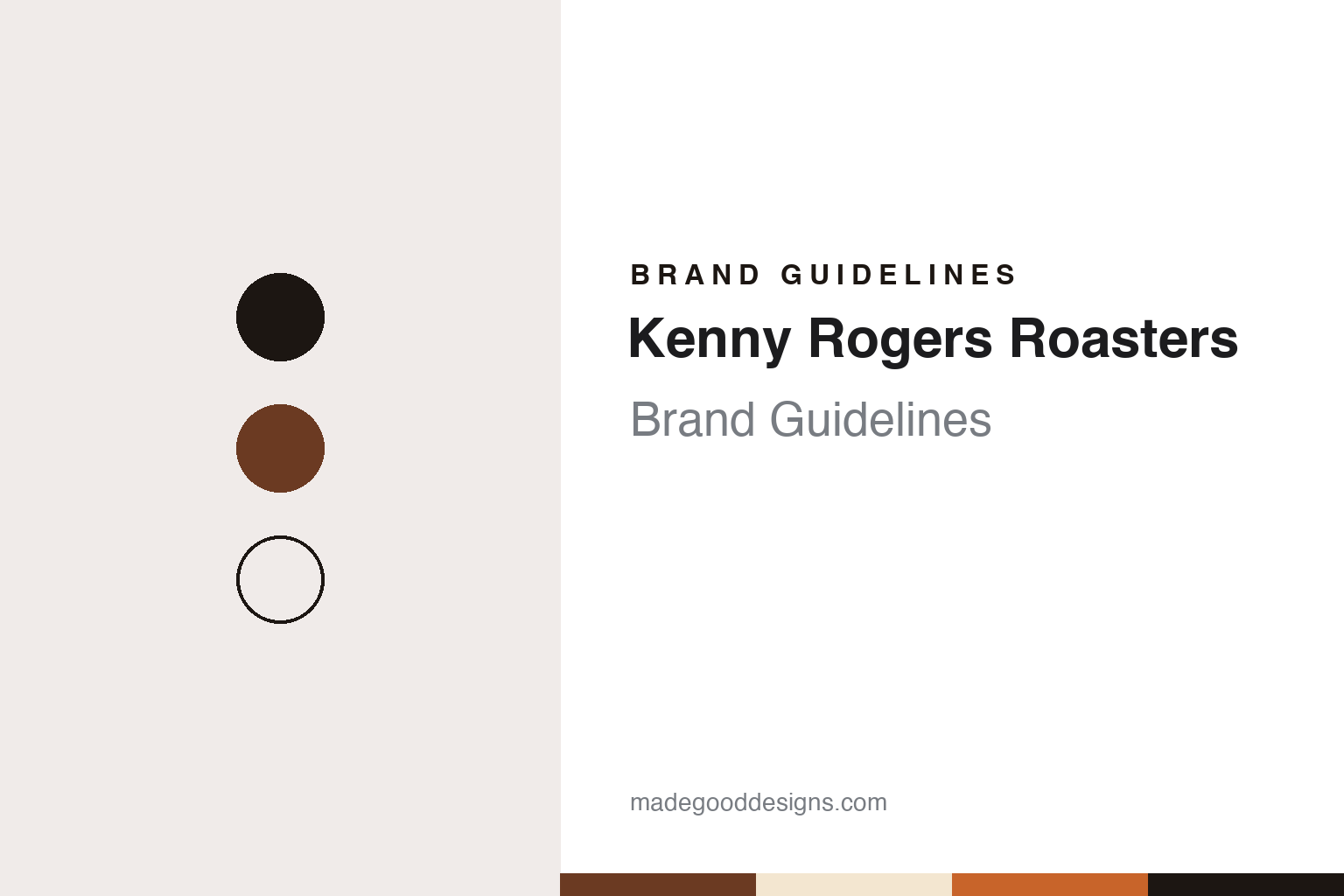
Kenny Rogers Roasters Brand Guidelines
A Florida rotisserie chain that found its second life in Asia.
Aa
Two constants: a roast brown, ember and cream palette and a Warm serif register. Abstract homage — not a Kenny Rogers Roasters product or mark; no logo, sign or menu item is reproduced.
Coral Springs, 1991
A singer, a former governor and a rotisserie.
Kenny Rogers Roasters began in Coral Springs, Florida, in 1991. English Wikipedia says the chain was started by the country singer Kenny Rogers and John Y. Brown Jr., a former chief executive of Kentucky Fried Chicken who had served as governor of Kentucky from 1979 to 1983. The same article, citing the South Florida Sun Sentinel of 6 September 1991, says the first restaurant opened that September with Rogers at the opening; the brand’s international website, run by its Malaysian owner, names the same founders and town but gives August 1991. The Takeout, in a December 2024 history of the chain, also places the first restaurant in Coral Springs in 1991.
The idea was a restaurant built around rotisserie-roasted chicken. The company describes its chickens as marinated with citrus, herbs and spices and turned slowly over a rotisserie fire, and lists the side dishes that came to define the menu: its own muffins, jacket potatoes, salads, pastas and soups. Tasting Table, writing in September 2025, describes the format as wood-fired rotisserie chicken with comforting sides such as macaroni and cheese and corn muffins. English Wikipedia adds that by 1995 the menu had grown to include turkey and ribs.
Growth was fast. English Wikipedia says the chain reached more than 350 restaurants, with locations in Canada, Europe, the Middle East and Asia, and Tasting Table puts it at more than 400 locations by 1996. Rotisserie chicken was a crowded field at the time: English Wikipedia names Boston Chicken, later Boston Market, as a rival, and says Kentucky Fried Chicken answered with a roasted line of its own called Rotisserie Gold.
Colour
Berjaya, Nathan’s and back to Berjaya.
The ownership story has three stages. In 1996, The Takeout reported, a majority share in the business passed to the Malaysian conglomerate Berjaya; English Wikipedia describes the same year’s sale as Brown selling his interest to the Berjaya Group. The American company filed for Chapter 11 bankruptcy protection in March 1998, and Nathan’s Famous, the New York hot-dog company, bought it; English Wikipedia dates the purchase to 1 April 1999. Restructuring followed, and by 2000 the chain was down to about 90 franchised restaurants, 40 of them in the United States, according to The Takeout.
In 2008 Nathan’s sold the brand to its Asian franchisee, Roasters Asia Pacific (Cayman) Limited, part of the Berjaya group, both The Takeout and English Wikipedia say. English Wikipedia describes the structure as a brand held by Kenny Rogers Roasters International Corporation, a subsidiary of Roasters Asia Pacific, which is in turn owned by Berjaya Corporation Berhad. In Malaysia the restaurants are run by Berjaya Roasters (M) Sdn Bhd, which became a wholly owned subsidiary of Berjaya Food Berhad in 2011, the year Berjaya Food listed on the Main Board of Bursa Malaysia, according to the same article.
The chain did not survive at home. The last Kenny Rogers Roasters in North America, in the food court of the Ontario Mills mall in Ontario, California, closed on 31 December 2011, English Wikipedia says, and both The Takeout and Tasting Table report that no restaurants remain in the United States. Tasting Table counted almost 140 restaurants across Asia by 2011 and more than 200 across the Asia-Pacific region in September 2025; The Takeout gave a figure of about 400 in December 2024. The two counts differ, and each is given here as its publication reported it.
In the United States the name now survives mainly in popular culture. English Wikipedia notes that an episode of Seinfeld, “The Chicken Roaster,” is built around a branch of the chain opening in the neighbourhood, and Tasting Table opens its 2025 history with the same episode.
Typography
Design and documentation.
The Philippines’ restaurant, bakeshop and snack chains tend to present themselves through a small set of recurring elements: a shop name and sign that customers can spot in a mall or on a busy road, menus organised around named dishes and named cakes, and packaging that travels home with the order. Some brands take their names from a place or a founder; Red Ribbon, by its own account, takes its name from the ribbon once tied around its cake boxes.
Many of these chains now sit inside a few restaurant groups. Jollibee Foods Corporation, which adopted “Jollibee Group” as its corporate brand in July 2025 according to BusinessWorld, owns brands including Jollibee, Chowking, Greenwich, Red Ribbon and Mang Inasal. Max’s Group, which traces itself to the Max’s Restaurant fried-chicken café of 1945, runs another portfolio of casual-dining brands, according to its own website.
Franchising is the usual route to growth, at home and abroad. Group and brand websites publish franchising pages for the Philippines and, in several cases, for international partners, and some chains have opened abroad. Red Ribbon is one example: it opened in California in 1984, according to English Wikipedia, and had 39 stores in the United States by October 2022, The Philippine Star reported.
This guide sets out what can be checked about each brand: who founded it, when and where, who owns it now, and how its own pages and the Philippine press describe its menu, stores and franchise network. Counts of stores are given with the date of the source, and claims that rest only on a company’s own word are marked as such.
Aa
A warm serif — a name that crossed the Pacific. (Specimen set in Fraunces, a serif STAND-IN; NOT the Kenny Rogers Roasters logo.)
Kenny Rogers Roasters
Alabang, 1995.
The Philippine story began while the American company was still growing. The brand’s listing with the Philippine Franchise Association says Kenny Rogers Roasters arrived in March 1995, with its first branch at Alabang Town Center in Muntinlupa, south of Manila — four years after the first Florida restaurant. The same listing names Epicurean Partners Exchange, Inc., of Makati, as the contact company for franchise enquiries. The brand itself, as distinct from the Philippine operating business, belongs to the Berjaya group through Roasters Asia Pacific.
English Wikipedia, citing the two countries’ own store lists, counted 163 branches in the Philippines and 25 in Malaysia as of October 2026. The Philippine website lists stores from Metro Manila malls such as Glorietta 3 in Makati and Ayala Malls Manila Bay in Parañaque to Ayala Center Cebu and Abreeza in Davao City, alongside roadside branches in Cavite, Bulacan and Batangas. English Wikipedia also lists Singapore, China, Indonesia, India, Brunei, Dubai, Phuket and Riyadh among the places the chain serves, with a first Brunei outlet in January 2013, a first Thai branch in Phuket in December 2016 and a Dubai flagship in February 2023.
The founder’s name has stayed on the sign. The Takeout noted in 2024 that the chain still carries Rogers’s name on its logo decades after he stopped owning it, and English Wikipedia captions the current logo as in use since 2008, the year Nathan’s sold the brand to Roasters Asia Pacific. The company’s international website still tells the founding story of Rogers and Brown in Florida, and still describes the restaurant as casual dining with rotisserie-roasted chicken at its core.
For a design guide, Kenny Rogers Roasters shows how a personal name can carry a restaurant brand across owners and oceans long after the founders have moved on. Compare Mang Inasal, a Philippine grilled-chicken chain, and Bonchon, a chicken chain founded in Busan. For this guide we use a roast brown, an ember orange and a muffin cream with a serif, an unofficial interpretation; no product or logo is reproduced.
Explore & save
Keep Kenny Rogers Roasters’s identity on hand — save it to a board in the Made Good inspiration library.
Kenny Rogers Roasters identity set
Pin the Kenny Rogers Roasters roast brown, ember and cream palette and the Warm serif register to your own board.
Source & notes
Frequently Asked Questions
What font can I use to match the Kenny Rogers Roasters look?
This guide describes Kenny Rogers Roasters’ type as “A warm serif — a name that crossed the Pacific”. Its type specimen is set in Fraunces from Google Fonts as a stand-in; Fraunces is not Kenny Rogers Roasters’ own lettering.
What colours are in the Kenny Rogers Roasters palette?
This guide’s Kenny Rogers Roasters palette is Roast brown #6B3A22, Ink #1C1612, Muffin cream #F3E6D0, Ember orange #C8642A and Paper #FAF6EF. The tones are the guide’s own unofficial interpretation, not official Kenny Rogers Roasters hex codes.
When was Kenny Rogers Roasters founded?
Kenny Rogers Roasters was founded in 1991, in Coral Springs, Florida.
Who founded Kenny Rogers Roasters?
Kenny Rogers Roasters was founded by Kenny Rogers and John Y. Brown Jr. in 1991.


