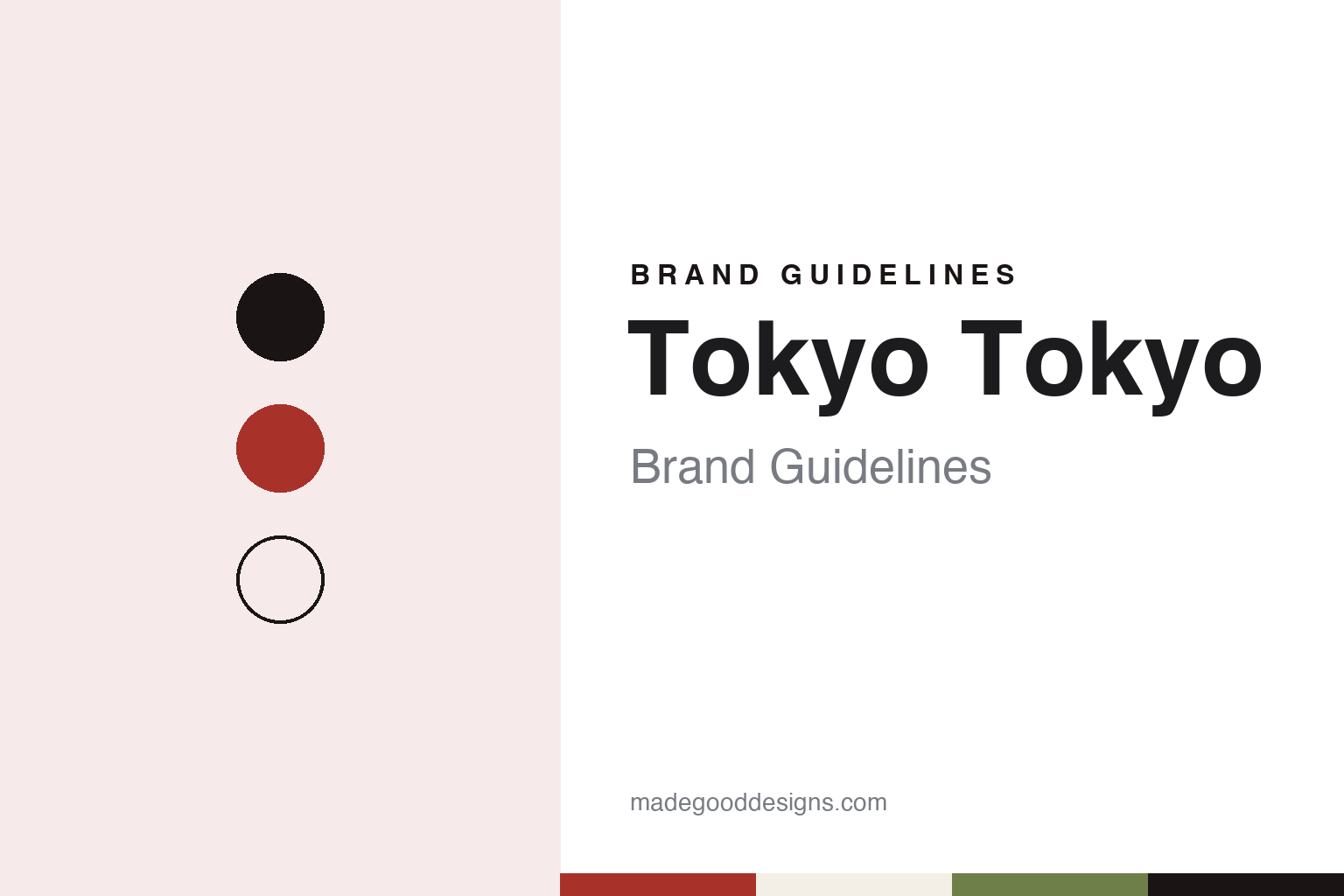
Tokyo Tokyo Brand Guidelines
Japanese-style fast food, made in Makati since 1985.
Aa
Two constants: a vermilion, matcha and rice white palette and a Clean sans register. Abstract homage — not a Tokyo Tokyo product or mark; no logo, sign or menu item is reproduced.
Makati, 1985
Japanese dishes in a fast-food format.
Tokyo Tokyo is a Philippine fast-food chain serving Japanese-style food. Its first restaurant opened on 22 April 1985 at the Quad Car Park in Makati, the site now known as Glorietta, the company says. English Wikipedia gives the same date and place in its history, describing the car park as later called Park Square 1, although its summary box gives 7 April. BusinessWorld wrote in August 2018 that the chain had been serving quick Japanese dishes such as tempura and tonkatsu to a mass audience since 1985.
The name repeats the Japanese capital’s, and English Wikipedia writes it in Japanese characters as 東京 東京. The early menu, according to the same article, ran to tempura, tonkatsu, yakisoba, sushi and sashimi — dishes familiar from sit-down Japanese restaurants, served in a counter-service format. English Wikipedia says the chain grew by taking Japanese food into the mainstream at a time when other Japanese restaurants in the country were more traditional.
The company tells the same story in its own words. Its history says that in 1985, as the idea of “fast food” was spreading quickly through the country, Tokyo Tokyo saw a chance to bring Japanese cooking to the Philippines, and that the Makati restaurant built its following on “quality, value, and abundance.” English Wikipedia lists the company as based in Quezon City and, citing The Philippine Star, counts 50 locations nationwide by the end of 2013.
Colour
Hansbury, the One Food Group and a TriNoma flagship.
As of 2018, Tokyo Tokyo was owned by Hansbury Inc., under the One Food Group, BusinessWorld reported; the same group held the Philippine franchises for KFC and Mister Donut. English Wikipedia gives the same ownership, dated to 2018.
In August 2018 the chain reopened its TriNoma branch in Quezon City as a flagship. BusinessWorld reported that the redesign was by James “JJ” Acuna of JJ Acuna/Bespoke Studio. According to the company’s press release, quoted by the paper, the façade drew on Japanese fusuma screens — the sliding paper-covered panels of Japanese interiors — and on the street culture of Japanese cities. Inside, a bar counter looked into an open kitchen, and two dining rooms carried the theme further: a Garden Room drawing on teahouse architecture and an enclosed Tatami Room for private dining. Acuna was quoted as calling it “a next generation version of Tokyo Tokyo.”
Inside Retail Asia described the TriNoma store on 29 August 2018 as a new concept that set aside the chain’s earlier, more casual image for a more cultural atmosphere. The relaunch came with a campaign called “Take Me to Tokyo Tokyo” and with dishes served first at the flagship, among them a wagyu bento box, soft-serve ice cream and a tempura dragon maki, BusinessWorld reported. The paper added that the façade’s references extended to the pop and anime culture of Japanese streets, and that the open kitchen was named the Master’s Open Kitchen. A social-media photo contest, “A Shot To Tokyo,” ran on Facebook and Instagram from 29 August to 30 October 2018 alongside the reopening.
At the time, BusinessWorld counted more than 60 Tokyo Tokyo stores. The chain’s marketing vice-president, Natalie Perez, told the paper, “We don’t claim to be authentic,” describing the business as a Filipino-based company and its food as “Japanese-inspired fastfood that is really customized for the Filipino taste.”
Typography
Design and documentation.
The Philippines’ restaurant, bakeshop and snack chains tend to present themselves through a small set of recurring elements: a shop name and sign that customers can spot in a mall or on a busy road, menus organised around named dishes and named cakes, and packaging that travels home with the order. Some brands take their names from a place or a founder; Red Ribbon, by its own account, takes its name from the ribbon once tied around its cake boxes.
Many of these chains now sit inside a few restaurant groups. Jollibee Foods Corporation, which adopted “Jollibee Group” as its corporate brand in July 2025 according to BusinessWorld, owns brands including Jollibee, Chowking, Greenwich, Red Ribbon and Mang Inasal. Max’s Group, which traces itself to the Max’s Restaurant fried-chicken café of 1945, runs another portfolio of casual-dining brands, according to its own website.
Franchising is the usual route to growth, at home and abroad. Group and brand websites publish franchising pages for the Philippines and, in several cases, for international partners, and some chains have opened abroad. Red Ribbon is one example: it opened in California in 1984, according to English Wikipedia, and had 39 stores in the United States by October 2022, The Philippine Star reported.
This guide sets out what can be checked about each brand: who founded it, when and where, who owns it now, and how its own pages and the Philippine press describe its menu, stores and franchise network. Counts of stores are given with the date of the source, and claims that rest only on a company’s own word are marked as such.
Aa
A clean sans — a doubled city name. (Specimen set in Inter Tight, a sans STAND-IN; NOT the Tokyo Tokyo logo.)
Tokyo Tokyo
Japinoy.
The menu reflects that position. English Wikipedia names chicken teriyaki and tuna misono as the house specials, with sides such as yakisoba, Japanese-style potato balls, miso soup and a kani crab and corn soup, and says the chain offers three kinds of sushi. Photographs in the same article show a beef sukiyaki rice bowl, wasabi fries and potato balls.
The chain has kept growing. In April 2026 the lifestyle site LionhearTV reported that Tokyo Tokyo had opened its 100th store, at Buayang Bato, on the site of the company’s former headquarters, and that the branch opens 24 hours a day. Its report described lanterns, textured brick walls, patterned surfaces and warm lighting, and called the mix the brand’s “Japinoy” identity — Japanese and Pinoy, the everyday word for Filipino. The company’s website, for its part, gives a figure of more than 80 stores nationwide. Guests at the opening, the same report said, were served tempura, bento meals and chicken karaage. The report also described seating arranged for both solo diners and groups, with geometric accents and modern finishes, and said the operations manager had drawn on visits to Japan for some of the store’s details.
The two store designs, eight years apart, show the brand’s range. The 2018 TriNoma flagship leaned on fusuma screens, a teahouse room and tatami; the 2026 store mixed lanterns with brick and bright colour. In both, the cues are Japanese and the setting is a Philippine fast-food restaurant, which matches how the company’s own marketing head described it in 2018: Japanese-inspired, and made for Filipino tastes.
For a design guide, Tokyo Tokyo shows how a chain can borrow a foreign cuisine’s visual language — screens, lanterns, tatami — while presenting itself plainly as a Philippine business. Compare Chowking, a Philippine chain built on Chinese-style food, and Jollibee, another Philippine fast-food chain. For this guide we use a vermilion, a matcha green and a rice white with a sans, an unofficial interpretation; no product or logo is reproduced.
Explore & save
Keep Tokyo Tokyo’s identity on hand — save it to a board in the Made Good inspiration library.
Tokyo Tokyo identity set
Pin the Tokyo Tokyo vermilion, matcha and rice white palette and the Clean sans register to your own board.
Source & notes
Frequently Asked Questions
What font can I use to match the Tokyo Tokyo look?
This guide describes Tokyo Tokyo’s type as “A clean sans — a doubled city name”. Its type specimen is set in Inter Tight from Google Fonts as a stand-in; Inter Tight is not Tokyo Tokyo’s own lettering.
What colours are in the Tokyo Tokyo palette?
This guide’s Tokyo Tokyo palette is Torii vermilion #A8322A, Ink #1A1414, Rice white #F4EFE6, Matcha #6E7F4A and Paper #FAF8F3. The tones are the guide’s own unofficial interpretation, not official Tokyo Tokyo hex codes.
When was Tokyo Tokyo founded?
Tokyo Tokyo was founded in 22 April 1985 (company), in Quad Car Park, Makati.
Who owns Tokyo Tokyo?
Tokyo Tokyo is owned by Hansbury Inc., One Food Group (as of 2018).
Where is Tokyo Tokyo based?
Tokyo Tokyo is based in Quezon City. This guide dates Tokyo Tokyo to 22 April 1985 (company), in Quad Car Park, Makati.