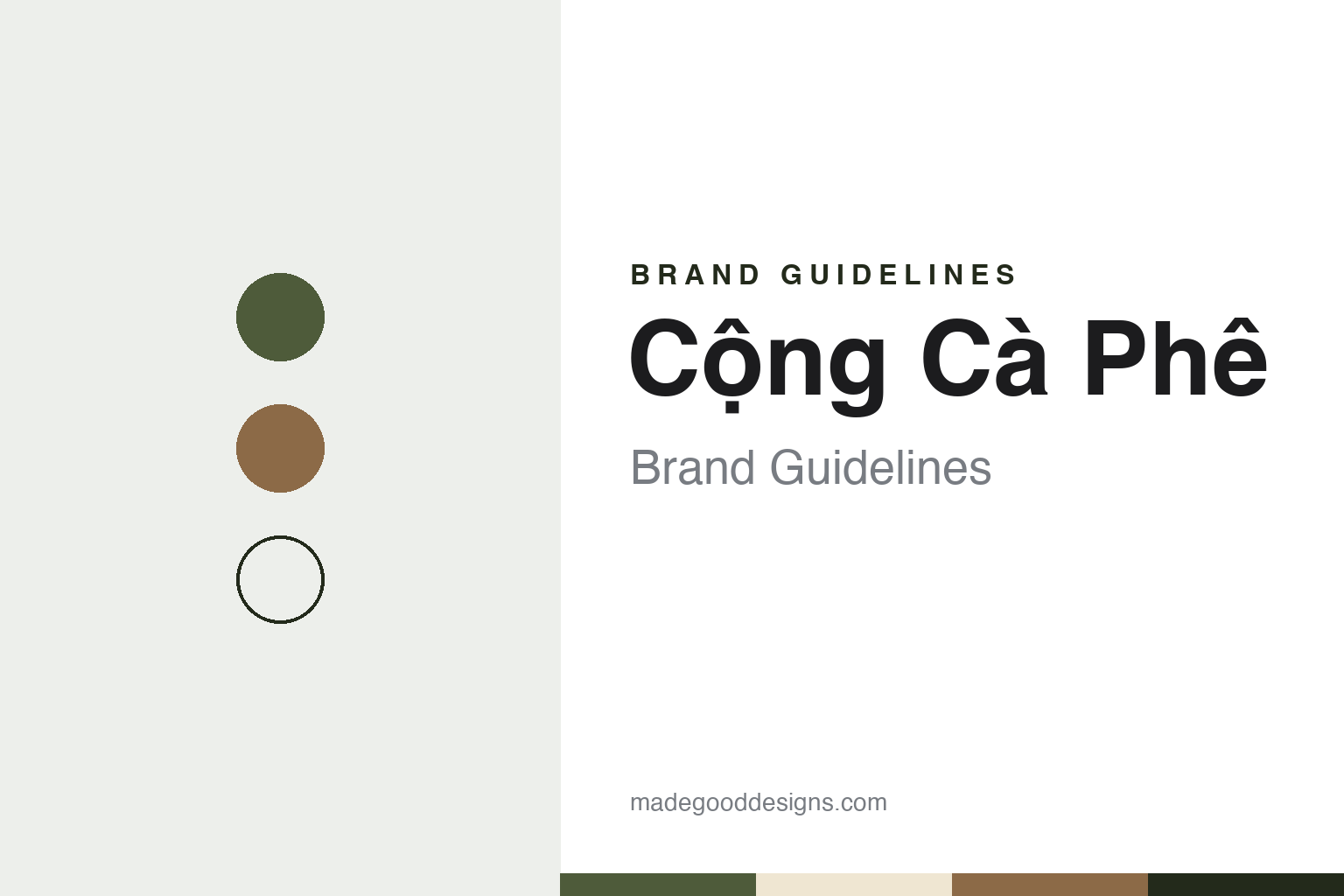
Cộng Cà Phê Brand Guidelines
A Hanoi café that turned the 1980s into a room you can sit in.
Aa
Two constants: an olive green, teak and coconut cream palette and a typewriter register. Abstract homage — not a Cộng Cà Phê product or mark; no cup, logo or sign is reproduced.
Hanoi, 2007
A small retro café on Triệu Việt Vương Street.
Cộng Cà Phê began in Hanoi in 2007. Inside Retail reported in January 2025 that it was founded by Linh Dung, a former performance artist, and Saigoneer wrote in July 2018 that it started as a small, retro-style coffee house on Triệu Việt Vương Street. The company writes its name Cộng Cà Phê, often shortened to Cộng, and uses the unaccented Cong Caphe abroad; its website names the operating company as Công ty TNHH Cộng Cà Phê, based in Hanoi.
The idea behind the rooms is a period rather than a product. Inside Retail wrote in August 2025 that the brand pays homage to Vietnam’s bao cấp, or subsidy period, the decade from 1976 to 1986, and in December 2023 it reported that the retro style was drawn from the founder’s childhood memories of Hanoi in those years. Saigoneer described the effect in 2018 as the atmosphere of northern Vietnam under a command economy, carried by wooden tables, dim lights, the colour of the walls and furniture, and the background music.
The chain spread first within Vietnam. In January 2016 Saigoneer reported on a newly opened southern branch in Ho Chi Minh City, noting that the Hanoi chain then had more than 20 locations, including a shop on Bùi Viện and a small corner café in the old Catinat apartment building on Lý Tự Trọng. By mid-2018 it had more than 50 stores in Vietnam’s major cities, according to Saigoneer and Vietnam Investment Review.
Colour
Seoul, Toronto, Manila, Paris.
The first move abroad was to South Korea. Saigoneer reported in July 2018 that the chain had announced a Seoul shop in Yeonnam-dong, a neighbourhood popular with young people, with staff trained in Vietnam, and Vietnam Investment Review reported in August 2018 that it had opened there, after business partners had suggested Germany or Thailand instead. The paper noted that the shops kept their retro look consistent, from table and chair sets to glasses and cups, while drinks would be adapted to each host country. Its lead bartender in Seoul was an experienced Vietnamese barista living in the city, and the paper suggested Korean customers might also want Vietnamese snacks such as bánh mì and peanut candy.
Inside Retail reported in December 2023 that Cộng had opened its first store in Canada, in Toronto, as its third international market after South Korea and Malaysia; at that point it had 63 locations in Vietnam, nine in South Korea and three in Malaysia. By January 2025 the same publication counted 66 stores in Vietnam, 45 of them in major cities such as Hanoi and Ho Chi Minh City, and listed Taiwan among its markets.
The Philippines followed. PhilSTAR Life reported that the first branch there opened on Sunday, March 16, 2025, in a Metro Manila mall rather than the old buildings and houses where most Cộng cafés sit, and that its designers and furniture, down to the picture frames, came from Vietnam. The franchise owner told the magazine that the Manila café served almost the whole Vietnamese drinks menu to the same recipes, leaving out only a few fruit drinks, such as ambarella, made with fruit that is local to Vietnam. In July 2025 the chain opened in Paris, on Rue Volney in the 2nd arrondissement. Reporting on that opening in August 2025, Inside Retail said Cộng had more than 25 outlets across South Korea and more than 100 stores worldwide, run as company-owned shops in some markets and with franchisees in others, and named Đặng Linh Giang as chief executive of Cong Caphe International.
Typography
Vietnamese café and restaurant chains.
Vietnam’s café and restaurant chains grew up in a country with a deep street culture of coffee, tea and noodle soup, and most of them present themselves through the shop itself. A chain’s identity is carried by its shopfronts and seating, by the cup a drink is handed over in, and by the bags of ground coffee and boxes of tea sold at the counter or in supermarkets.
Menus are built around named drinks and dishes rather than abstract promises. Coffee chains list house blends, iced coffee with condensed milk and ice-blended drinks; tea chains list fruit teas, milk teas and loose-leaf varieties from Vietnam’s highland growing areas; phở, pizza and hot-pot chains name their broths, toppings and set menus. Store formats vary too, from large flagship cafés to kiosks placed inside supermarkets, and the press has followed which formats the chains keep and which they close.
Ownership is often part of the story. Several of the chains in this set belong to wider groups: Highlands Coffee sits under SuperFoods, in which the Philippine group Jollibee Foods holds a stake, alongside Phở 24; Phúc Long is a subsidiary of the Vietnamese consumer group Masan; others covered here belong to the restaurant group Golden Gate or the retail group Seedcom, as their own guides set out. Store counts change quickly, so each guide gives its figures with the date and the publication that reported them.
Each guide sets out what can be checked about a brand from independent, dated reporting by publications such as VnExpress International, Tuoi Tre News, Viet Nam News and Vietnam Investment Review: who founded it, who owns it, how it trades and what its stores and products look like, with company statements marked as the company’s own word.
Aa
A worn typewriter face, in the spirit of old notices and certificates. (Specimen set in Special Elite, a typewriter STAND-IN; NOT the Cộng Cà Phê logo.)
Cộng Cà Phê
Green walls, school desks and coconut coffee.
The interiors are the brand. Inside Retail described them in August 2025 as walls painted green, wooden school desks and framed certificates from earlier decades, and said the Paris café kept the same weathered wood and metal fans. Saigoneer, visiting the Ho Chi Minh City branch in 2016, listed transistor radios, chipped tin cups and shelves of vintage books, a wooden loft with low folding chairs and floral cushions in a 1970s pattern, and staff dressed in shades of green.
The menu is built on Vietnamese coffee, which Inside Retail reported in January 2025 the chain makes with Vietnamese robusta beans. Its signature is coffee with coconut: Saigoneer named the cốt dừa cà phê, Vietnamese coffee with a coconut smoothie, as the house drink in 2016. Inside Retail listed the Coconut Coffee Smoothie, cà phê sữa đá and Saigon Salted Kumquat as signature drinks in Toronto in 2023, and coconut green rice coffee among the specialities in 2025. Saigoneer also mentioned old Vietnamese snacks, such as a croissant served with condensed milk for dipping.
Beyond the cafés, the company’s website sells packaged goods: coffee in a new paper-box range, a Shan Tuyết cổ thụ tea in paper boxes, and what it describes as its first instant milk tea, named “Nhài ơi”. Those product descriptions are the company’s own.
For a design guide, Cộng Cà Phê shows how a café brand can be carried almost entirely by an interior: furniture, objects, colour and music do the work a logo would do elsewhere, and the same room has been rebuilt from Hanoi to Seoul and Paris. Compare Trung Nguyên, another Vietnamese coffee name that has gone abroad, and The Coffee House. For this guide we use olive green, teak and coconut cream with a typewriter face, an unofficial interpretation; no product or logo is reproduced.
Explore & save
Keep Cộng Cà Phê’s identity on hand — save it to a board in the Made Good inspiration library.
Cộng Cà Phê identity set
Pin the olive green, teak and coconut cream palette and the typewriter register to your own board.
Source & notes
Frequently Asked Questions
What font can I use to match the Cộng Cà Phê look?
This guide describes Cộng Cà Phê’s type as “A worn typewriter face, in the spirit of old notices and certificates”. Its type specimen is set in Special Elite from Google Fonts as a stand-in; Special Elite is not Cộng Cà Phê’s own lettering.
What colours are in the Cộng Cà Phê palette?
This guide’s Cộng Cà Phê palette is Olive wall green #4E5B3A, Deep moss #232A1B, Coconut cream #EFE6D2, Weathered teak #8C6A47 and Paper #F8F5EE. The tones are the guide’s own unofficial interpretation, not official Cộng Cà Phê hex codes.
When was Cộng Cà Phê founded?
Cộng Cà Phê was founded in 2007, in Hanoi, Vietnam.
Who founded Cộng Cà Phê?
Cộng Cà Phê was founded by Linh Dung in 2007.