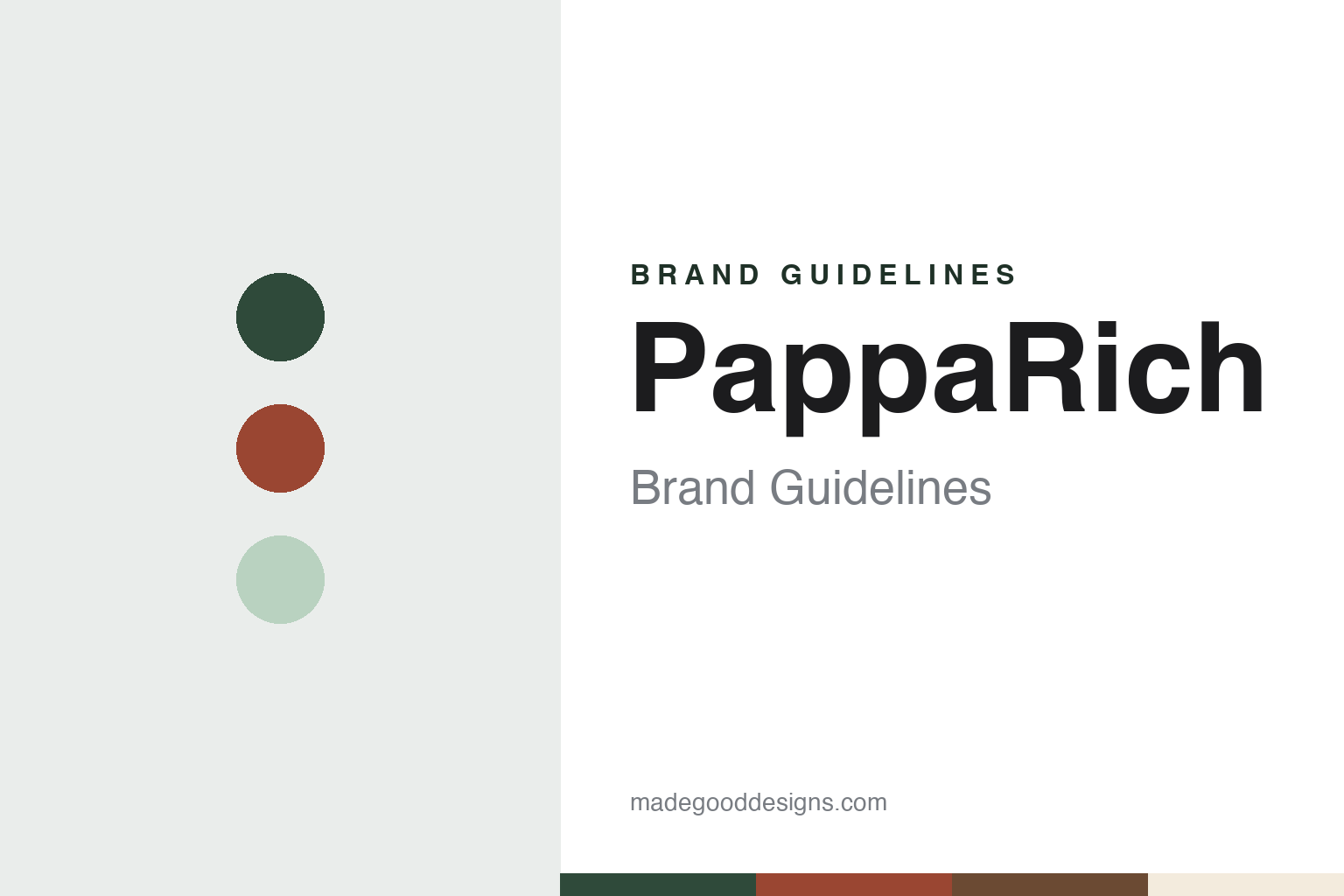
PappaRich Brand Guidelines
The Selayang kopitiam that became a wood-and-brick mall chain.
Aa
Two constants: a green, brick and timber palette and a kopitiam serif register. Abstract homage — not a PappaRich product or mark; no logo, menu or interior is reproduced.
Pappa Kopitiam
A Selayang Mall coffee shop renamed in 2009.
PappaRich began as a single kopitiam-style restaurant at Selayang Mall, in the Klang Valley around Kuala Lumpur. Its founder, Rich Tan, came from sales and had run an electrical appliance store before he opened the outlet, The Edge Malaysia reported in June 2012. Sources differ on the year. The Edge Malaysia gave 2005; Vulcan Post in June 2023 and English Wikipedia give 2006, and Tan told Vulcan Post in July 2023 that he started his own business in 2006.
The outlet was first called Pappa Kopitiam. It followed a trend Tan had noticed in Singapore in the early 2000s: air-conditioned coffee shops in shopping malls serving the staples of old-time kopitiams, such as kaya toast, soft-boiled eggs and Hainanese coffee, The Edge Malaysia reported. Tan saw a gap for a more polished kind of kopitiam dining in Malaysia. The first menu was small, with five dishes and a few drinks, and a second outlet followed at Bukit Tinggi in 2007, according to the same report.
The name changed when the business turned to franchising. A licensing company approached Tan, and he decided that the word “kopitiam” held the brand back: to him it signalled cheap food, while he wanted to charge for quality and ambience. In 2009 the outlets were renamed PappaRich, and the first franchise outlet opened in Kota Damansara. By mid-2012, The Edge Malaysia counted more than 60 further outlets opened across Malaysia since 2009.
The renaming also widened the menu beyond coffee-shop fare to what Tan called “Malaysian delights,” The Edge Malaysia reported, with dim sum, fruit smoothies, new takes on roti canai and a separate vegetarian section. English Wikipedia lists nasi lemak, nasi goreng, laksa and Hainanese chicken rice among the chain’s dishes.
Colour
Mall kopitiams, a central kitchen and an overseas push.
Overseas growth began soon after the rename. In 2012 PappaRich opened in Melbourne through a joint venture, at QV Square, with a slightly larger menu that added satay and nasi briyani, The Edge Malaysia reported that June. The same year Sebastian Low, chief executive of PappaRich Asia Pacific, took the brand to Singapore. Vulcan Post, citing an earlier AsiaOne interview, wrote in June 2023 that trade there was slow at first and improved after a second outlet opened at Parkway Parade.
English Wikipedia records further openings: Hong Kong in February 2016, at L-Square in Causeway Bay; Auckland in March 2016; and Sri Lanka in 2019. In 2017 the chain had about 100 outlets worldwide, it says, and that year it considered a listing in Singapore before putting the plan on hold in October. In June 2023 Vulcan Post listed PappaRich outlets in ten countries outside Malaysia, among them Singapore, Australia, New Zealand and the United States. As of August 2026, English Wikipedia says the brand has four outlets in Singapore.
Part of the operation was run centrally. Low told AsiaOne, as Vulcan Post reported, that the company kept a central kitchen in Malaysia where dishes went through recipe and taste testing, that every store used pepper from Sarawak, and that ingredients were flown in where a country ran short. He also described an egg machine developed by the company to cook soft-boiled eggs to a set temperature and texture, used across its outlets. Some recipes came from the street rather than the test kitchen: the fried chicken thigh in one combination meal was the work of a former nasi padang cook who joined around 2010 or 2011, Low said.
The Singapore team also tried to reach younger diners, Vulcan Post wrote, citing the same interview, including by toning down the colours of the restaurants so that outlets felt more like a place to spend time.
Typography
Design and documentation.
Malaysian and Singaporean food chains tend to tell their story through the shop itself. Kopitiam chains present a coffee-shop past inside modern premises: Ya Kun Kaya Toast puts the same posters about its old stall in every outlet, according to a case study by the World Intellectual Property Organization, while Killiney Kopitiam still trades from the shophouse where its predecessor opened in 1919. Bakery, cake and bubble-tea chains often lean instead on bright counters, packaged goods and the look of the cup, box or bag a customer carries away.
Menus are written dish by dish and drink by drink. Kaya toast, soft-boiled eggs, laksa and nasi lemak appear under their everyday names, and coffee and tea orders often keep the local shorthand of the kopitiam, such as kopi O or teh C, which some chains explain on their own websites for newcomers.
Store networks are something the companies publish themselves. Websites list outlets at home and abroad, often in malls, food courts and airport terminals, and franchise pages set out what a partner receives: the trade name, trademarks, training and support. Counts change quickly, so this guide gives each one with the date and source it comes from.
Ownership is described plainly. Some chains remain family businesses passed to a second generation; others belong to listed groups or larger food companies, or have changed hands as their franchise networks grew. Corporate pages on founders, owners and franchise partners are where each company sets out its own account, and this guide marks clearly which facts rest only on that account.
Aa
A warm display serif for a kopitiam register. (Specimen set in DM Serif Display, a serif STAND-IN; NOT the PappaRich logo.)
PappaRich
A wood-and-brick interior and a new owner.
The look of the restaurants was part of the brand from early on. In 2012 The Edge Malaysia described dark wood panelling and tables, red brick feature walls, parquet floors, mint green leather booths and open cooking stations with steam rising from bamboo steamers, and said Tan had shaped the look, taste and feel of the chain himself. He wanted a father figure as the logo, a wholesome image that anyone could relate to, the paper reported. In June 2023 Vulcan Post described the same elements, meranti wood finishes, pale green leather booths and exposed red brick, as shared by its outlets worldwide and as a nod to restaurants of Malaysia’s colonial era.
Ownership changed after 2019. Tan told Vulcan Post in July 2023 that he had sold his stakes in PappaRich to his business partner in 2019. In 2020 a winding-up petition was filed against the operator of the Malaysian chain, and in 2021 the Shah Alam High Court ordered that company to be wound up, Vulcan Post reported in June 2023, citing The Edge. By then the number of PappaRich outlets in Malaysia had fallen, the publication said. Tan went on to open a separate restaurant business, Rich Kopitiam, at 1 Utama Shopping Centre in July 2023.
In 2023 Andy Lim bid for and won the PappaRich brand for Malaysia and Cambodia, Vulcan Post reported in February 2024; English Wikipedia identifies him as chief executive of Pineapple Resources Berhad. Lim, whose family had run a PappaRich franchise outlet at NU Sentral for close to ten years, became executive director of PappaRich. He described a revamp with refreshed menus centred on classic Malaysian food, and a sister brand, PappaRich Lite, with standalone outlets aimed at younger working adults; in February 2024 the Lite concept was still at the trial stage, the report said.
For a design guide, PappaRich shows how a kopitiam can be turned into a mall restaurant through materials — wood, brick and green upholstery — as much as through a logo. Compare OLDTOWN White Coffee, which The Edge Malaysia placed in the same 2005 wave of Klang Valley kopitiam chains, and Secret Recipe, another Malaysian café chain. For this guide we use a deep green, a brick red and a timber brown with a serif, an unofficial interpretation; no product or logo is reproduced.
Explore & save
Keep PappaRich’s identity on hand — save it to a board in the Made Good inspiration library.
PappaRich identity set
Pin the PappaRich green, brick and timber palette and the kopitiam serif register to your own board.
Source & notes
Frequently Asked Questions
What font can I use to match the PappaRich look?
This guide describes PappaRich’s type as “A warm display serif for a kopitiam register”. Its type specimen is set in DM Serif Display from Google Fonts as a stand-in; DM Serif Display is not PappaRich’s own lettering.
What colours are in the PappaRich palette?
This guide’s PappaRich palette is Booth green #2F4A3A, Brick red #9A4632, Timber brown #6B4A33, Mint leather #B9D2C0 and Kaya cream #F3EBDD. The tones are the guide’s own unofficial interpretation, not official PappaRich hex codes.
When was PappaRich founded?
PappaRich was founded in 2005 or 2006 (as Pappa Kopitiam), in Selayang Mall, Malaysia.
Who founded PappaRich?
PappaRich was founded by Rich Tan in 2005 or 2006 (as Pappa Kopitiam).