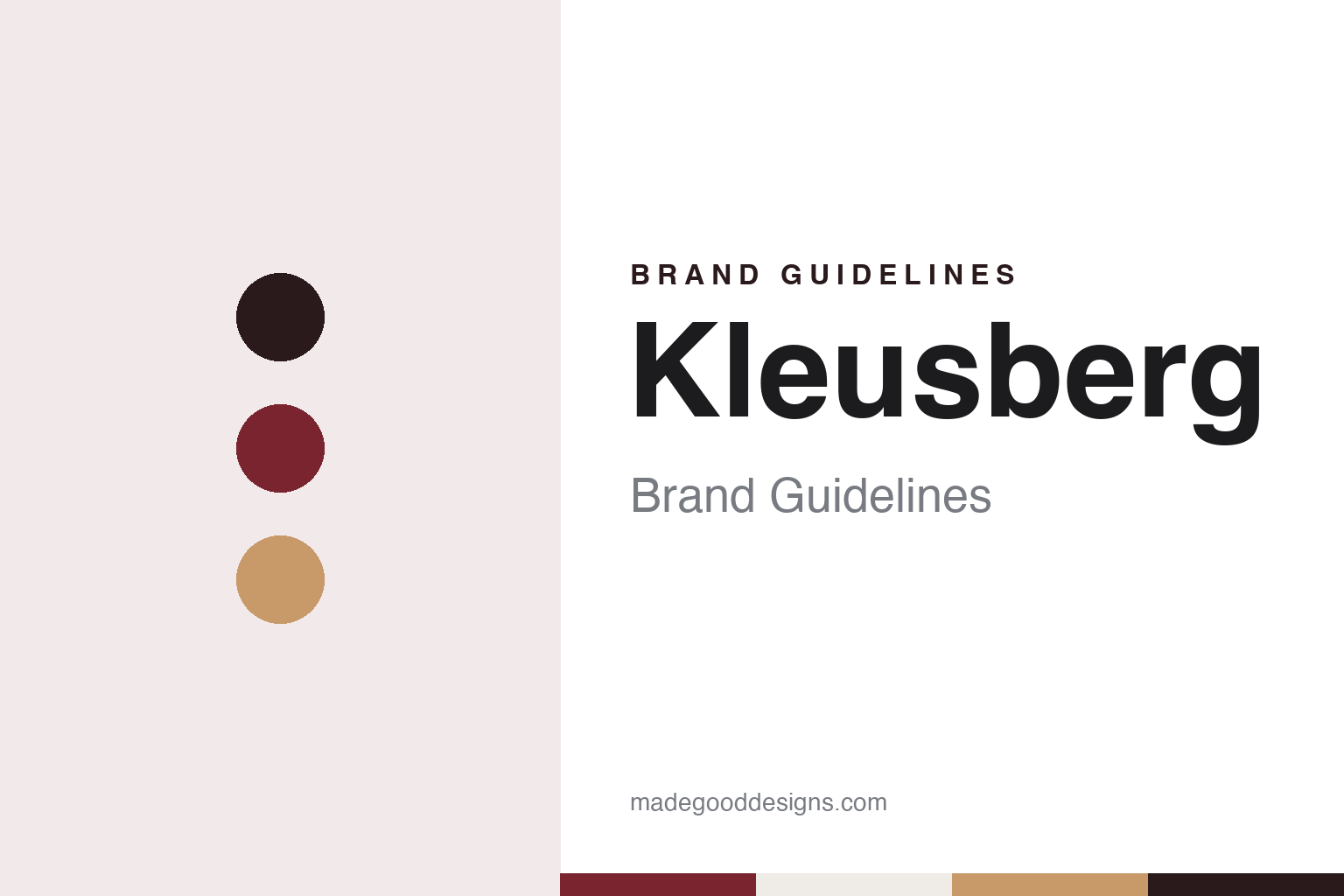
Kleusberg Brand Guidelines
From a 1948 Morsbach joinery to ModuLine and SOLID.
Aa
Two constants: a deep red, steel grey and timber palette and a capital sans register. Abstract homage — not a Kleusberg product or mark; no building, logo or container is reproduced.
The Morsbach Joinery
Furniture, doors and site wagons first.
Kleusberg was founded on 1 May 1948, when, the company says, Willi Kleusberg opened a building and furniture joinery in Morsbach, in North Rhine-Westphalia. German Wikipedia gives the same year and place and says the workshop made furniture and exterior doors and later stairs; the company’s timeline adds windows for housebuilding by 1958 and its 500th construction-site wagon in 1963. In the 1960s it also built showmen’s, living and camping wagons, the company says, and German Wikipedia records utility buildings and timber buildings for contractors from that decade.
The business moved toward modular building in the 1970s. German Wikipedia says it put up its first buildings for commercial and public clients and developed its first office containers then, and that the foundation stone of a first production hall in neighbouring Wissen, across the state line in Rhineland-Palatinate, was laid in 1972. The company dates the start of its rental business to 1975, when it first offered a site wagon on hire, and it marked 50 years of what it calls Mobile Raumsysteme, or mobile space systems, in 2024.
After German reunification Kleusberg expanded east. In 1992 it bought the former VEB Raumzellen und Fertighausbau at Dölbau near Halle from the Treuhand, German Wikipedia says, and built a plant with 16,300 square metres of production space there in 1994. The Mitteldeutsche Zeitung reported in July 2017 that the Kabelsketal site employed around 300 people, had gained a three-storey modular office building, was adding a taller final-assembly hall, and that Kleusberg had bought a further 200,000 square metres near Gröbers to expand its rental business. In 2020 Kleusberg bought the Frankfurt construction-machinery dealer and crane-hire firm Rhein-Main-Baugeräte, according to German Wikipedia.
Kleusberg has stayed in family hands since 1948, German Wikipedia says, and the company spoke of three generations at its 75th anniversary in 2023. Its head office is in Wissen, and the Allgemeine Bauzeitung reported in July 2026 that the group had opened its own branch in St. Marien near Linz, Austria, that year.
Colour
Modular buildings, rental space and hall interiors.
Kleusberg divides its work into three areas: Modulgebäude (modular buildings), Mobile Raumsysteme (mobile space systems for rent or sale) and Industrieräume (rooms built inside industrial halls). German Wikipedia describes the core as building in standardised room modules with a basic frame of steel or timber, plus a hybrid method that combines modular and conventional construction.
For permanent buildings, the named system is ModuLine, which the company says it launched in 2018 as a rent-or-buy system for expandable, fully permitted modular buildings. The Allgemeine Bauzeitung listed its uses, as the manufacturer gives them, as schools and day-care centres, administrative buildings and commercial and industrial projects. Kleusberg says it first used timber modules in 2021, for the Hausburg primary school in Berlin, and that in 2003 it was one of the first prefabricated-building firms to complete a six-storey modular building.
The rental side runs under the name SOLID, a container system for construction and industry, with a PLUS series for longer hire periods, according to the 2026 Allgemeine Bauzeitung report. German Wikipedia says the rental modules use a self-supporting steel frame, are prefabricated in the factory, and can be stacked up to three storeys for hire of up to 48 months. The company’s own figures give more than 35,000 containers in its rental fleet and more than 1,400 staff at 18 sites in Germany and one in Austria; German Wikipedia, citing the 2024 group accounts, gives 1,268 staff and 70 trainees at 14 German sites in 2024.
Production is concentrated at a few large sites. German Wikipedia names the Dölbau plant as Kleusberg’s main production site and gives 20,500 square metres of production space in Wissen; the company says its production and logistics areas total more than 170,000 square metres and that up to 95 percent of a building is prefabricated in the factory. In 2023 Kleusberg ranked 48th in a list of the 50 largest German construction firms published by the German construction industry federation, German Wikipedia says.
Typography
How the category presents itself.
Modular and portable-building firms sell something people mostly see from the roadside: a cabin at the edge of a building site, a stack of steel modules beside a school, a row of storage containers in a depot yard. Their websites lean on that picture. Product pages show single units and stacked blocks photographed outside and in, often with the furniture and fittings that turn a box into an office or a classroom, and case studies show finished complexes from the air.
The units themselves carry much of the identity. A company name on the side of a cabin is seen by everyone who passes a site, and colour can become a signature: Algeco says the dark grey finish it introduced with its Progress range in 2005 is now emblematic of the market. Some names have become so familiar that the companies ask for them not to be used as generic words; Algeco’s French website has a page making exactly that request.
Much of the selling now happens online. WillScot’s website, rebuilt in 2024 when it folded the Mobile Mini site into its own, offers configurable packages for furniture, entrances and fencing, a fencing estimator and a search for units on sale. Configurators of this kind let a buyer assemble a building from named parts before anyone visits the site.
Behind the cabins sit corporate pages written for investors. Firms in this sector publish fleet sizes, country counts and the names of their owners: Modulaire Group, for example, gives its fleet as more than 330,000 modular space and storage units across 24 countries. This guide uses such figures only as dated, attributed statements, and notes where a claim rests on a company’s own word.
Aa
A capital sans for a name the company writes in upper case. (Specimen set in Barlow, a sans STAND-IN; NOT the Kleusberg logo.)
Kleusberg
A family timeline told as a brand story.
Kleusberg writes its name in capital letters across its website, and pairs it with short German lines such as “Raum für alle” (room for everyone) and “Zukunft Raum” (future space), the phrase that heads its history page. The product names are short and kept apart from the company name: ModuLine for permanent buildings, SOLID and PLUS for rental containers.
The company leans on its history. Its milestones page runs from the 1948 joinery and the 1960s site wagons to the timber-module school of 2021, and it built microsites for its 75th anniversary in 2023 and for 50 years of rental space systems in 2024, the second under the line “Happy Container.” Its mission text stresses “Made in Germany” and lists education, childcare, research, housing and work among the uses it builds for.
Two trade reports show how the company is covered. The Mitteldeutsche Zeitung in 2017 quoted the Kabelsketal works manager describing the new three-storey modular office building there as both a better workplace and a reference project for the company’s products, and the 2026 Allgemeine Bauzeitung report set out the SOLID, PLUS and ModuLine ranges for the new Austrian branch.
For a design guide, Kleusberg shows how a family joinery can turn its own timeline into a brand story, with plain capitals, short product names and anniversary pages for its factory and rental history. Compare Karmod, a Turkish prefabricated-building and container maker, and Algeco. For this guide we use a deep red, a steel grey and a warm timber tone with a sans, an unofficial interpretation; no product or logo is reproduced.
Explore & save
Keep Kleusberg’s identity on hand — save it to a board in the Made Good inspiration library.
Kleusberg identity set
Pin the Kleusberg deep red, steel grey and timber palette and the capital sans register to your own board.