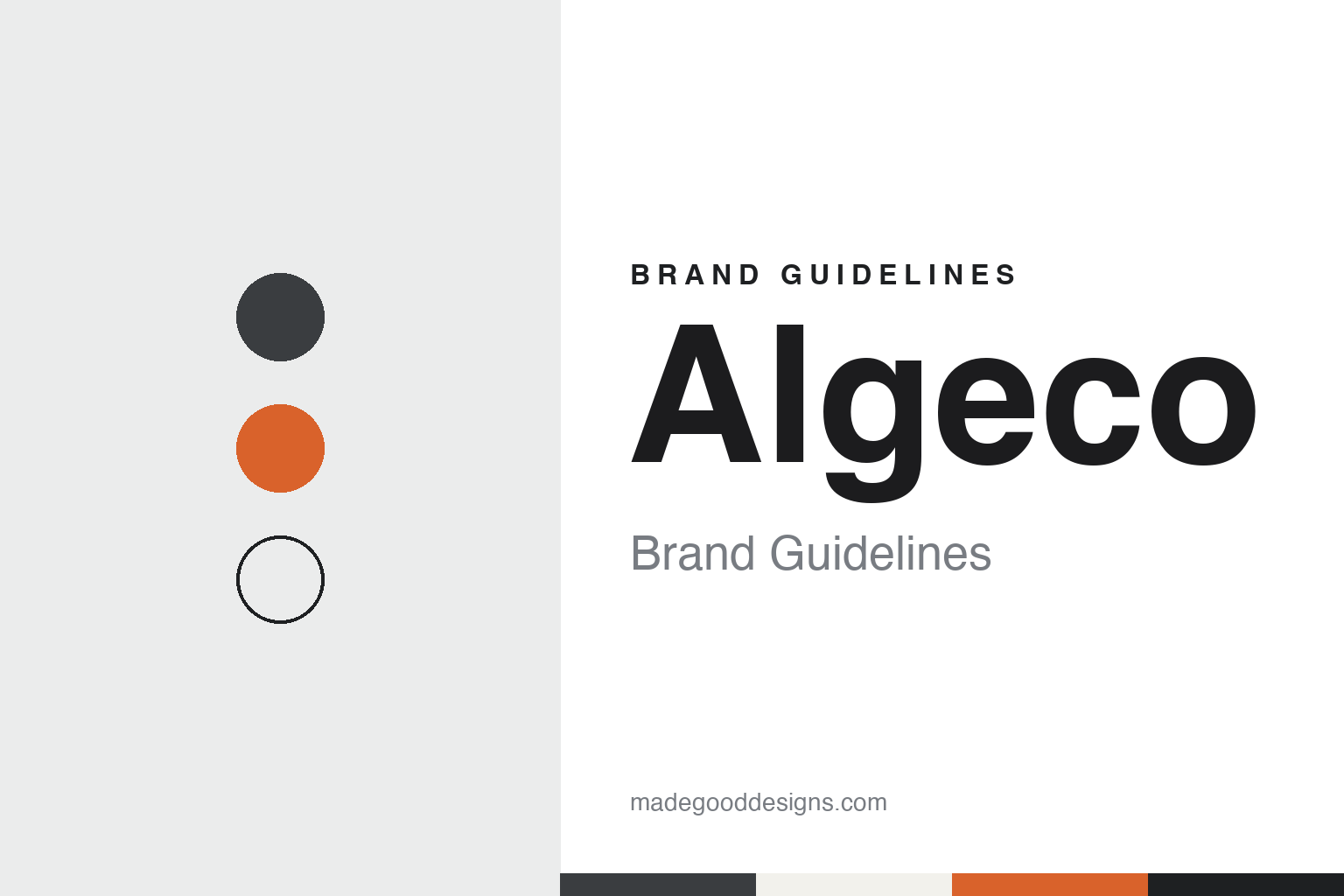
Algeco Brand Guidelines
From wine wagons in Mâcon to modules stacked across Europe.
Aa
Two constants: a module grey, chalk and orange palette and a geometric sans register. Abstract homage — not an Algeco product or mark; no module, logo or livery is reproduced.
Mâcon, 1955
From wine wagons to the site hut.
Algeco began in 1955 in Mâcon, a wine town in Burgundy. According to the company’s own history, Jean-Pierre Bruggeman and Jean Thomachot founded a firm called Alliance de Gestion Commerciale, a name soon shortened to Algeco. Its first business, the company says, was moving wine by rail, and it worked on tank wagons and on containers that travelled on rails.
The turn to buildings came a year later. In 1956, Algeco says, it launched its first prefabricated site hut, the “baraque de chantier”: a wooden cabin with a stove and a dormitory for building crews. The company calls itself the inventor of the concept, which is its own claim. In 1965 it moved to steel modules, which it says replaced timber in the frame and panels and gave more freedom in where windows and doors could go, with parts that could be screwed, clipped and fitted together.
Ownership changed early. In 1966, the company history says, the German group Preussag bought Algeco and combined it with its rail-wagon subsidiary VTG, and the business grew through acquisitions and new subsidiaries in Belgium, Spain and the United Kingdom. The ALGECO mark was registered in 1971. In 1980 Algeco bought a sheet-metal works at Saint-Amour, in the Jura, which became its main factory and research centre.
The French website still stresses the mark. A page devoted to the trademark reminds readers that ALGECO is a registered trademark, asks that it not be used as a generic word, and says the company reserves the right to act against third parties who use it that way.
Colour
Bulle 2002, Progress and the Saint-Amour lines.
Algeco’s product history reads as a sequence of named ranges. In 1973, with the designer Sébastien Baldini, it developed the Bulle 2002, a plastic module of nine square metres that could be assembled into larger units. The company describes it as rounded, brightly coloured and fitted with large acrylic windows, and says it became a fixture of temporary shops and exhibitions. In 1995 came the 7000 series, modules that could be joined and stacked up to three levels for offices, classrooms, washrooms, changing rooms and canteens.
The Progress range followed in 2005, drawn with the architecture practice Outsign in response to the French thermal regulation of that year. Algeco says the range introduced the dark grey finish that it now calls emblematic of the market and widely copied; that description rests on the company’s word. In 2022 it presented Progress 20, which it describes as fully compatible with France’s RE2020 building regulation.
Production for France is centred on Saint-Amour. The company says the site has two production lines and more than 80,000 square metres of workshops, storage and logistics, employs about 130 permanent staff, and turns out more than 5,000 modules a year. New modules are made to order there: floor and roof bases arrive by lorry, insulation and floors are fitted, the floor and roof are bolted to four corner posts, and façade panels, partitions, doors, windows, plumbing and wiring follow before a final check against the client’s specification. Algeco names ISO 9001 and ISO 14001 among the factory’s certifications.
Services widened after 2015, when the company says it began adding furniture, connections, accessories and module cladding to what it calls “ready-to-live” spaces. Its French site now lists services under names such as Algeco Design and Algeco Aménagement, alongside refurbished and second-hand modules. In 2020 it bought Altempo, a firm that designs, builds and manages modular buildings, according to its history page.
Typography
Cabins, fleets and owners.
Modular and portable-building firms sell something people mostly see from the roadside: a cabin at the edge of a building site, a stack of steel modules beside a school, a row of storage containers in a depot yard. Their websites lean on that picture. Product pages show single units and stacked blocks photographed outside and in, often with the furniture and fittings that turn a box into an office or a classroom, and case studies show finished complexes from the air.
The units themselves carry much of the identity. A company name on the side of a cabin is seen by everyone who passes a site, and colour can become a signature: Algeco says the dark grey finish it introduced with its Progress range in 2005 is now emblematic of the market. Some names have become so familiar that the companies ask for them not to be used as generic words; Algeco’s French website has a page making exactly that request.
Much of the selling now happens online. WillScot’s website, rebuilt in 2024 when it folded the Mobile Mini site into its own, offers configurable packages for furniture, entrances and fencing, a fencing estimator and a search for units on sale. Configurators of this kind let a buyer assemble a building from named parts before anyone visits the site.
Behind the cabins sit corporate pages written for investors. Firms in this sector publish fleet sizes, country counts and the names of their owners: Modulaire Group, for example, gives its fleet as more than 330,000 modular space and storage units across 24 countries. This guide uses such figures only as dated, attributed statements, and notes where a claim rests on a company’s own word.
Aa
A geometric sans — echoing a logo the company calls Bauhaus-inspired. (Specimen set in Jost, a sans STAND-IN; NOT the Algeco logo.)
Algeco and Modulaire
A Bauhaus-style logo since the 1970s.
Algeco’s identity is unusually well described by the company itself. Its history page says that since the 1970s Algeco has used a logotype of Bauhaus inspiration, in which each letter is built from a few simple geometric shapes — just as, the company says, modules are assembled to make a building. It adds that colours and dressing have changed over the decades while the basic drawing has stayed. On the web, algeco.com, checked in November 2026, sets its text in Roboto.
The ownership story is a chain of investors. The company history says the British private-equity firm TDR Capital became the owner in 2004, and that under TDR Algeco bought the American firm Williams Scotsman. Le Moniteur reported in December 2007 that the deal, announced that July, was completed on 31 October 2007, and described it as the European number one joining the American number one. Ausco in Australia and Portacom in New Zealand followed in 2011. At the end of 2018 the group bought Touax’s modular business, and in 2019, according to the Algeco history, the parent, by then called Modulaire Group, separated from its North American branch.
In June 2021 Modulaire announced that its shareholders, including funds managed by TDR Capital, had agreed to sell the group to funds managed by Brookfield Business Partners. Financier Worldwide reported the agreement in September 2021, when Modulaire had operations in 25 countries and about 259,000 modular space and storage units. Modulaire’s 2026 leadership page lists two managing partners of Brookfield’s private-equity group as co-chairmen, and a chief executive, Remco Teulings, who joined that year.
Modulaire, which has its corporate office in London, calls Algeco the largest brand in its group. In a November 2026 release Modulaire said it operated in 24 countries with a fleet of more than 330,000 modular space and storage units, and that Algeco had opened in the Middle East through a subsidiary based in Dubai. The group’s other names include Ausco Modular, Portacom and Advanté, which runs site welfare units under the Oasis brand in the UK.
For a design guide, Algeco shows a company guarding its name against generic use, with a logo drawn the way its buildings are assembled. Compare WillScot, another large fleet of site offices and storage, and Portakabin. For this guide we use a module grey, chalk and a warm orange with a geometric sans, an unofficial interpretation; no product or logo is reproduced.
Explore & save
Keep Algeco’s identity on hand — save it to a board in the Made Good inspiration library.
Algeco identity set
Pin the Algeco module grey, chalk and orange palette and the geometric sans register to your own board.