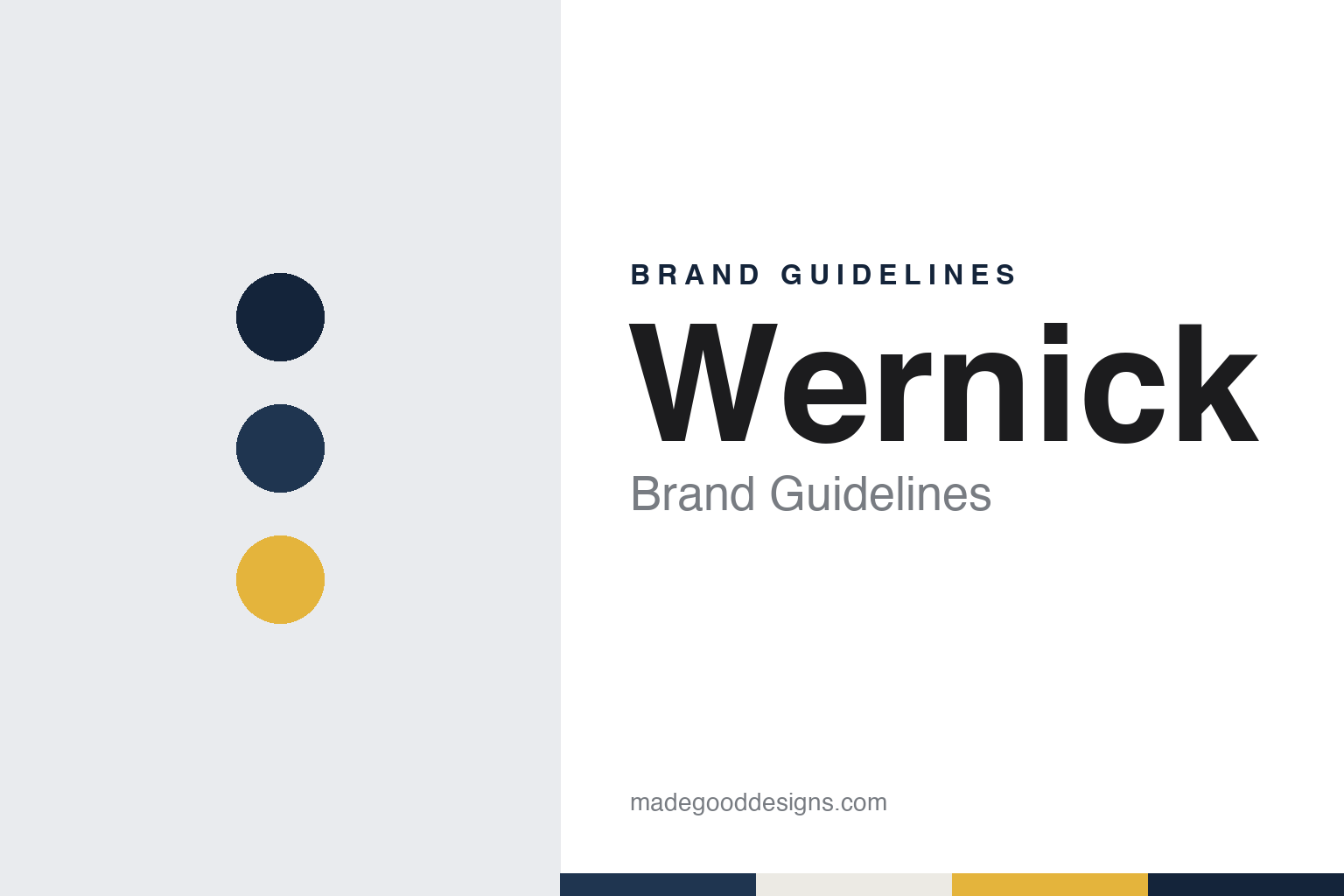
Wernick Brand Guidelines
The Essex family group that grew from poultry crates to cabins.
Aa
Two constants: an ink blue, cabin grey and signal yellow palette and a plain grotesque register. Abstract homage — not a Wernick product or mark; no building, logo or livery is reproduced.
From Crates to Cabins
A family business that dates itself to 1934.
Wernick traces its history to 1934, when, the company says, it began as a maker of poultry crates. It has been family-owned and family-run ever since, according to its own account. KHL, the construction trade publisher, described it in October 2009 in the same terms: family-owned and run, founded more than 70 years earlier, with chief executive David Wernick the grandson of the founder. The sources used for this guide do not say how the business moved from crates to buildings, or how it operated during the Second World War.
By 2009 the business was a large rental operation. In October that year KHL reported that Wernick had bought Rollalong, a cabin hire firm founded in 1968 that ran about 4,000 cabins from eight branches, taking Wernick’s cabin fleet to about 24,000 units. The same report called Wernick “the largest independent renter and manufacturer of modular and portable buildings in Britain,” with 28 rental depots, six divisional sales offices and two event hire depots at the time.
More purchases followed. KHL reported in August 2012 that Wernick Hire had bought the temporary accommodation business of the contractor Kier Group, and that a year earlier Wernick had acquired Harsco’s Rovacabin and Eventlink businesses, adding about 4,000 cabins and modular buildings and temporary grandstands for 36,000 seats. In September 2021 The Construction Index reported that Wernick had taken over AVDanzer, a Manchester-based maker and hirer of modular buildings set up in the 1980s as Ashton Vernon Rentakabin, adding manufacturing capacity and more than 2,000 cabins and modular bays to the hire fleet.
The family remains in charge. In November 2025 The Construction Index reported a new management structure announced by group chief executive Jonathan Wernick under a strategy the company calls Vision2030, and in June 2026 the same publication described David Wernick as executive chairman when a new Wernick Hire depot opened in Inverness, joining depots in Glasgow, Lochgelly and Dundee. The group’s head office is in Wickford, Essex, according to its website.
Colour
Hire, buildings, events, power and portal frames.
Wernick presents itself as a group of companies rather than a single product brand. Its website lists Wernick Hire for portable and modular buildings on hire, Wernick Buildings for permanent modular projects, a refurbished-buildings arm, Wernick AVDanzer for steel anti-vandal units, Wernick Events for portable buildings at events, Wernick Power Solutions for generators and temporary power, and the newest arm, Wernick Portal Frames. The group says it runs 45 operating centres across 39 locations in the UK and works for both public and private clients.
The hire companies sit in one division. The Construction Index listed its rental companies in November 2025 as Wernick Hire, Wernick Power Solutions, Wernick Events and Rawley Plant Hire, all placed under one rental division from January 2026. Wernick Hire’s own page gives 28 depots across England, Scotland and Wales, and names ranges such as GreenSpace ECO cabins and RestPod units alongside welfare cabins, toilet blocks and modular buildings for offices, schools and clinics. Site accommodation ranges on the group site carry the names PSflex, AVflex and FMflex.
Wernick Buildings handles permanent work. It says it designs and builds most of its buildings to order, using design-for-manufacture-and-assembly principles, and its project pages include a school building meeting the BB104 guidance for special-needs schools and workspace for Tata Steel’s move to electric arc steelmaking. Wernick AVDanzer says it makes its steel units at two sites, at Langley Mill and on Cromford Road, Nottingham, and lists ISO 9001 and ISO 14001 accreditations; The Construction Index noted in 2021 that the anti-vandal steel manufacturing at Langley Mill would carry on under the AVDanzer name.
In October 2026 Construction Enquirer reported the launch of Wernick Portal Frames, which supplies and installs steel portal frame buildings for warehouses, workshops, logistics depots and leisure uses, for hire or purchase. The division added an online building configurator, the report said, with typical buildings from 5 to 100 metres long and up to 20 metres wide.
Typography
How the category presents itself.
Modular and portable-building firms sell something people mostly see from the roadside: a cabin at the edge of a building site, a stack of steel modules beside a school, a row of storage containers in a depot yard. Their websites lean on that picture. Product pages show single units and stacked blocks photographed outside and in, often with the furniture and fittings that turn a box into an office or a classroom, and case studies show finished complexes from the air.
The units themselves carry much of the identity. A company name on the side of a cabin is seen by everyone who passes a site, and colour can become a signature: Algeco says the dark grey finish it introduced with its Progress range in 2005 is now emblematic of the market. Some names have become so familiar that the companies ask for them not to be used as generic words; Algeco’s French website has a page making exactly that request.
Much of the selling now happens online. WillScot’s website, rebuilt in 2024 when it folded the Mobile Mini site into its own, offers configurable packages for furniture, entrances and fencing, a fencing estimator and a search for units on sale. Configurators of this kind let a buyer assemble a building from named parts before anyone visits the site.
Behind the cabins sit corporate pages written for investors. Firms in this sector publish fleet sizes, country counts and the names of their owners: Modulaire Group, for example, gives its fleet as more than 330,000 modular space and storage units across 24 countries. This guide uses such figures only as dated, attributed statements, and notes where a claim rests on a company’s own word.
Aa
A plain grotesque for a family name used across every division. (Specimen set in Archivo, a sans STAND-IN; NOT the Wernick logo.)
Wernick
One surname across every division.
Wernick’s public face is built around one family name applied across every division: Hire, Buildings, Events, Power, Portal Frames and AVDanzer all carry the Wernick word first. That makes the group name, rather than any product line, the constant across the website and its division pages. The site adds a short finder that asks a visitor a few questions and points them to the right company, in about 30 seconds, the site says.
Product names follow a pattern of short coined words: PSflex, AVflex and FMflex for site accommodation, RestPod and GreenSpace ECO for hire units. Case-study pages are organised around named projects and clients, such as the Little Heath School building and the Tata Steel workspace. The group’s stated business goals are short imperative lines, such as “Simplify work to get more done each day” and “Look after the world around us.”
The family thread is part of the story too. The company describes itself as family-owned since 1934, and trade reports in 2025 and 2026 name David Wernick as chairman and Jonathan Wernick as chief executive. When it bought AVDanzer in 2021, David Wernick said both family-owned businesses shared the same values, The Construction Index reported.
For a design guide, Wernick shows how a family group can stretch one surname across hire, manufacture, events and power without inventing separate brands. Compare Portakabin, another long-running British portable-building name, and Elliott. For this guide we use an ink blue, a cabin grey and a signal yellow with a sans, an unofficial interpretation; no product or logo is reproduced.
Explore & save
Keep Wernick’s identity on hand — save it to a board in the Made Good inspiration library.
Wernick identity set
Pin the Wernick ink blue, cabin grey and signal yellow palette and the plain grotesque register to your own board.