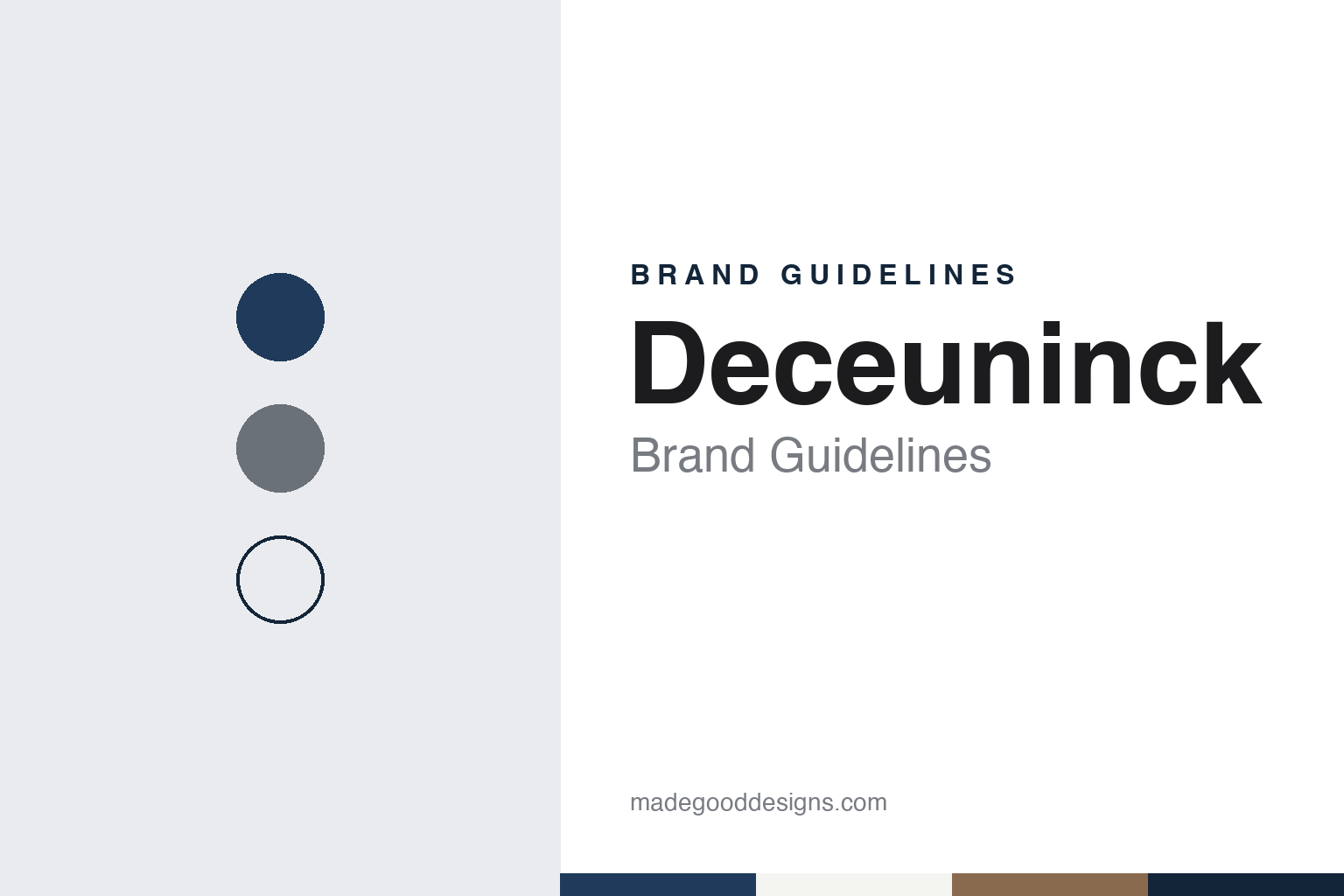
Deceuninck Brand Guidelines
The Flemish button workshop that became a PVC and aluminium profile brand.
Aa
Two constants: a Deceuninck ink blue, white and slate palette and a Technical sans register. Abstract homage — not a Deceuninck product or mark; no profile, logo or nameplate is reproduced.
Buttons and combs
A Beveren-Roeselare workshop of 1937.
Deceuninck began in West Flanders in 1937, when Benari Deceuninck set up a small business in Beveren, near Roeselare, making buttons, buckles and combs from plastic sheet. The company tells the same story on its own history page, where it describes “a small production workplace for buttons and combs.” Dutch Wikipedia notes that he was not the first in the region to work this way: button-making from Galalith had begun at the company Erta in Tielt in the late 1920s.
In 1941 the sole proprietorship became a private limited company, the PVBA Etablissementen Deceuninck, and bought its first injection-moulding machine for combs, small plastic boxes and toys, Dutch Wikipedia says; from 1947 it made its own moulds. The sources used for this guide do not say how the company operated during the occupation of 1940–1944.
The turn to building products came with the next generation. In 1960 Benari’s sons Roger and Michel Deceuninck bought a first extrusion machine at a trade fair in Milan to make PVC profiles for roller shutters, and with their youngest brother, Lionel, built up the extrusion business. A subsidiary, Deceuninck Plastics, won a contract in 1963 to supply bus shelters across Flanders, added PVC planks for façade, wall and ceiling cladding in 1965, and in 1967 began extruding PVC profiles for windows, the first company in Flanders to do so, according to Dutch Wikipedia. In 1968 the works moved from Roeselare to a larger site just over the boundary in Gits, now part of Hooglede, where the head office still stands. Mould-making followed it to Gits only in 1988, Dutch Wikipedia adds, two decades after the extrusion lines.
Colour
Plants abroad, and a listing in 1985.
Expansion abroad began in France. The first foreign site, Plastibat, opened at Houplines in 1970, and the company says that after its products found buyers in France, the Netherlands and the United Kingdom it set up sales subsidiaries there, followed by Spain. As demand grew in the mid-1980s it opened plants at Roye in France and Calne in England. The family business became a public limited company (NV) on 31 July 1974, and its shares were listed on the Brussels stock exchange on 11 June 1985; the company says it has been listed on Euronext Brussels since 1985 and part of the BEL Small index since 2022.
Growth then came through acquisitions. In 1988 Deceuninck bought the former site of the tennis-racket maker Snauwaert in Diksmuide and built its own compounding plant there. In the mid-1990s it started extrusion in Poznań, Poland, and entered the United States, buying Acro Extrusions of Wilmington, Delaware, in 1995 and American Dayton Technologies of Monroe, Ohio, from the Alcoa group in 1997. The 2000s added Turkey, through Ege Profil and Winsa, and Germany, through Thyssen Polymer, bought from ThyssenKrupp in June 2003; the Turkish listed company Pimas followed in 2014. The company took its present name, Deceuninck NV, in 2000. By 2016 it had fourteen production sites in eleven countries, including Belgium, Turkey and the United States, according to Dutch Wikipedia.
The family stepped back from daily management in 1994, when an external chief executive took over and family members moved to the board. In 2014 Gramo, the investment company of the Roeselare entrepreneur Francis Van Eeckhout, became the largest shareholder, Dutch Wikipedia says.
Typography
Profiles, plants and owners.
Window, door and façade system makers rarely sell a finished window to a homeowner. Most of them design and produce the profiles, in PVC or aluminium, that independent fabricators cut, assemble and glaze, and that installers then fit. Their identities are shaped by that chain: the companies speak first to fabricators and architects, and only then to the people who will live behind the glass.
Two kinds of picture recur in how these companies present themselves. One is the profile cross-section, a technical drawing of the frame’s chambers, gaskets and reinforcement, published in system brochures and on product pages. The other is building photography: houses, flats and offices shown with the finished windows and doors in place, often in a range of colours and woodgrain finishes. Between the two sit the swatches, since surface choices such as foils, lacquered finishes and aluminium cover shells have become a large part of what is offered.
Naming tends to be systematic. Ranges are grouped into systems and series, and the name often carries a number tied to a dimension: VEKA, for example, explains that its SOFTLINE 82 profile measures 82 mm in depth. Behind the public pages, many makers run separate areas for professional partners, such as fabricator sections, training seminars and technical downloads, alongside the consumer-facing site.
Corporate pages tell a further story about plants and owners. Makers in this group publish histories that trace small workshops into international groups, list their extrusion and recycling sites, and, where shares are listed, maintain investor pages with shareholder notices. This guide sets out what those pages and independent dated sources say about each brand, and marks what rests on the company’s own word.
Aa
A technical sans for a profile maker. (Specimen set in IBM Plex Sans, a sans STAND-IN; NOT the Deceuninck logo.)
Deceuninck
PVC, aluminium and one brand name.
Deceuninck’s range is built on PVC profiles for windows and doors, with roofline, cladding and terrace products alongside. Dutch Wikipedia counts it among the pioneers of wood composites in Western Europe, under the Twinson name, which the company still uses for its terrace systems. In 2017 it added aluminium with the Decalu range, and it now presents its window line-up in “two variations: PVC or aluminium,” with the line “Sometimes PVC. Sometimes aluminium. Sometimes both.” In 2019 it announced a “One Europe” strategy under a single global brand, Deceuninck, and its Elegant window range won a Red Dot award that year, according to Dutch Wikipedia. Recycling sits at the centre of its own account: the company says its plant at Diksmuide supplies recycled and compound material to its profile plants, and Dutch Wikipedia dates the recycling line there to 2012, fully running from December 2018.
The ownership picture moved in 2026. On 9 June the Flemish business site Made in reported that Gramo, together with related parties, had crossed the 30 per cent threshold of voting rights after exercising subscription rights, which under Belgian takeover law obliged it to bid for all remaining shares. The cash bid ran from 16 to 30 July 2026. According to Gramo’s results announcement of 6 August 2026, published on Deceuninck’s website, shares equal to 1.33 per cent were tendered, leaving Gramo and its affiliates with 31.86 per cent; the bid was not reopened, and Deceuninck’s shares remain listed on Euronext Brussels.
The name also reaches well beyond building sites. English Wikipedia notes that Deceuninck co-sponsored the Deceuninck–Quick-Step cycling team from 2019 to 2021, and later Alpecin–Deceuninck.
For a design guide, Deceuninck shows how a family plastics workshop turned a surname into a single building-products brand across PVC, aluminium and composites. Compare VEKA, the German PVC profile maker, and Reynaers, the Belgian family firm behind aluminium window systems. For this guide we use an ink blue, profile white, slate and a terrace brown with a sans, an unofficial interpretation; no product or logo is reproduced.
Explore & save
Keep Deceuninck’s identity on hand — save it to a board in the Made Good inspiration library.
Deceuninck identity set
Save the Deceuninck ink blue, white and slate palette and the Technical sans register to your own board.