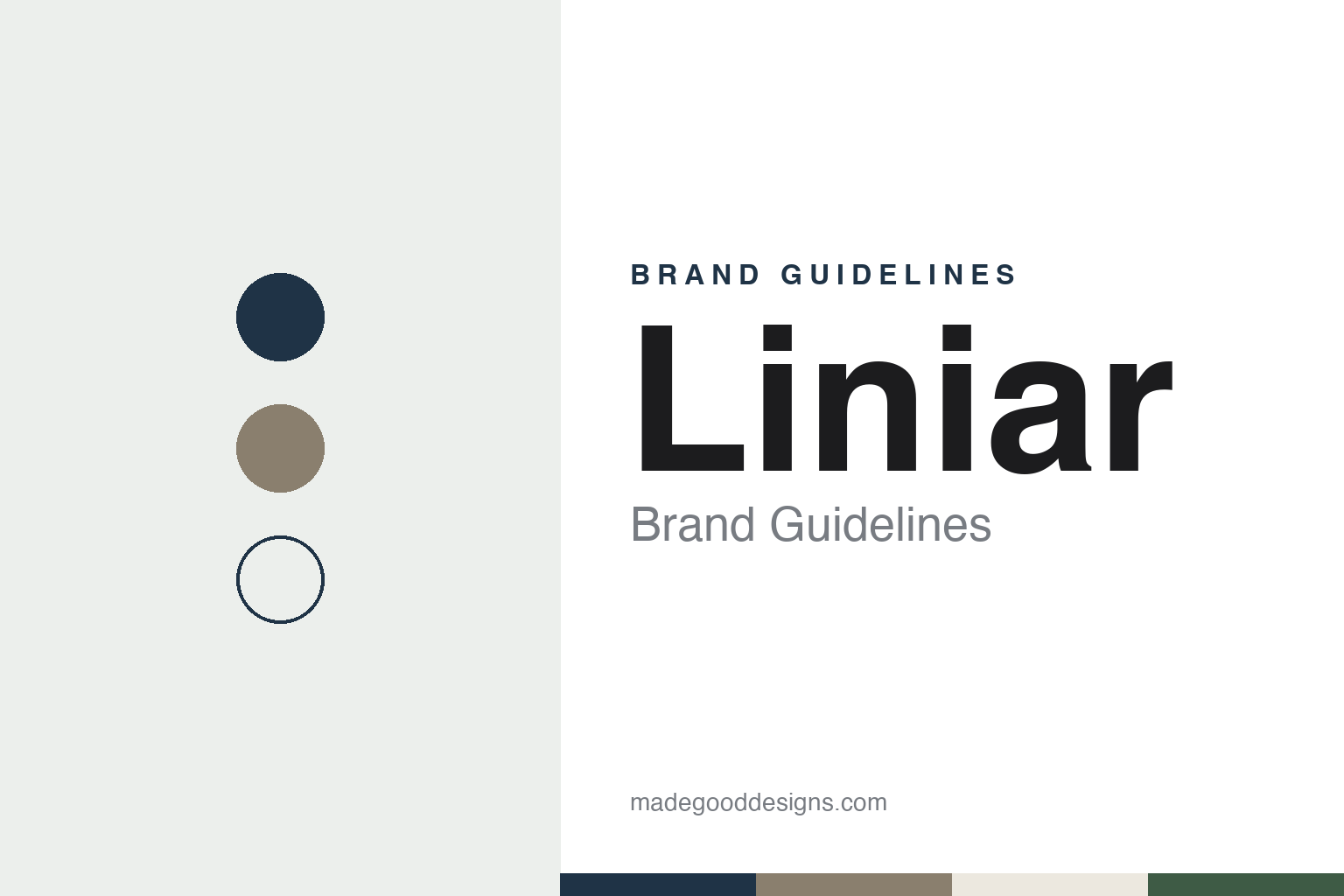
Liniar Brand Guidelines
A Derbyshire extrusion firm’s PVC-U systems brand, introduced in 2006.
Aa
Two constants: an ink blue, gritstone and moss green palette and a geometric sans register. Abstract homage — not a Liniar product or mark; no profile, logo or nameplate is reproduced.
Riddings, 1974
An extrusion firm that grew a brand of its own.
Liniar is a British maker of PVC-U profiles for windows, doors, conservatories and garden products, based at Denby in Derbyshire. The brand itself is young, but the business behind it is not. The company’s own history says it began in 1974, when Godfrey Harris and Stuart Leese started HL Plastics, a trade extrusion company, in a 10,000-square-foot factory at Riddings in Derbyshire. In 1977, the timeline says, it moved to a purpose-built factory at Little Eaton, and in 1981 it launched its first own-brand range, a duckboard system for roof walkways.
A management buyout followed in 1988, led by Roger Hartshorn and Mike Bosworth, according to the company. The next year HL Plastics bought Tarpey Harris, a precision toolmaker, to bring the making of extrusion tools in-house. In 1991, the timeline says, it created the Eurocell name to supply its growing base of window customers, and in 1994 it designed a 70mm window system sold under that name. By 1997 HL Plastics, Tarpey Harris and Eurocell had been grouped together under the name Fairbrook.
The company’s account of the next decade is one of selling and buying back. It says the Belgian Tessenderlo Group bought three-quarters of the group in 1998 and the rest in 2003, and that in 2005 Hartshorn and Bosworth formed Flamstead Holdings to buy back HL Plastics and Tarpey Harris.
The company says the Liniar brand was introduced to the Flamstead Group in 2006, the year building work began on a new factory at Denby, and that the group moved there in 2007. The first Liniar products, according to the timeline, were a fencing and gravel-board system in 2007 and a chamfered window system in 2008, followed by a sculptured window and a decking system in 2009.
Colour
From Flamstead to Quanex.
Growth at Denby is recorded in the trade press. Logistics Manager reported in August 2015 that HL Plastics, which it described as the maker of Liniar PVC-U extrusions, had won planning permission for a 150,000-square-foot warehouse next to its factory and mixing plant at Denby Hall Business Park. The plan, the magazine said, would move Liniar’s foiling plant and roof divisions from premises a few miles away in Somercotes, bringing the whole operation onto one site. Roger Hartshorn, then chief executive, told the magazine it made commercial sense to run everything in the same place. The company says the finished warehouse, at 178,000 square feet, opened in 2017.
The same year brought a change of owner. Quanex, the building-products group headquartered in Houston, Texas, lists “Quanex acquires HL Plastics (Liniar)” as a 2015 event in its own history, and Liniar says Quanex Building Plastics took full ownership of the Flamstead Group that year. Quanex traces its own roots to the Michigan Seamless Tube Company, incorporated in 1927, and says its building-products businesses became a separate company, Quanex Building Products Corporation, in 2008. Machinery supplier Avantek was acquired alongside Liniar, Liniar says, and the two now share a group managing director, Martin Thurley, who took over the running of the business from Hartshorn in 2018 after a two-year handover.
English Wikipedia says the American group acquired Tyman, the London-listed building-products company, in August 2024, and Quanex now places Liniar in its Extruded Solutions division alongside Mikron, Edgetech and Schlegel. Liniar describes itself as a fully owned subsidiary that shares improvement plans with its American counterparts.
The brand has been reworked twice along the way. The company says the Liniar identity was refreshed in 2013, and that in 2022 a group-wide Quanex brand refresh aligned Liniar’s colours with its parent and added the tagline “A part of something bigger”, which Quanex also uses across its own sites.
Typography
Profiles, plants and patents.
Window, door and façade system makers rarely sell a finished window to a homeowner. Most of them design and produce the profiles, in PVC or aluminium, that independent fabricators cut, assemble and glaze, and that installers then fit. Their identities are shaped by that chain: the companies speak first to fabricators and architects, and only then to the people who will live behind the glass.
Two kinds of picture recur in how these companies present themselves. One is the profile cross-section, a technical drawing of the frame’s chambers, gaskets and reinforcement, published in system brochures and on product pages. The other is building photography: houses, flats and offices shown with the finished windows and doors in place, often in a range of colours and woodgrain finishes. Between the two sit the swatches, since surface choices such as foils, lacquered finishes and aluminium cover shells have become a large part of what is offered.
Naming tends to be systematic. Ranges are grouped into systems and series, and the name often carries a number tied to a dimension: VEKA, for example, explains that its SOFTLINE 82 profile measures 82 mm in depth. Behind the public pages, many makers run separate areas for professional partners, such as fabricator sections, training seminars and technical downloads, alongside the consumer-facing site.
Corporate pages tell a further story about plants and owners. Makers in this group publish histories that trace small workshops into international groups, list their extrusion and recycling sites, and, where shares are listed, maintain investor pages with shareholder notices. This guide sets out what those pages and independent dated sources say about each brand, and marks what rests on the company’s own word.
Aa
A geometric sans for a profile-systems maker. (Specimen set in Outfit, a sans STAND-IN; NOT the Liniar logo.)
Liniar
Designed, printed and extruded in Derbyshire.
Liniar sells profiles rather than finished windows. The company says it designs and tests its products, extrudes the PVC-U profiles at Denby and delivers them to independent fabricators and resellers across the United Kingdom, who make and fit the windows. Its range runs from window and door systems to conservatory roofs, lantern roofs, fencing, decking and piling, and it also offers an aluminium bi-folding door called Alumina, launched in 2016.
The products the company points to most are its door and window systems. The ModLok bi-folding door, launched in 2014, uses a PVC-U frame inside an aluminium exoskeleton, and the company says it won a Queen’s Award for Enterprise in Innovation in 2017. Resurgence, a double-rebated flush sash window launched in 2019, won New Product of the Year at the National Fenestration Awards that year, according to Liniar, and in 2023 the company added Zero|90, a 90mm window and door system with a recycled core. Liniar also says it was named PVCu Systems Company of the Year at the 2024 National Fenestration Awards.
Much of that design work starts on a printer. The design magazine DEVELOP3D reported in July 2020 that Liniar, then employing about 500 people at Denby and holding more than 50 registered patents and a Queen’s Award, had used a Stratasys multi-material 3D printer for nearly six years and had added a second machine for tougher functional parts. Its product design manager told the magazine that the team could design a product, assemble it, make changes, reprint it and try again within a day, and that printed parts let the designers screw together full assemblies before any extrusion tooling was cut. The printers also make jigs and fixtures for the fabrication divisions, the magazine said.
Today the company says its Denby site houses 33 extrusion lines, a lamination hall offering 36 stocked colours for PVC-U and aluminium products, and twin mixing plants, with all operations on a single site.
For a design guide, Liniar shows how a contract extruder can build a consumer-facing name in its own right, and then fold that name into a larger group’s identity without losing it. Compare VEKA, the German PVC-U profile maker, and Deceuninck, the Belgian profile-systems group. For this guide we use ink blue, gritstone and moss green on limestone with a sans, an unofficial interpretation; no product or logo is reproduced.
Explore & save
Keep Liniar’s identity on hand — save it to a board in the Made Good inspiration library.
Liniar identity set
Pin the Liniar ink blue, gritstone and moss green palette and the geometric sans register to your own board.