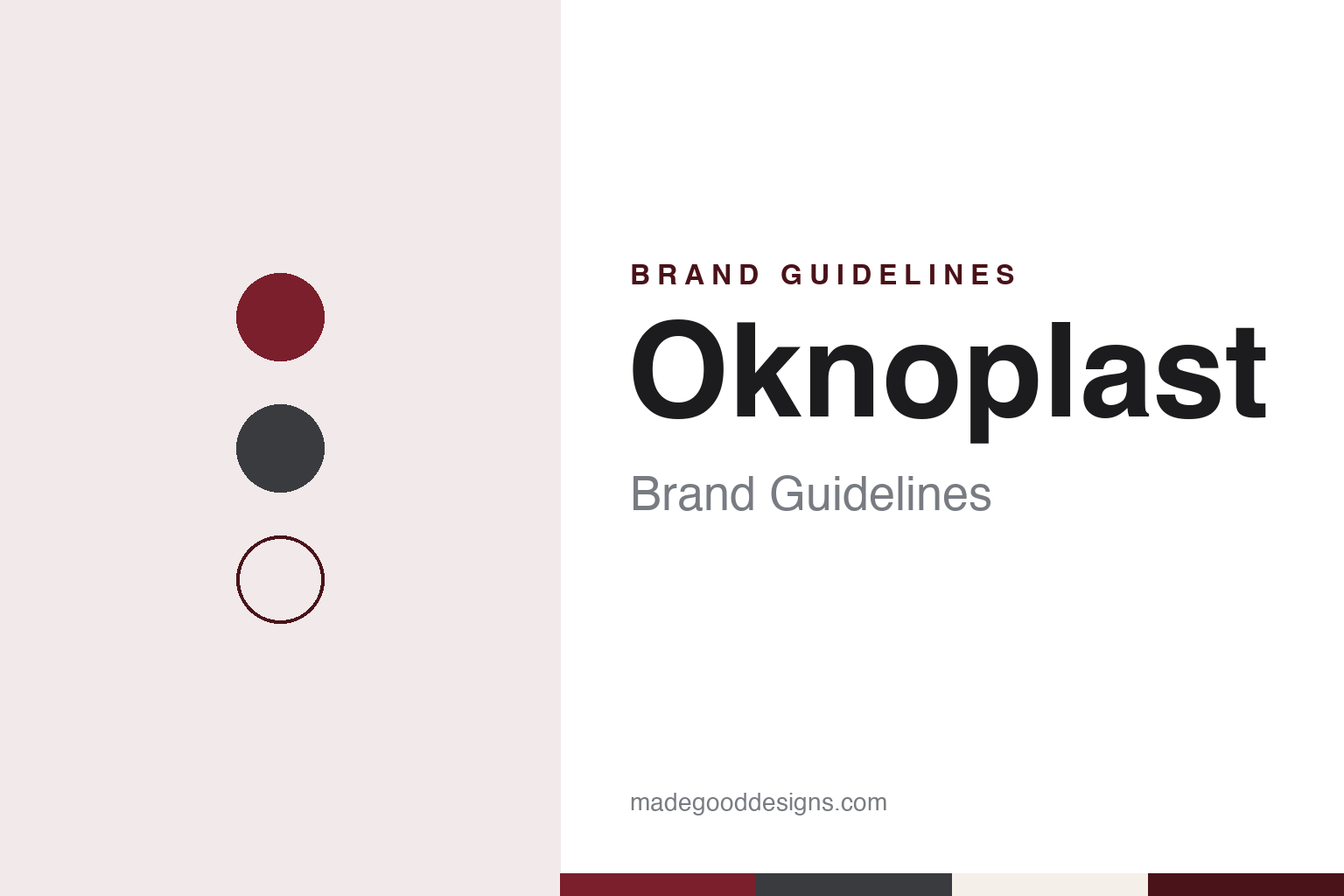
Oknoplast Brand Guidelines
A Kraków window maker that grew into a seven-brand group.
Aa
Two constants: a deep wine, graphite and warm white palette and a rounded sans register. Abstract homage — not an Oknoplast product or mark; no window, logo or showroom sign is reproduced.
From Kraków to Ochmanów
A PVC window workshop that moved to an economic zone.
Oknoplast began in Kraków in 1994. English and Polish Wikipedia both give that year and describe a maker of PVC windows, doors, roller shutters and aluminium products. The company’s own history names its founder as Adam Placek, who set up Przedsiębiorstwo Produkcyjne OKNOPLAST-Kraków to make PVC windows, with its first premises in a former Polmozbyt building in the city. In August 2016 the business site MamStartup, drawing on interviews in Puls Biznesu, reported that production began in a hall in Nowa Huta and that after its first year the firm began working with the German profile maker VEKA, a link Polish Wikipedia still records, alongside the Austrian hardware maker MACO.
Growth came in steps. Polish Wikipedia dates aluminium joinery to 1997, and the company says it was then making windows at two Kraków plants. In 2000 it moved to Ochmanów, in the Niepołomice district east of Kraków, inside a special economic zone; MamStartup reported that it was the second company, after Coca-Cola, to build a plant in that zone. Exports began in 2005, with Germany and Italy among the first markets, according to the same article, and the company says its first German showroom opened at Iggingen near Stuttgart that year. Roller shutters followed in 2009 and the firm’s own glass units in 2012. In 2010 the company name was shortened from Przedsiębiorstwo Produkcyjne OKNOPLAST – Kraków to OKNOPLAST, Polish Wikipedia says.
Oknoplast has stayed in the Placek family. MamStartup reported in 2016 that the founder handed management to his son Mikołaj Placek in 2007, together with a 51 per cent stake, and described him as president and co-owner; the company’s own timeline dates his appointment as president to 2008. In April 2025 the group’s website still named him as president, and on its Polish site the company calls Oknoplast a family brand.
Colour
Named windows, football shirts and a Polish emblem.
The company presents its history as a run of named windows. It dates the Platinium window, with a profile rounded on the inside, to 2007 and Platinium Evolution to 2011; Winergetic Premium and a passive-house version followed in 2013, the angular Pixel in 2016, Prismatic in 2019 and PAVA in 2022. Pixel was launched with a 360-degree projection show at the Gdańsk Shakespeare Theatre, the company says. Its current range in Poland covers PVC windows and terrace doors, roller shutters, façade blinds, entrance doors, garage doors and insect screens, and the company dates its first garage door to 2019.
Recognition is mostly Polish. Polish Wikipedia records the “Teraz Polska” emblem for the Platinium line in 2010 and for the Winergetic Premium window in 2013, a Forbes Diamonds listing in 2010 for companies growing their value quickly, and a TOP Builder distinction from the monthly Builder for Platinium Evolution, dated 2011 there and 2012 in English Wikipedia. The company adds TopBuilder awards for Prismatic in 2020 and PAVA in 2023, and says it was named Building Brand of the Year 2022 at the Builder Awards.
Sport made the name familiar abroad. From January 2012 Oknoplast sponsored Inter Milan, and the deal was extended to the end of the 2014–15 season, Polish Wikipedia says; in 2013 it added partnerships with Olympique Lyon and Borussia Dortmund, and the Bologna basketball club Virtus took the name Oknoplast Bologna from March 2013. Closer to home it sponsored the football club Puszcza Niepołomice from 2010. In 2022 it became a patron of the MOCAK contemporary art museum in Kraków, the company says, and Polish Wikipedia records its sponsorship of the International Architecture Biennale in 2025.
The marketing has followed the export map. The company says it ran its first television campaign in France in 2018, after entering the French market in 2010, and that it refreshed its logotype in 2011 and rebranded its own showrooms in Poland in 2016.
Typography
How system makers present themselves.
Window, door and façade system makers rarely sell a finished window to a homeowner. Most of them design and produce the profiles, in PVC or aluminium, that independent fabricators cut, assemble and glaze, and that installers then fit. Their identities are shaped by that chain: the companies speak first to fabricators and architects, and only then to the people who will live behind the glass.
Two kinds of picture recur in how these companies present themselves. One is the profile cross-section, a technical drawing of the frame’s chambers, gaskets and reinforcement, published in system brochures and on product pages. The other is building photography: houses, flats and offices shown with the finished windows and doors in place, often in a range of colours and woodgrain finishes. Between the two sit the swatches, since surface choices such as foils, lacquered finishes and aluminium cover shells have become a large part of what is offered.
Naming tends to be systematic. Ranges are grouped into systems and series, and the name often carries a number tied to a dimension: VEKA, for example, explains that its SOFTLINE 82 profile measures 82 mm in depth. Behind the public pages, many makers run separate areas for professional partners, such as fabricator sections, training seminars and technical downloads, alongside the consumer-facing site.
Corporate pages tell a further story about plants and owners. Makers in this group publish histories that trace small workshops into international groups, list their extrusion and recycling sites, and, where shares are listed, maintain investor pages with shareholder notices. This guide sets out what those pages and independent dated sources say about each brand, and marks what rests on the company’s own word.
Aa
A rounded sans for a consumer window brand. (Specimen set in Manrope, a sans STAND-IN; NOT the Oknoplast logo.)
OKNOPLAST Group
Seven brands, six factories, three countries.
Oknoplast is now the core of OKNOPLAST Group. The group’s history page says the aluminium brand Aluhaus was created in 1998; in 2012 the group bought a plant at Rąbień near Łódź and created the economy brand WnD; in 2020 it bought the Spanish brand Hermet 10; it added the aluminium pergola brand Skyvi in 2022 and Catadi, aimed at investment clients, in 2023; and in 2024 it joined forces with the Austrian wooden-window maker Hrachowina. The group lists seven brands and six factories: Oknoplast and Aluhaus at Ochmanów, WnD at Rąbień, Hermet 10 at Limpias in Cantabria and at Cebolla in Spain, and Hrachowina in Vienna. It says it sells in 21 markets in Europe and North America through about 3,500 showrooms, and Polish Wikipedia puts exports at 88 per cent of the company’s sales in 2024.
Where the windows are made is documented mainly by the company: the Oknoplast brand is produced at Ochmanów, according to the group’s factory list. One naming trap is worth knowing: the domain oknoplast.pl belongs to an unrelated family window firm in Łańcut, in south-east Poland, which says it was founded in 1990. Oknoplast’s Polish site is oknoplast.com.pl, and the group’s site is oknoplastgroup.com.
For a design guide, Oknoplast shows a window maker that speaks to homeowners through product names, showrooms and sport sponsorship. Compare VEKA, the German profile maker it has worked with since its early years, and Drutex, another Polish window maker. For this guide we use a deep wine red, graphite and warm white with a sans, an unofficial interpretation; no product or logo is reproduced.
Explore & save
Keep Oknoplast’s identity on hand — save it to a board in the Made Good inspiration library.
Oknoplast identity set
Pin the Oknoplast deep wine, graphite and warm white palette and the rounded sans register to your own board.