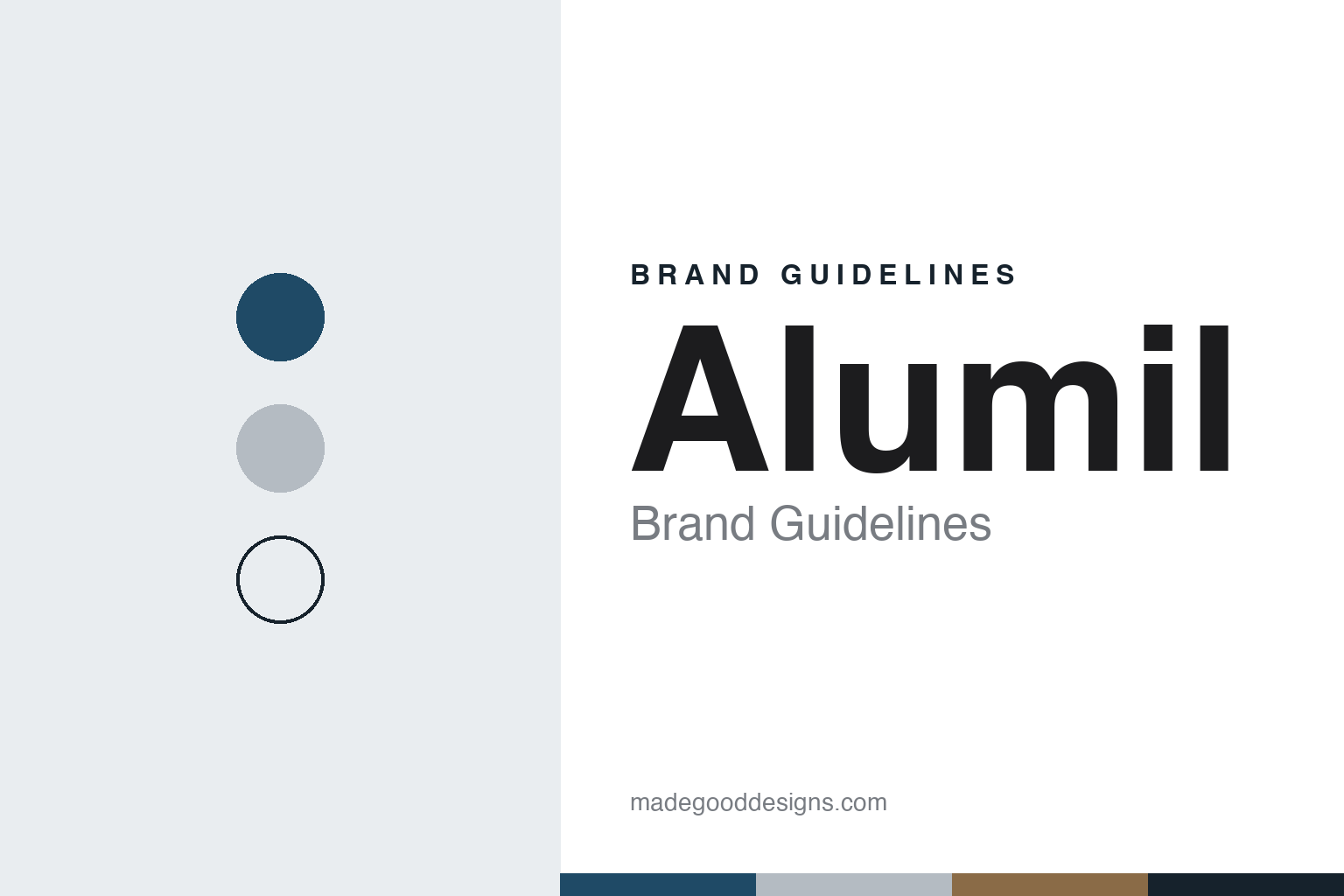
Alumil Brand Guidelines
The Kilkis aluminium systems maker founded by the Mylonas family.
Aa
Two constants: an ink blue, slate and silver palette and an engineered sans register. Abstract homage — not an Alumil product or mark; no profile, logo or drawing is reproduced.
Kilkis, 1988
A family extruder in northern Greece.
Alumil began in 1988 in northern Greece. The company’s own history says it was set up that year by its present shareholders, the Mylonas family, after they left the Aluminium Industry of Northern Greece, another maker of aluminium profiles. The business magazine BusinessVoice, in a company history published in February 2020, gives the same account and says the family is still the main shareholder. Building work on the first plant, in the industrial area of Stavrochori near Kilkis, began in March 1988, the company says.
In 1989 Alumil showed its first three aluminium systems at the Thessaloniki International Fair, and production began in 1990 with its first extrusion line, rated by the company at 7,000 tonnes a year. English Wikipedia says the first systems of the 1990s were produced in Italy, before the company built its own vertically integrated production. In 1993 it set up Alusys in Athens to sell profiles and accessories across southern Greece, and added a powder-coating unit at Kilkis. A research and development department followed: in 1994 according to the company and BusinessVoice, in 1993 according to English Wikipedia.
A foundry subsidiary, Alufond, was set up in 1996, and in November that year, the company says, it signed an agreement with Porsche Design to produce door and window systems carrying the Porsche signature. In 1997 Alumil entered the main market of the Athens Stock Exchange, BusinessVoice reported; the company dates the start of its listing process to December 1997. In June 2022 the Greek business site mononews reported that in 2021 Alumil was one of 35 listed companies that met the criteria of the exchange’s ESG index.
Colour
South-east Europe first, then further afield.
Expansion abroad came quickly. English Wikipedia lists subsidiaries in Romania from 1997; in Hungary, Albania and Bulgaria in 1998; in Poland and Ukraine in 1999; in Germany, North Macedonia and Cyprus in 2000; and in Serbia and Italy in 2001. BusinessVoice calls 1999 to 2008 the years in which Alumil set up commercial and production subsidiaries around the world, starting in south-east Europe. Its first acquisition, the Bosnian aluminium maker Alpro, was completed in May 2004, the magazine says. Its Romanian arm, Alumil Rom, was listed on the Bucharest stock exchange in 2007, the year a Gulf subsidiary opened in the United Arab Emirates, and Alumil North America followed in the United States in 2008.
The years after 2009 were harder. BusinessVoice describes the Greek financial crisis as a time of an unprecedented fall in sales and a collapsed building sector, which the company met by leaning further on exports; English Wikipedia says the group gave priority to international markets in that period. New companies still followed, including Alumil Solar in 2009, for photovoltaic mounting systems, and subsidiaries in Kenya, Australia and India by 2015. English Wikipedia says that in 2014 Alumil set up a certification and testing centre in collaboration with the German institute ift Rosenheim, and BusinessVoice places the founding of Carbon Fiber Technologies, a unit that researches carbon fibre and its uses, in the years from 2015 to 2019.
Today the company describes itself on its website as having 12 factories, with 11 aluminium extrusion lines, eight powder-coating lines, three anodising plants and a foundry. Its range runs from hinged and sliding windows and doors to entrance doors, curtain walls and façades, shutters, pergolas, railings and cladding, grouped into product families it calls SMARTIA, SUPREME and COMFORT. The international website has separate sections for homeowners, fabricators and specifiers, a gallery of projects sorted by product category, and country sites across Europe, the Middle East, North America, Asia and Africa.
Typography
How the category presents itself.
Window, door and façade system makers rarely sell a finished window to a homeowner. Most of them design and produce the profiles, in PVC or aluminium, that independent fabricators cut, assemble and glaze, and that installers then fit. Their identities are shaped by that chain: the companies speak first to fabricators and architects, and only then to the people who will live behind the glass.
Two kinds of picture recur in how these companies present themselves. One is the profile cross-section, a technical drawing of the frame’s chambers, gaskets and reinforcement, published in system brochures and on product pages. The other is building photography: houses, flats and offices shown with the finished windows and doors in place, often in a range of colours and woodgrain finishes. Between the two sit the swatches, since surface choices such as foils, lacquered finishes and aluminium cover shells have become a large part of what is offered.
Naming tends to be systematic. Ranges are grouped into systems and series, and the name often carries a number tied to a dimension: VEKA, for example, explains that its SOFTLINE 82 profile measures 82 mm in depth. Behind the public pages, many makers run separate areas for professional partners, such as fabricator sections, training seminars and technical downloads, alongside the consumer-facing site.
Corporate pages tell a further story about plants and owners. Makers in this group publish histories that trace small workshops into international groups, list their extrusion and recycling sites, and, where shares are listed, maintain investor pages with shareholder notices. This guide sets out what those pages and independent dated sources say about each brand, and marks what rests on the company’s own word.
Aa
An engineered sans for a maker of extruded systems. (Specimen set in Archivo, a sans STAND-IN; NOT the Alumil logo.)
Alumil
Greek awards, recycling and a family at the head.
Alumil’s recognition is mostly Greek and industrial. The company lists a 2019 Archiproducts Design Award for its SMARTIA M630 PHOS system, Superbrands Greece status in construction materials in 2016, 2018 and 2019, and a 2015 “Technological Excellence” award in the Greek Value competition, run by the Federation of Industries of Greece with the newspaper Kathimerini. English Wikipedia adds Europe’s GrowthPlus Top 500 and an export award from the Athens Chamber of Commerce and Industry; BusinessVoice dates the export award to 2006.
Recycled aluminium is a steady theme of its corporate communication. In June 2022 mononews reported that Alumil had invested in aluminium recycling for more than two decades, with its own foundry, and had recently built a scrap sorting and processing unit in the Kilkis industrial area. The same report said Alumil had become the first Greek architectural aluminium systems company to receive Cradle to Cradle Certified Silver certification, which the company announced in May 2022, and that it had held environmental product declarations for many of its systems since 2017.
The founding family is still at the head of the group. In 2022 mononews named Giorgos Mylonas as Alumil’s chairman and chief executive, and the company says that in 2019 he was honoured for its 30 years in architectural aluminium systems.
For a design guide, Alumil shows how a family-founded extruder from northern Greece presents itself through named system families, a projects gallery and separate portals for homeowners, fabricators and specifiers. Compare Reynaers, a Belgian family firm in aluminium systems, and Schüco, the Bielefeld maker of window and façade systems. For this guide we use an ink blue, a slate and an extrusion silver with a sans, an unofficial interpretation; no product or logo is reproduced.
Explore & save
Keep Alumil’s identity on hand — save it to a board in the Made Good inspiration library.
Alumil identity set
Save the Alumil ink blue, slate and silver palette and the engineered sans register to your own board.